1944 · CLOSE READING
The Book of Thoth
The Book of Thoth (1944), PDF p. 69
Original page
Enlarge ↗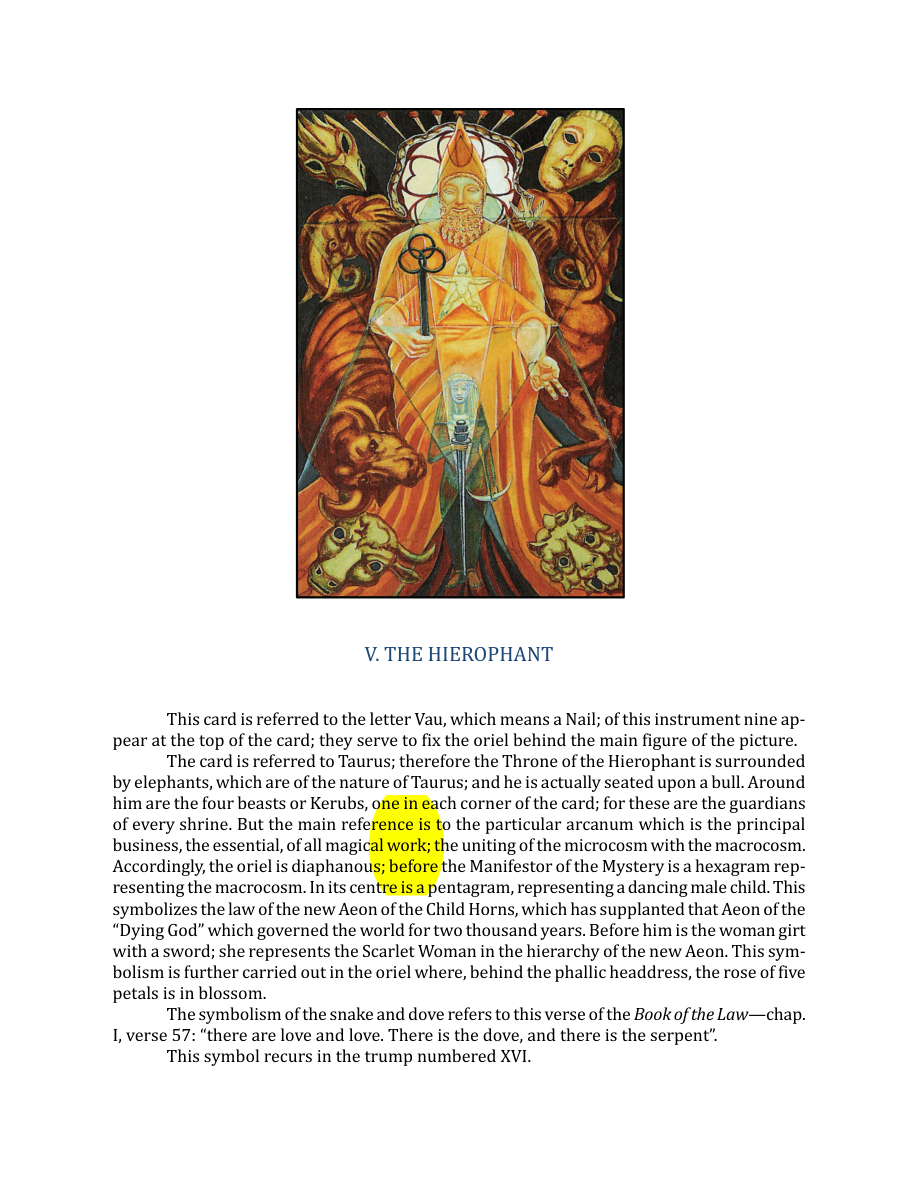
Highlights use the original PDF text layer. OCR-only matches may not be visible on the scan.
Transcription
Download text ↓raw extractionoriginal embedded textReview: unreviewed
V. THE HIEROPHANT
This card is referred to the letter Vau, which means a Nail; of this instrument nine ap‐
pear at the top of the card; they serve to fix the oriel behind the main figure of the picture.
The card is referred to Taurus; therefore the Throne of the Hierophant is surrounded
by elephants, which are of the nature of Taurus; and he is actually seated upon a bull. Around
him are the four beasts or Kerubs, one in each corner of the card; for these are the guardians
of every shrine. But the main reference is to the particular arcanum which is the principal
business, the essential, of all magical work; the uniting of the microcosm with the macrocosm.
Accordingly, the oriel is diaphanous; before the Manifestor of the Mystery is a hexagram rep‐
resenting the macrocosm. In its centre is a pentagram, representing a dancing male child. This
symbolizes the law of the new Aeon of the Child Horns, which has supplanted that Aeon of the
“Dying God” which governed the world for two thousand years. Before him is the woman girt
with a sword; she represents the Scarlet Woman in the hierarchy of the new Aeon. This sym‐
bolism is further carried out in the oriel where, behind the phallic headdress, the rose of five
petals is in blossom.
The symbolism of the snake and dove refers to this verse of the Book of the Law—chap.
I, verse 57: “there are love and love. There is the dove, and there is the serpent”.
This symbol recurs in the trump numbered XVI.
Page provenance & review flags
Stable page ID: c2293fa5b8d18e0cf1f666dc:p00069
Line breaks are preserved. Reading order and OCR accuracy may need review.
Printed page label has not been verified.
- No automated review flags. This does not establish transcription accuracy.