1944 · CLOSE READING
The Book of Thoth
The Book of Thoth (1944), PDF p. 54
Original page
Enlarge ↗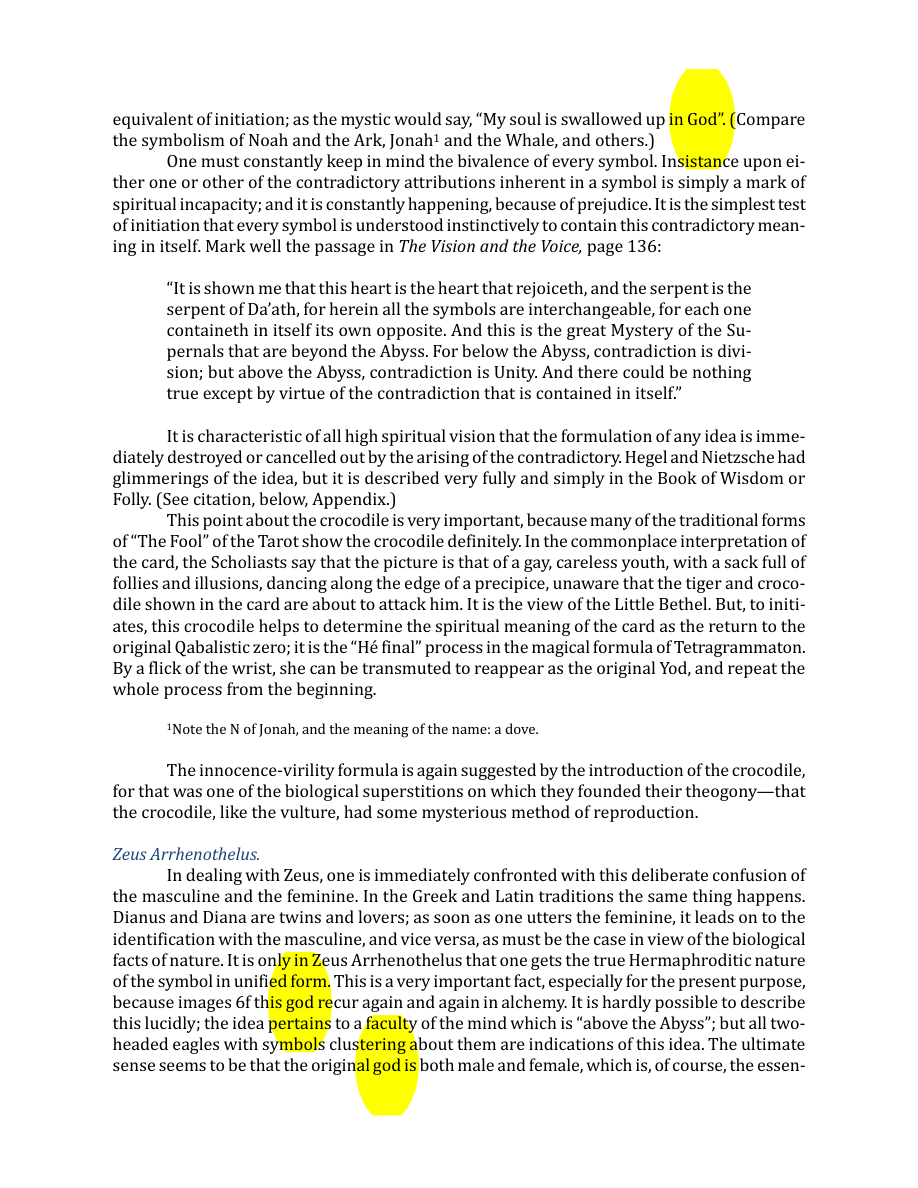
Highlights use the original PDF text layer. OCR-only matches may not be visible on the scan.
Transcription
Download text ↓raw extractionoriginal embedded textReview: unreviewed
equivalent of initiation; as the mystic would say, “My soul is swallowed up in God”. (Compare
the symbolism of Noah and the Ark, Jonah1 and the Whale, and others.)
One must constantly keep in mind the bivalence of every symbol. Insistance upon ei‐
ther one or other of the contradictory attributions inherent in a symbol is simply a mark of
spiritual incapacity; and it is constantly happening, because of prejudice. It is the simplest test
of initiation that every symbol is understood instinctively to contain this contradictory mean‐
ing in itself. Mark well the passage in The Vision and the Voice, page 136:
“It is shown me that this heart is the heart that rejoiceth, and the serpent is the
serpent of Da’ath, for herein all the symbols are interchangeable, for each one
containeth in itself its own opposite. And this is the great Mystery of the Su‐
pernals that are beyond the Abyss. For below the Abyss, contradiction is divi‐
sion; but above the Abyss, contradiction is Unity. And there could be nothing
true except by virtue of the contradiction that is contained in itself.”
It is characteristic of all high spiritual vision that the formulation of any idea is imme‐
diately destroyed or cancelled out by the arising of the contradictory. Hegel and Nietzsche had
glimmerings of the idea, but it is described very fully and simply in the Book of Wisdom or
Folly. (See citation, below, Appendix.)
This point about the crocodile is very important, because many of the traditional forms
of “The Fool” of the Tarot show the crocodile definitely. In the commonplace interpretation of
the card, the Scholiasts say that the picture is that of a gay, careless youth, with a sack full of
follies and illusions, dancing along the edge of a precipice, unaware that the tiger and croco‐
dile shown in the card are about to attack him. It is the view of the Little Bethel. But, to initi‐
ates, this crocodile helps to determine the spiritual meaning of the card as the return to the
original Qabalistic zero; it is the “Hé final” process in the magical formula of Tetragrammaton.
By a flick of the wrist, she can be transmuted to reappear as the original Yod, and repeat the
whole process from the beginning.
1Note the N of Jonah, and the meaning of the name: a dove.
The innocence‐virility formula is again suggested by the introduction of the crocodile,
for that was one of the biological superstitions on which they founded their theogony—that
the crocodile, like the vulture, had some mysterious method of reproduction.
Zeus Arrhenothelus.
In dealing with Zeus, one is immediately confronted with this deliberate confusion of
the masculine and the feminine. In the Greek and Latin traditions the same thing happens.
Dianus and Diana are twins and lovers; as soon as one utters the feminine, it leads on to the
identification with the masculine, and vice versa, as must be the case in view of the biological
facts of nature. It is only in Zeus Arrhenothelus that one gets the true Hermaphroditic nature
of the symbol in unified form. This is a very important fact, especially for the present purpose,
because images 6f this god recur again and again in alchemy. It is hardly possible to describe
this lucidly; the idea pertains to a faculty of the mind which is “above the Abyss”; but all two‐
headed eagles with symbols clustering about them are indications of this idea. The ultimate
sense seems to be that the original god is both male and female, which is, of course, the essen‐
Page provenance & review flags
Stable page ID: c2293fa5b8d18e0cf1f666dc:p00054
Line breaks are preserved. Reading order and OCR accuracy may need review.
Printed page label has not been verified.
- legacy text differs review