1944 · CLOSE READING
The Book of Thoth
The Book of Thoth (1944), PDF p. 42
Original page
Enlarge ↗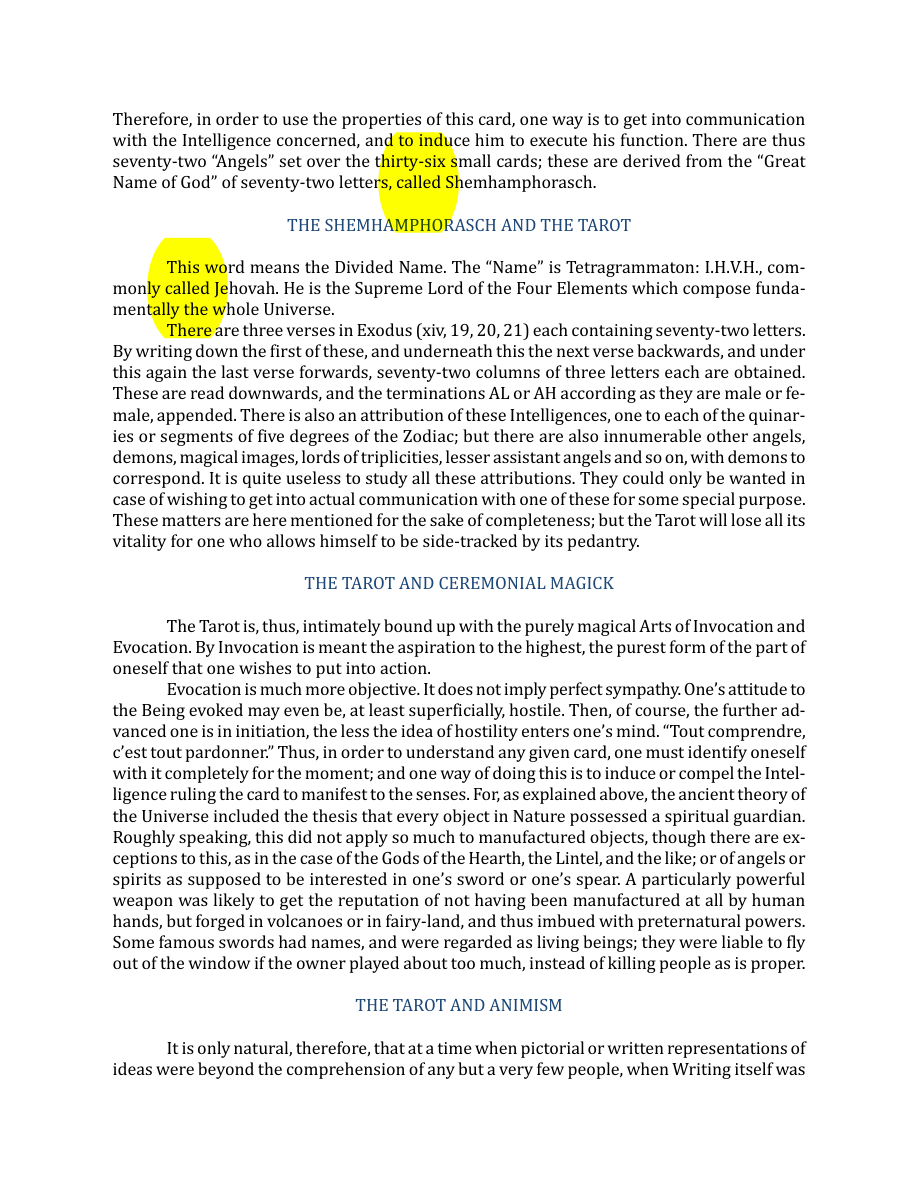
Highlights use the original PDF text layer. OCR-only matches may not be visible on the scan.
Transcription
Download text ↓raw extractionoriginal embedded textReview: unreviewed
Therefore, in order to use the properties of this card, one way is to get into communication
with the Intelligence concerned, and to induce him to execute his function. There are thus
seventy‐two “Angels” set over the thirty‐six small cards; these are derived from the “Great
Name of God” of seventy‐two letters, called Shemhamphorasch.
THE SHEMHAMPHORASCH AND THE TAROT
This word means the Divided Name. The “Name” is Tetragrammaton: I.H.V.H., com‐
monly called Jehovah. He is the Supreme Lord of the Four Elements which compose funda‐
mentally the whole Universe.
There are three verses in Exodus (xiv, 19, 20, 21) each containing seventy‐two letters.
By writing down the first of these, and underneath this the next verse backwards, and under
this again the last verse forwards, seventy‐two columns of three letters each are obtained.
These are read downwards, and the terminations AL or AH according as they are male or fe‐
male, appended. There is also an attribution of these Intelligences, one to each of the quinar‐
ies or segments of five degrees of the Zodiac; but there are also innumerable other angels,
demons, magical images, lords of triplicities, lesser assistant angels and so on, with demons to
correspond. It is quite useless to study all these attributions. They could only be wanted in
case of wishing to get into actual communication with one of these for some special purpose.
These matters are here mentioned for the sake of completeness; but the Tarot will lose all its
vitality for one who allows himself to be side‐tracked by its pedantry.
THE TAROT AND CEREMONIAL MAGICK
The Tarot is, thus, intimately bound up with the purely magical Arts of Invocation and
Evocation. By Invocation is meant the aspiration to the highest, the purest form of the part of
oneself that one wishes to put into action.
Evocation is much more objective. It does not imply perfect sympathy. One’s attitude to
the Being evoked may even be, at least superficially, hostile. Then, of course, the further ad‐
vanced one is in initiation, the less the idea of hostility enters one’s mind. “Tout comprendre,
c’est tout pardonner.” Thus, in order to understand any given card, one must identify oneself
with it completely for the moment; and one way of doing this is to induce or compel the Intel‐
ligence ruling the card to manifest to the senses. For, as explained above, the ancient theory of
the Universe included the thesis that every object in Nature possessed a spiritual guardian.
Roughly speaking, this did not apply so much to manufactured objects, though there are ex‐
ceptions to this, as in the case of the Gods of the Hearth, the Lintel, and the like; or of angels or
spirits as supposed to be interested in one’s sword or one’s spear. A particularly powerful
weapon was likely to get the reputation of not having been manufactured at all by human
hands, but forged in volcanoes or in fairy‐land, and thus imbued with preternatural powers.
Some famous swords had names, and were regarded as living beings; they were liable to fly
out of the window if the owner played about too much, instead of killing people as is proper.
THE TAROT AND ANIMISM
It is only natural, therefore, that at a time when pictorial or written representations of
ideas were beyond the comprehension of any but a very few people, when Writing itself was
Page provenance & review flags
Stable page ID: c2293fa5b8d18e0cf1f666dc:p00042
Line breaks are preserved. Reading order and OCR accuracy may need review.
Printed page label has not been verified.
- legacy text differs review