1944 · CLOSE READING
The Book of Thoth
The Book of Thoth (1944), PDF p. 40
Original page
Enlarge ↗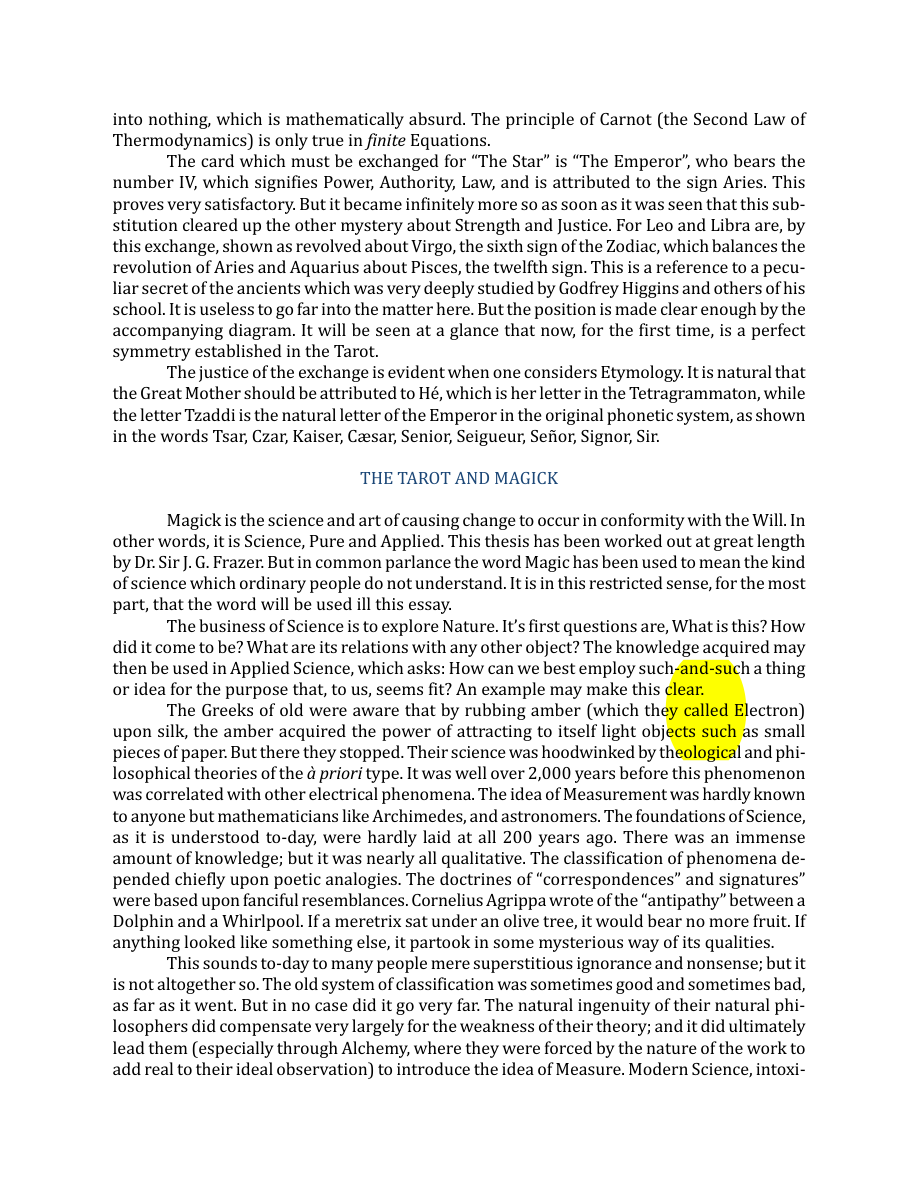
Highlights use the original PDF text layer. OCR-only matches may not be visible on the scan.
Transcription
Download text ↓raw extractionoriginal embedded textReview: unreviewed
into nothing, which is mathematically absurd. The principle of Carnot (the Second Law of
Thermodynamics) is only true in finite Equations.
The card which must be exchanged for “The Star” is “The Emperor”, who bears the
number IV, which signifies Power, Authority, Law, and is attributed to the sign Aries. This
proves very satisfactory. But it became infinitely more so as soon as it was seen that this sub‐
stitution cleared up the other mystery about Strength and Justice. For Leo and Libra are, by
this exchange, shown as revolved about Virgo, the sixth sign of the Zodiac, which balances the
revolution of Aries and Aquarius about Pisces, the twelfth sign. This is a reference to a pecu‐
liar secret of the ancients which was very deeply studied by Godfrey Higgins and others of his
school. It is useless to go far into the matter here. But the position is made clear enough by the
accompanying diagram. It will be seen at a glance that now, for the first time, is a perfect
symmetry established in the Tarot.
The justice of the exchange is evident when one considers Etymology. It is natural that
the Great Mother should be attributed to Hé, which is her letter in the Tetragrammaton, while
the letter Tzaddi is the natural letter of the Emperor in the original phonetic system, as shown
in the words Tsar, Czar, Kaiser, Cæsar, Senior, Seigueur, Señor, Signor, Sir.
THE TAROT AND MAGICK
Magick is the science and art of causing change to occur in conformity with the Will. In
other words, it is Science, Pure and Applied. This thesis has been worked out at great length
by Dr. Sir J. G. Frazer. But in common parlance the word Magic has been used to mean the kind
of science which ordinary people do not understand. It is in this restricted sense, for the most
part, that the word will be used ill this essay.
The business of Science is to explore Nature. It’s first questions are, What is this? How
did it come to be? What are its relations with any other object? The knowledge acquired may
then be used in Applied Science, which asks: How can we best employ such‐and‐such a thing
or idea for the purpose that, to us, seems fit? An example may make this clear.
The Greeks of old were aware that by rubbing amber (which they called Electron)
upon silk, the amber acquired the power of attracting to itself light objects such as small
pieces of paper. But there they stopped. Their science was hoodwinked by theological and phi‐
losophical theories of the à priori type. It was well over 2,000 years before this phenomenon
was correlated with other electrical phenomena. The idea of Measurement was hardly known
to anyone but mathematicians like Archimedes, and astronomers. The foundations of Science,
as it is understood to‐day, were hardly laid at all 200 years ago. There was an immense
amount of knowledge; but it was nearly all qualitative. The classification of phenomena de‐
pended chiefly upon poetic analogies. The doctrines of “correspondences” and signatures”
were based upon fanciful resemblances. Cornelius Agrippa wrote of the “antipathy” between a
Dolphin and a Whirlpool. If a meretrix sat under an olive tree, it would bear no more fruit. If
anything looked like something else, it partook in some mysterious way of its qualities.
This sounds to‐day to many people mere superstitious ignorance and nonsense; but it
is not altogether so. The old system of classification was sometimes good and sometimes bad,
as far as it went. But in no case did it go very far. The natural ingenuity of their natural phi‐
losophers did compensate very largely for the weakness of their theory; and it did ultimately
lead them (especially through Alchemy, where they were forced by the nature of the work to
add real to their ideal observation) to introduce the idea of Measure. Modern Science, intoxi‐
Page provenance & review flags
Stable page ID: c2293fa5b8d18e0cf1f666dc:p00040
Line breaks are preserved. Reading order and OCR accuracy may need review.
Printed page label has not been verified.
- legacy text differs review