1944 · CLOSE READING
The Book of Thoth
The Book of Thoth (1944), PDF p. 22
Original page
Enlarge ↗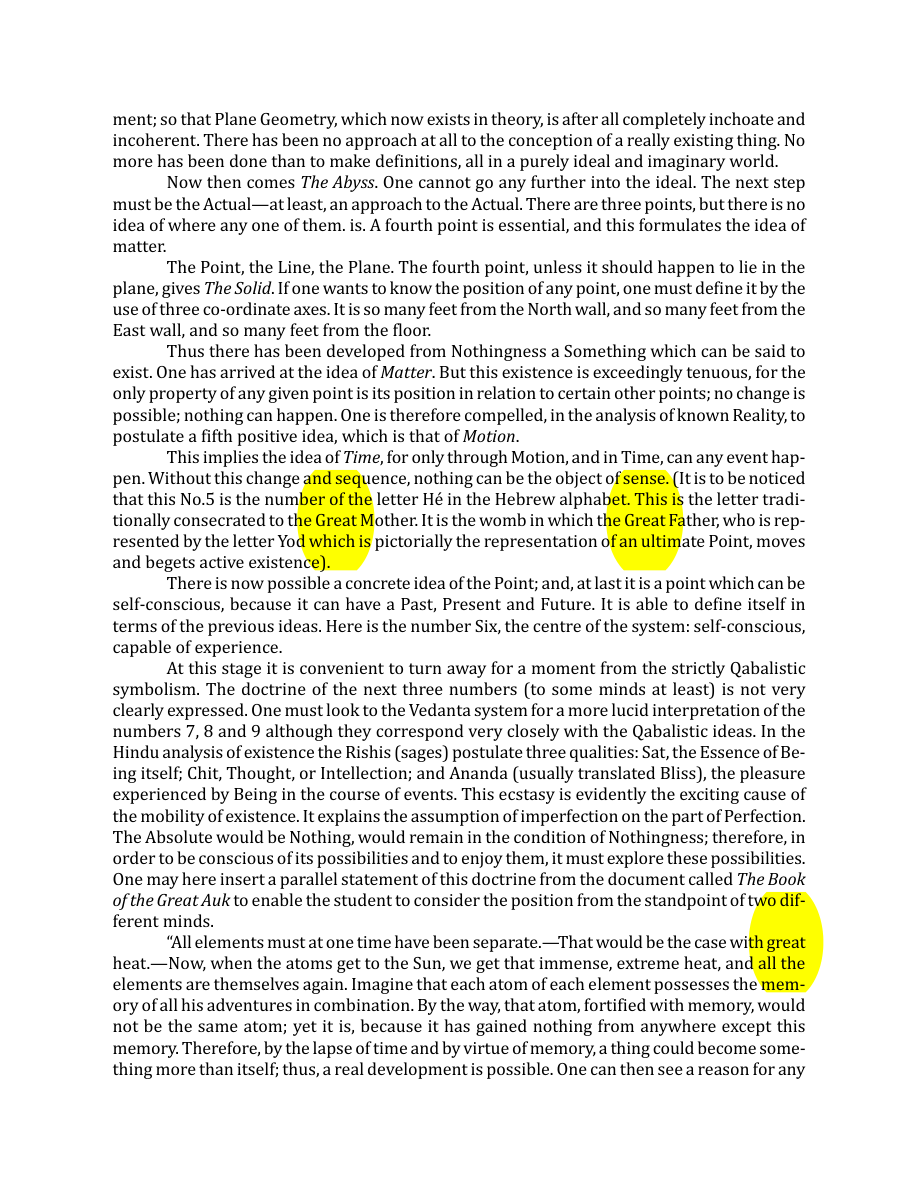
Highlights use the original PDF text layer. OCR-only matches may not be visible on the scan.
Transcription
Download text ↓raw extractionoriginal embedded textReview: unreviewed
ment; so that Plane Geometry, which now exists in theory, is after all completely inchoate and
incoherent. There has been no approach at all to the conception of a really existing thing. No
more has been done than to make definitions, all in a purely ideal and imaginary world.
Now then comes The Abyss. One cannot go any further into the ideal. The next step
must be the Actual—at least, an approach to the Actual. There are three points, but there is no
idea of where any one of them. is. A fourth point is essential, and this formulates the idea of
matter.
The Point, the Line, the Plane. The fourth point, unless it should happen to lie in the
plane, gives The Solid. If one wants to know the position of any point, one must define it by the
use of three co‐ordinate axes. It is so many feet from the North wall, and so many feet from the
East wall, and so many feet from the floor.
Thus there has been developed from Nothingness a Something which can be said to
exist. One has arrived at the idea of Matter. But this existence is exceedingly tenuous, for the
only property of any given point is its position in relation to certain other points; no change is
possible; nothing can happen. One is therefore compelled, in the analysis of known Reality, to
postulate a fifth positive idea, which is that of Motion.
This implies the idea of Time, for only through Motion, and in Time, can any event hap‐
pen. Without this change and sequence, nothing can be the object of sense. (It is to be noticed
that this No.5 is the number of the letter Hé in the Hebrew alphabet. This is the letter tradi‐
tionally consecrated to the Great Mother. It is the womb in which the Great Father, who is rep‐
resented by the letter Yod which is pictorially the representation of an ultimate Point, moves
and begets active existence).
There is now possible a concrete idea of the Point; and, at last it is a point which can be
self‐conscious, because it can have a Past, Present and Future. It is able to define itself in
terms of the previous ideas. Here is the number Six, the centre of the system: self‐conscious,
capable of experience.
At this stage it is convenient to turn away for a moment from the strictly Qabalistic
symbolism. The doctrine of the next three numbers (to some minds at least) is not very
clearly expressed. One must look to the Vedanta system for a more lucid interpretation of the
numbers 7, 8 and 9 although they correspond very closely with the Qabalistic ideas. In the
Hindu analysis of existence the Rishis (sages) postulate three qualities: Sat, the Essence of Be‐
ing itself; Chit, Thought, or Intellection; and Ananda (usually translated Bliss), the pleasure
experienced by Being in the course of events. This ecstasy is evidently the exciting cause of
the mobility of existence. It explains the assumption of imperfection on the part of Perfection.
The Absolute would be Nothing, would remain in the condition of Nothingness; therefore, in
order to be conscious of its possibilities and to enjoy them, it must explore these possibilities.
One may here insert a parallel statement of this doctrine from the document called The Book
of the Great Auk to enable the student to consider the position from the standpoint of two dif‐
ferent minds.
“All elements must at one time have been separate.—That would be the case with great
heat.—Now, when the atoms get to the Sun, we get that immense, extreme heat, and all the
elements are themselves again. Imagine that each atom of each element possesses the mem‐
ory of all his adventures in combination. By the way, that atom, fortified with memory, would
not be the same atom; yet it is, because it has gained nothing from anywhere except this
memory. Therefore, by the lapse of time and by virtue of memory, a thing could become some‐
thing more than itself; thus, a real development is possible. One can then see a reason for any
Page provenance & review flags
Stable page ID: c2293fa5b8d18e0cf1f666dc:p00022
Line breaks are preserved. Reading order and OCR accuracy may need review.
Printed page label has not been verified.
- No automated review flags. This does not establish transcription accuracy.