1944 · CLOSE READING
The Book of Thoth
The Book of Thoth (1944), PDF p. 21
Original page
Enlarge ↗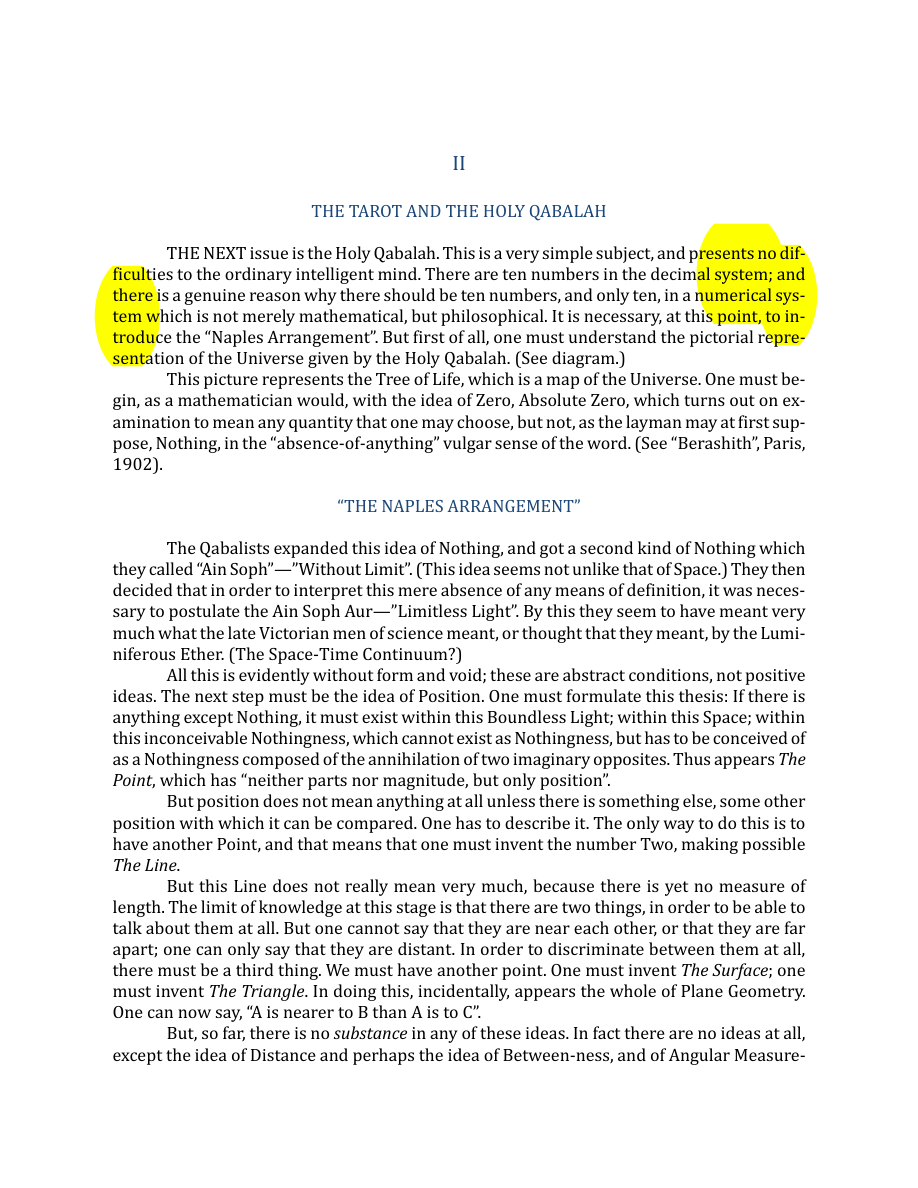
Highlights use the original PDF text layer. OCR-only matches may not be visible on the scan.
Transcription
Download text ↓raw extractionoriginal embedded textReview: unreviewed
II
THE TAROT AND THE HOLY QABALAH
THE NEXT issue is the Holy Qabalah. This is a very simple subject, and presents no dif‐
ficulties to the ordinary intelligent mind. There are ten numbers in the decimal system; and
there is a genuine reason why there should be ten numbers, and only ten, in a numerical sys‐
tem which is not merely mathematical, but philosophical. It is necessary, at this point, to in‐
troduce the “Naples Arrangement”. But first of all, one must understand the pictorial repre‐
sentation of the Universe given by the Holy Qabalah. (See diagram.)
This picture represents the Tree of Life, which is a map of the Universe. One must be‐
gin, as a mathematician would, with the idea of Zero, Absolute Zero, which turns out on ex‐
amination to mean any quantity that one may choose, but not, as the layman may at first sup‐
pose, Nothing, in the “absence‐of‐anything” vulgar sense of the word. (See “Berashith”, Paris,
1902).
“THE NAPLES ARRANGEMENT”
The Qabalists expanded this idea of Nothing, and got a second kind of Nothing which
they called “Ain Soph”—”Without Limit”. (This idea seems not unlike that of Space.) They then
decided that in order to interpret this mere absence of any means of definition, it was neces‐
sary to postulate the Ain Soph Aur—”Limitless Light”. By this they seem to have meant very
much what the late Victorian men of science meant, or thought that they meant, by the Lumi‐
niferous Ether. (The Space‐Time Continuum?)
All this is evidently without form and void; these are abstract conditions, not positive
ideas. The next step must be the idea of Position. One must formulate this thesis: If there is
anything except Nothing, it must exist within this Boundless Light; within this Space; within
this inconceivable Nothingness, which cannot exist as Nothingness, but has to be conceived of
as a Nothingness composed of the annihilation of two imaginary opposites. Thus appears The
Point, which has “neither parts nor magnitude, but only position”.
But position does not mean anything at all unless there is something else, some other
position with which it can be compared. One has to describe it. The only way to do this is to
have another Point, and that means that one must invent the number Two, making possible
The Line.
But this Line does not really mean very much, because there is yet no measure of
length. The limit of knowledge at this stage is that there are two things, in order to be able to
talk about them at all. But one cannot say that they are near each other, or that they are far
apart; one can only say that they are distant. In order to discriminate between them at all,
there must be a third thing. We must have another point. One must invent The Surface; one
must invent The Triangle. In doing this, incidentally, appears the whole of Plane Geometry.
One can now say, “A is nearer to B than A is to C”.
But, so far, there is no substance in any of these ideas. In fact there are no ideas at all,
except the idea of Distance and perhaps the idea of Between‐ness, and of Angular Measure‐
Page provenance & review flags
Stable page ID: c2293fa5b8d18e0cf1f666dc:p00021
Line breaks are preserved. Reading order and OCR accuracy may need review.
Printed page label has not been verified.
- legacy text differs review