1944 · CLOSE READING
The Book of Thoth
The Book of Thoth (1944), PDF p. 177
Original page
Enlarge ↗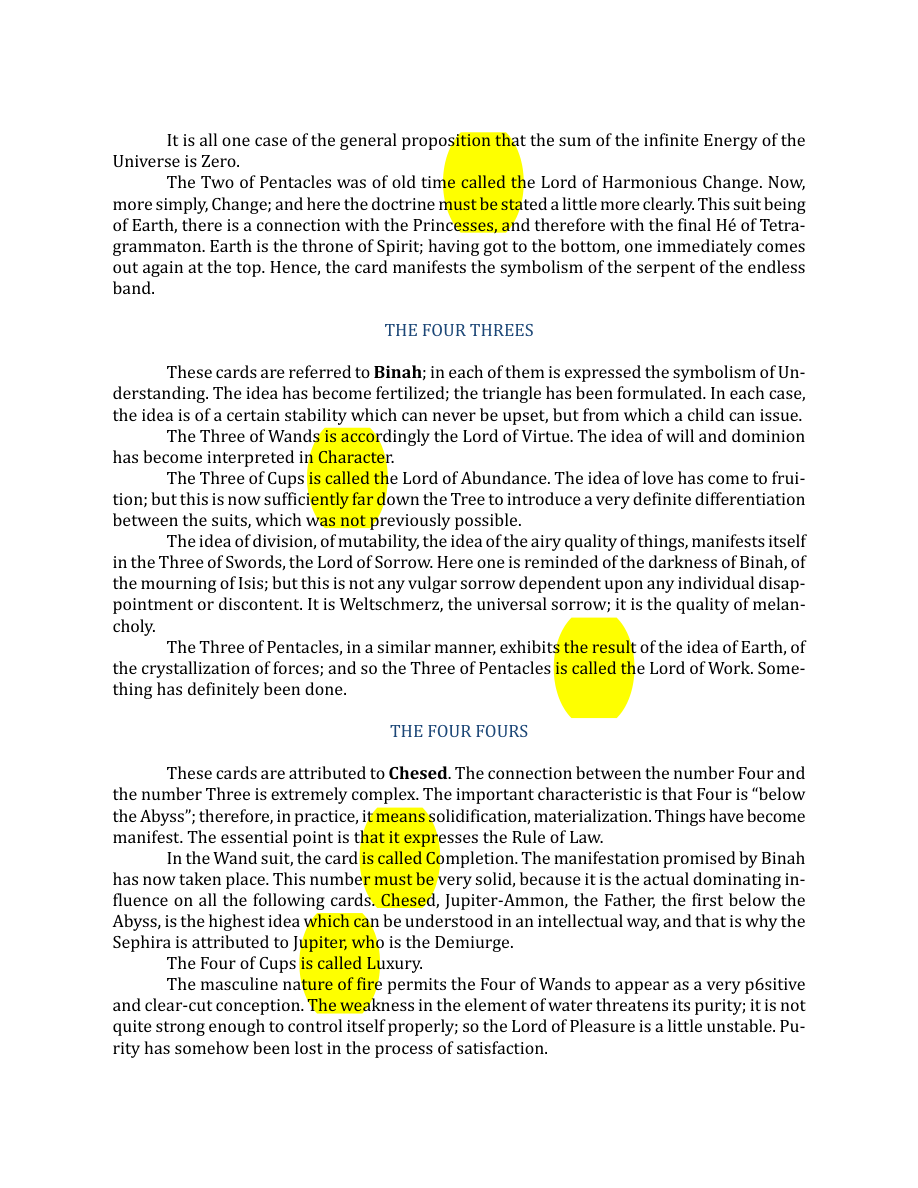
Highlights use the original PDF text layer. OCR-only matches may not be visible on the scan.
Transcription
Download text ↓raw extractionoriginal embedded textReview: unreviewed
It is all one case of the general proposition that the sum of the infinite Energy of the
Universe is Zero.
The Two of Pentacles was of old time called the Lord of Harmonious Change. Now,
more simply, Change; and here the doctrine must be stated a little more clearly. This suit being
of Earth, there is a connection with the Princesses, and therefore with the final Hé of Tetra‐
grammaton. Earth is the throne of Spirit; having got to the bottom, one immediately comes
out again at the top. Hence, the card manifests the symbolism of the serpent of the endless
band.
THE FOUR THREES
These cards are referred to Binah; in each of them is expressed the symbolism of Un‐
derstanding. The idea has become fertilized; the triangle has been formulated. In each case,
the idea is of a certain stability which can never be upset, but from which a child can issue.
The Three of Wands is accordingly the Lord of Virtue. The idea of will and dominion
has become interpreted in Character.
The Three of Cups is called the Lord of Abundance. The idea of love has come to frui‐
tion; but this is now sufficiently far down the Tree to introduce a very definite differentiation
between the suits, which was not previously possible.
The idea of division, of mutability, the idea of the airy quality of things, manifests itself
in the Three of Swords, the Lord of Sorrow. Here one is reminded of the darkness of Binah, of
the mourning of Isis; but this is not any vulgar sorrow dependent upon any individual disap‐
pointment or discontent. It is Weltschmerz, the universal sorrow; it is the quality of melan‐
choly.
The Three of Pentacles, in a similar manner, exhibits the result of the idea of Earth, of
the crystallization of forces; and so the Three of Pentacles is called the Lord of Work. Some‐
thing has definitely been done.
THE FOUR FOURS
These cards are attributed to Chesed. The connection between the number Four and
the number Three is extremely complex. The important characteristic is that Four is “below
the Abyss”; therefore, in practice, it means solidification, materialization. Things have become
manifest. The essential point is that it expresses the Rule of Law.
In the Wand suit, the card is called Completion. The manifestation promised by Binah
has now taken place. This number must be very solid, because it is the actual dominating in‐
fluence on all the following cards. Chesed, Jupiter‐Ammon, the Father, the first below the
Abyss, is the highest idea which can be understood in an intellectual way, and that is why the
Sephira is attributed to Jupiter, who is the Demiurge.
The Four of Cups is called Luxury.
The masculine nature of fire permits the Four of Wands to appear as a very p6sitive
and clear‐cut conception. The weakness in the element of water threatens its purity; it is not
quite strong enough to control itself properly; so the Lord of Pleasure is a little unstable. Pu‐
rity has somehow been lost in the process of satisfaction.
Page provenance & review flags
Stable page ID: c2293fa5b8d18e0cf1f666dc:p00177
Line breaks are preserved. Reading order and OCR accuracy may need review.
Printed page label has not been verified.
- legacy text differs review