1944 · CLOSE READING
The Book of Thoth
The Book of Thoth (1944), PDF p. 173
Original page
Enlarge ↗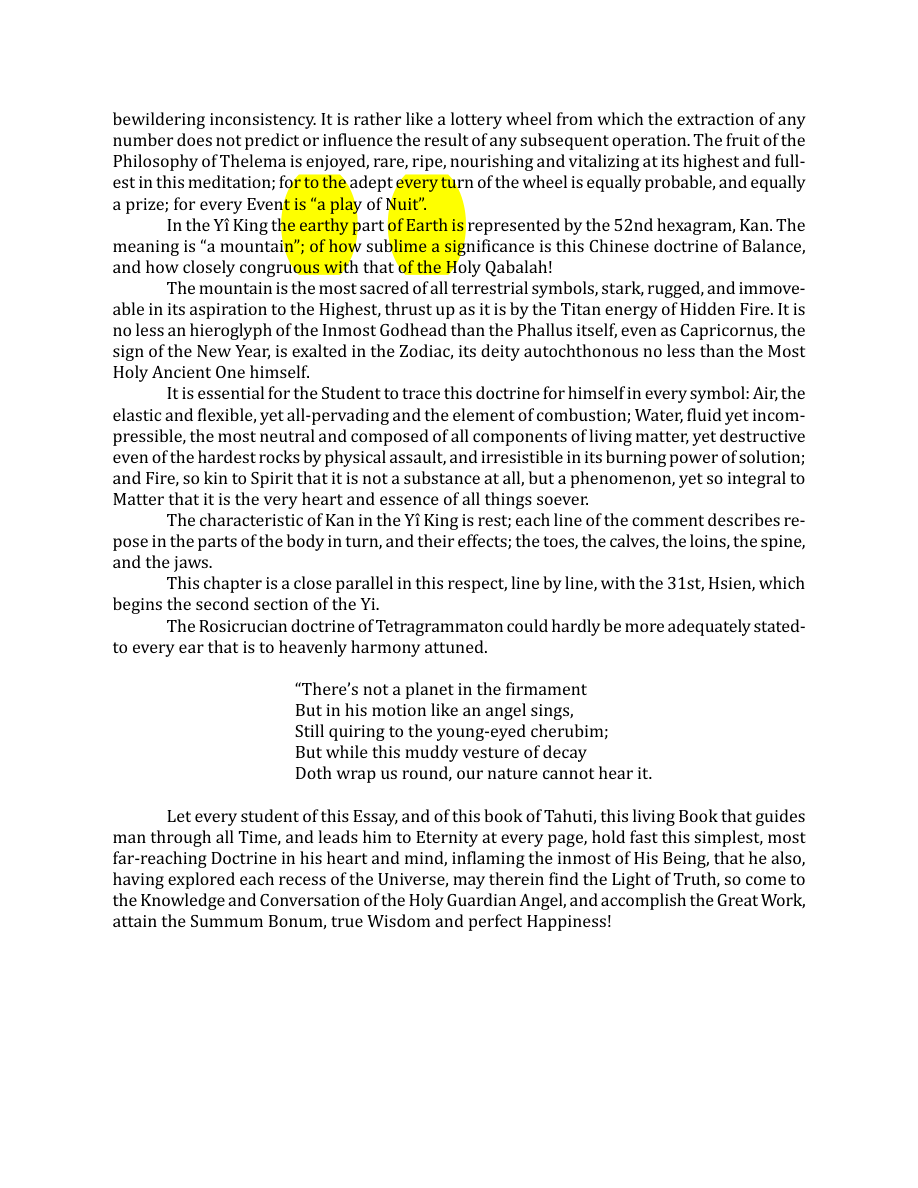
Highlights use the original PDF text layer. OCR-only matches may not be visible on the scan.
Transcription
Download text ↓raw extractionoriginal embedded textReview: unreviewed
bewildering inconsistency. It is rather like a lottery wheel from which the extraction of any
number does not predict or influence the result of any subsequent operation. The fruit of the
Philosophy of Thelema is enjoyed, rare, ripe, nourishing and vitalizing at its highest and full‐
est in this meditation; for to the adept every turn of the wheel is equally probable, and equally
a prize; for every Event is “a play of Nuit”.
In the Yî King the earthy part of Earth is represented by the 52nd hexagram, Kan. The
meaning is “a mountain”; of how sublime a significance is this Chinese doctrine of Balance,
and how closely congruous with that of the Holy Qabalah!
The mountain is the most sacred of all terrestrial symbols, stark, rugged, and immove‐
able in its aspiration to the Highest, thrust up as it is by the Titan energy of Hidden Fire. It is
no less an hieroglyph of the Inmost Godhead than the Phallus itself, even as Capricornus, the
sign of the New Year, is exalted in the Zodiac, its deity autochthonous no less than the Most
Holy Ancient One himself.
It is essential for the Student to trace this doctrine for himself in every symbol: Air, the
elastic and flexible, yet all‐pervading and the element of combustion; Water, fluid yet incom‐
pressible, the most neutral and composed of all components of living matter, yet destructive
even of the hardest rocks by physical assault, and irresistible in its burning power of solution;
and Fire, so kin to Spirit that it is not a substance at all, but a phenomenon, yet so integral to
Matter that it is the very heart and essence of all things soever.
The characteristic of Kan in the Yî King is rest; each line of the comment describes re‐
pose in the parts of the body in turn, and their effects; the toes, the calves, the loins, the spine,
and the jaws.
This chapter is a close parallel in this respect, line by line, with the 31st, Hsien, which
begins the second section of the Yi.
The Rosicrucian doctrine of Tetragrammaton could hardly be more adequately stated‐
to every ear that is to heavenly harmony attuned.
“There’s not a planet in the firmament
But in his motion like an angel sings,
Still quiring to the young‐eyed cherubim;
But while this muddy vesture of decay
Doth wrap us round, our nature cannot hear it.
Let every student of this Essay, and of this book of Tahuti, this living Book that guides
man through all Time, and leads him to Eternity at every page, hold fast this simplest, most
far‐reaching Doctrine in his heart and mind, inflaming the inmost of His Being, that he also,
having explored each recess of the Universe, may therein find the Light of Truth, so come to
the Knowledge and Conversation of the Holy Guardian Angel, and accomplish the Great Work,
attain the Summum Bonum, true Wisdom and perfect Happiness!
Page provenance & review flags
Stable page ID: c2293fa5b8d18e0cf1f666dc:p00173
Line breaks are preserved. Reading order and OCR accuracy may need review.
Printed page label has not been verified.
- No automated review flags. This does not establish transcription accuracy.