1944 · CLOSE READING
The Book of Thoth
The Book of Thoth (1944), PDF p. 15
Original page
Enlarge ↗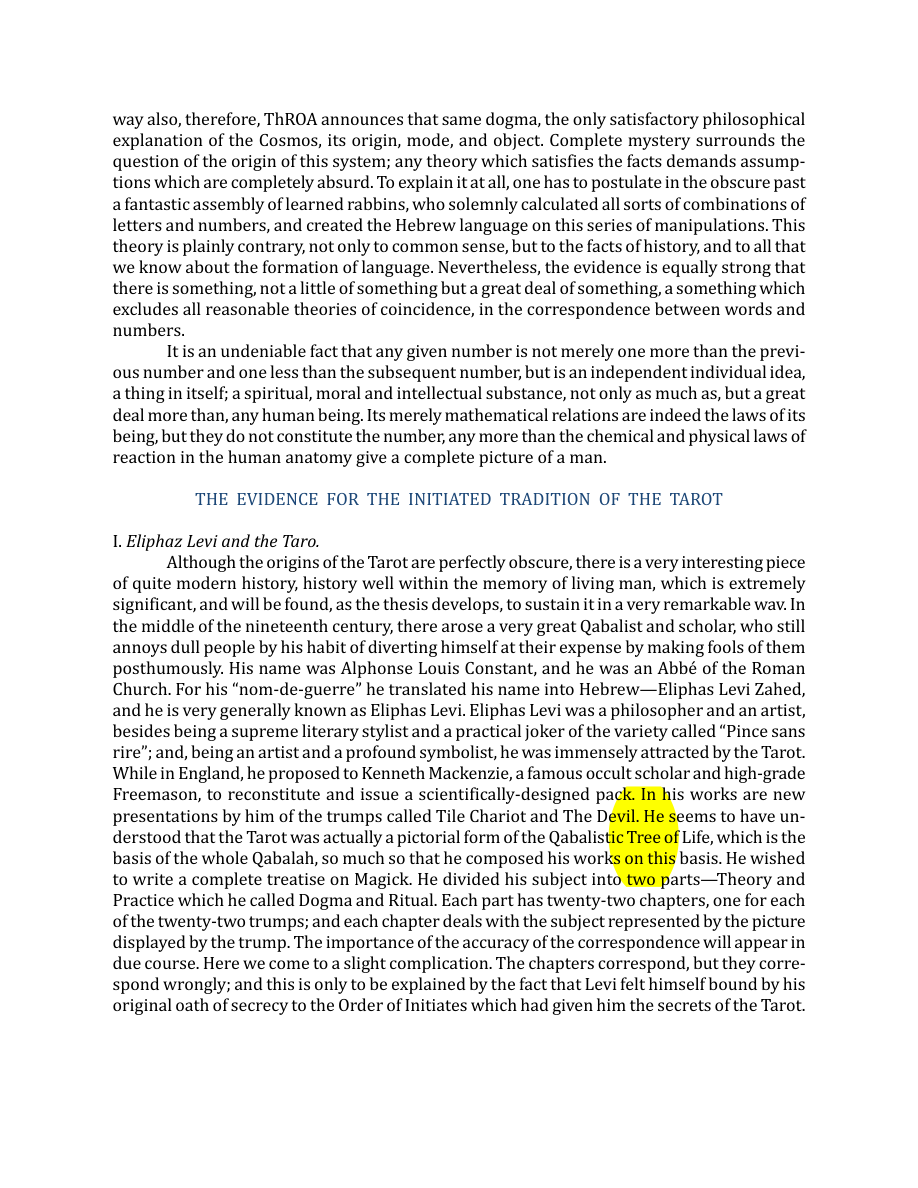
Highlights use the original PDF text layer. OCR-only matches may not be visible on the scan.
Transcription
Download text ↓raw extractionoriginal embedded textReview: unreviewed
way also, therefore, ThROA announces that same dogma, the only satisfactory philosophical
explanation of the Cosmos, its origin, mode, and object. Complete mystery surrounds the
question of the origin of this system; any theory which satisfies the facts demands assump‐
tions which are completely absurd. To explain it at all, one has to postulate in the obscure past
a fantastic assembly of learned rabbins, who solemnly calculated all sorts of combinations of
letters and numbers, and created the Hebrew language on this series of manipulations. This
theory is plainly contrary, not only to common sense, but to the facts of history, and to all that
we know about the formation of language. Nevertheless, the evidence is equally strong that
there is something, not a little of something but a great deal of something, a something which
excludes all reasonable theories of coincidence, in the correspondence between words and
numbers.
It is an undeniable fact that any given number is not merely one more than the previ‐
ous number and one less than the subsequent number, but is an independent individual idea,
a thing in itself; a spiritual, moral and intellectual substance, not only as much as, but a great
deal more than, any human being. Its merely mathematical relations are indeed the laws of its
being, but they do not constitute the number, any more than the chemical and physical laws of
reaction in the human anatomy give a complete picture of a man.
THE EVIDENCE FOR THE INITIATED TRADITION OF THE TAROT
I. Eliphaz Levi and the Taro.
Although the origins of the Tarot are perfectly obscure, there is a very interesting piece
of quite modern history, history well within the memory of living man, which is extremely
significant, and will be found, as the thesis develops, to sustain it in a very remarkable wav. In
the middle of the nineteenth century, there arose a very great Qabalist and scholar, who still
annoys dull people by his habit of diverting himself at their expense by making fools of them
posthumously. His name was Alphonse Louis Constant, and he was an Abbé of the Roman
Church. For his “nom‐de‐guerre” he translated his name into Hebrew—Eliphas Levi Zahed,
and he is very generally known as Eliphas Levi. Eliphas Levi was a philosopher and an artist,
besides being a supreme literary stylist and a practical joker of the variety called “Pince sans
rire”; and, being an artist and a profound symbolist, he was immensely attracted by the Tarot.
While in England, he proposed to Kenneth Mackenzie, a famous occult scholar and high‐grade
Freemason, to reconstitute and issue a scientifically‐designed pack. In his works are new
presentations by him of the trumps called Tile Chariot and The Devil. He seems to have un‐
derstood that the Tarot was actually a pictorial form of the Qabalistic Tree of Life, which is the
basis of the whole Qabalah, so much so that he composed his works on this basis. He wished
to write a complete treatise on Magick. He divided his subject into two parts—Theory and
Practice which he called Dogma and Ritual. Each part has twenty‐two chapters, one for each
of the twenty‐two trumps; and each chapter deals with the subject represented by the picture
displayed by the trump. The importance of the accuracy of the correspondence will appear in
due course. Here we come to a slight complication. The chapters correspond, but they corre‐
spond wrongly; and this is only to be explained by the fact that Levi felt himself bound by his
original oath of secrecy to the Order of Initiates which had given him the secrets of the Tarot.
Page provenance & review flags
Stable page ID: c2293fa5b8d18e0cf1f666dc:p00015
Line breaks are preserved. Reading order and OCR accuracy may need review.
Printed page label has not been verified.
- legacy text differs review