1944 · CLOSE READING
The Book of Thoth
The Book of Thoth (1944), PDF p. 121
Original page
Enlarge ↗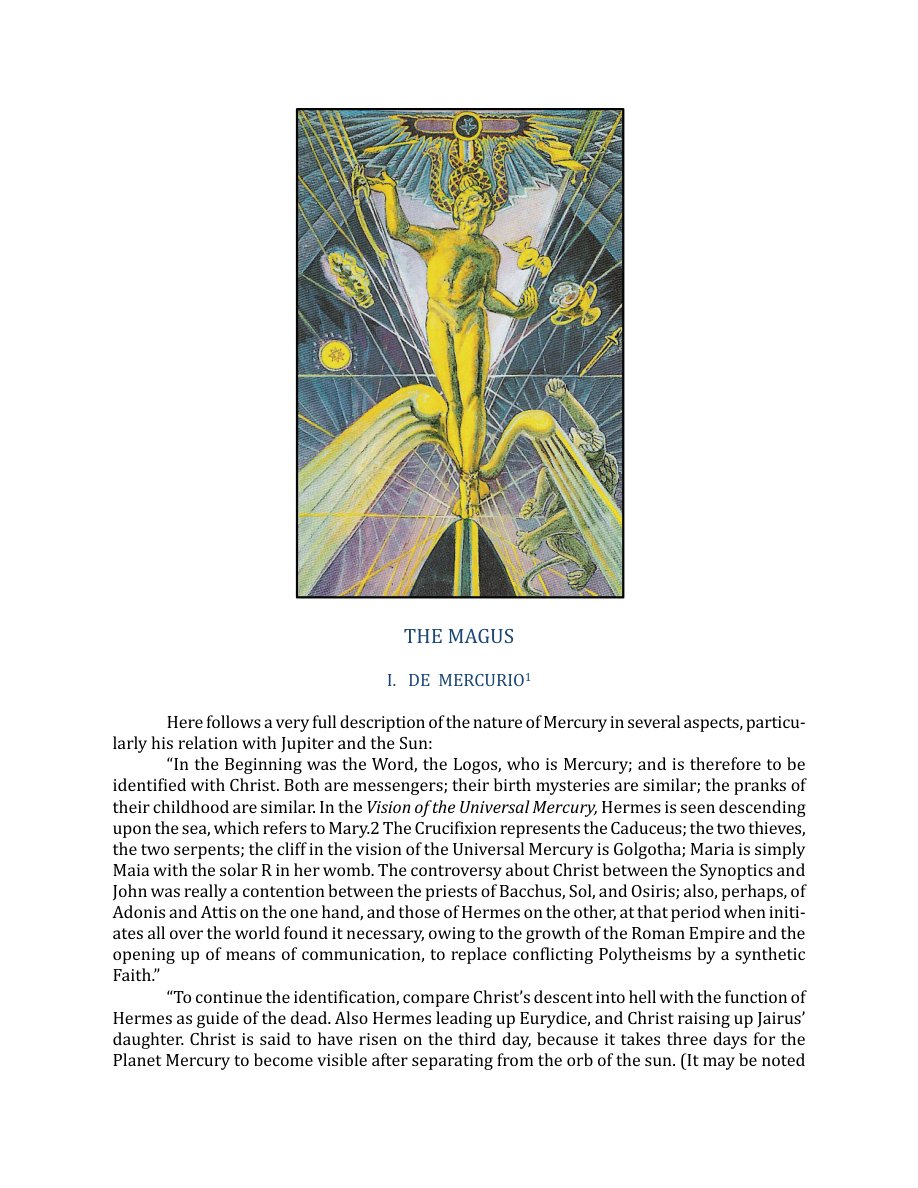
Highlights use the original PDF text layer. OCR-only matches may not be visible on the scan.
Transcription
Download text ↓raw extractionoriginal embedded textReview: unreviewed
THE MAGUS
I. DE MERCURIO1
Here follows a very full description of the nature of Mercury in several aspects, particu‐
larly his relation with Jupiter and the Sun:
“In the Beginning was the Word, the Logos, who is Mercury; and is therefore to be
identified with Christ. Both are messengers; their birth mysteries are similar; the pranks of
their childhood are similar. In the Vision of the Universal Mercury, Hermes is seen descending
upon the sea, which refers to Mary.2 The Crucifixion represents the Caduceus; the two thieves,
the two serpents; the cliff in the vision of the Universal Mercury is Golgotha; Maria is simply
Maia with the solar R in her womb. The controversy about Christ between the Synoptics and
John was really a contention between the priests of Bacchus, Sol, and Osiris; also, perhaps, of
Adonis and Attis on the one hand, and those of Hermes on the other, at that period when initi‐
ates all over the world found it necessary, owing to the growth of the Roman Empire and the
opening up of means of communication, to replace conflicting Polytheisms by a synthetic
Faith.”
“To continue the identification, compare Christ’s descent into hell with the function of
Hermes as guide of the dead. Also Hermes leading up Eurydice, and Christ raising up Jairus’
daughter. Christ is said to have risen on the third day, because it takes three days for the
Planet Mercury to become visible after separating from the orb of the sun. (It may be noted
Page provenance & review flags
Stable page ID: c2293fa5b8d18e0cf1f666dc:p00121
Line breaks are preserved. Reading order and OCR accuracy may need review.
Printed page label has not been verified.
- No automated review flags. This does not establish transcription accuracy.