1909 · CLOSE READING
The Equinox (Volume I, Number II)
The Equinox (Volume I, Number II) (1909), PDF p. 69
Original page
Enlarge ↗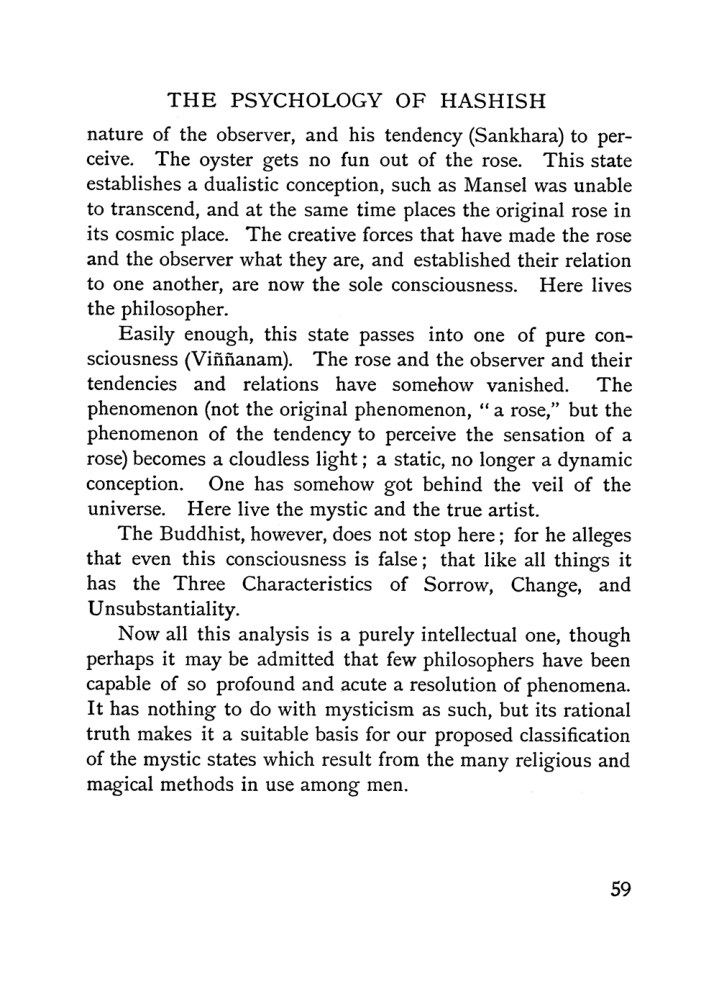
Highlights use the original PDF text layer. OCR-only matches may not be visible on the scan.
Transcription
Download text ↓raw extractionoriginal embedded textReview: unreviewed
THE PSYCHOLOGY OF HASHISH
nature of the observer, and his tendency (Sankhara) to per-
ceive. The oyster gets no fun out of the rose. This state
establishes a dualistic conception, such as Mansel was unable
to transcend, and at the same time places the original rose in
its cosmic place. The creative forces that have made the rose
and the observer what they are, and established their relation
to one another, are now the sole consciousness. Here lives
the philosopher.
Easily enough, this state passes into one of pure con-
sciousness (Vififianam). The rose and the observer and their
tendencies and relations have somehow vanished. The
phenomenon (not the original phenomenon, “a rose,” but the
phenomenon of the tendency to perceive the sensation of a
rose) becomes a cloudless light; a static, no longer a dynamic
conception. One has somehow got behind the veil of the
universe. Here live the mystic and the true artist.
The Buddhist, however, does not stop here; for he alleges
that even this consciousness is false; that like all things it
has the Three Characteristics of Sorrow, Change, and
Unsubstantiality.
Now all this analysis is a purely intellectual one, though
perhaps it may be admitted that few philosophers have been
capable of so profound and acute a resolution of phenomena.
It has nothing to do with mysticism as such, but its rational
truth makes it a suitable basis for our proposed classification
of the mystic states which result from the many religious and
magical methods in use among men.
59
Page provenance & review flags
Stable page ID: bf2afab45b1dc0687d2d189d:p00069
Line breaks are preserved. Reading order and OCR accuracy may need review.
Printed page label has not been verified.
- No automated review flags. This does not establish transcription accuracy.