1909 · CLOSE READING
The Equinox (Volume I, Number II)
The Equinox (Volume I, Number II) (1909), PDF p. 57
Original page
Enlarge ↗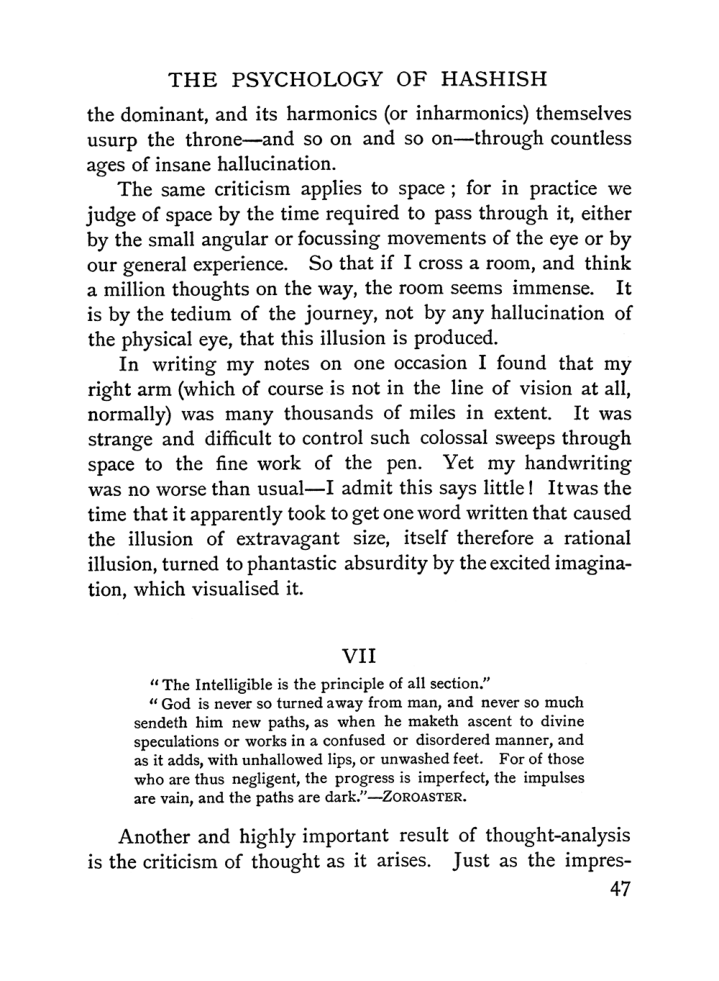
Highlights use the original PDF text layer. OCR-only matches may not be visible on the scan.
Transcription
Download text ↓raw extractionoriginal embedded textReview: unreviewed
THE PSYCHOLOGY OF HASHISH
the dominant, and its harmonics (or inharmonics) themselves
usurp the throne—and so on and so on—through countless
ages of insane hallucination.
The same criticism applies to space; for in practice we
judge of space by the time required to pass through it, either
by the small angular or focussing movements of the eye or by
our general experience. So that if I cross a room, and think
a million thoughts on the way, the room seems immense. It
is by the tedium of the journey, not by any hallucination of
the physical eye, that this illusion is produced.
In writing my notes on one occasion I found that my
right arm (which of course is not in the line of vision at all,
normally) was many thousands of miles in extent. It was
strange and difficult to control such colossal sweeps through
space to the fine work of the pen. Yet my handwriting
was no worse than usual—I admit this says little! Itwas the
time that it apparently took to get one word written that caused
the illusion of extravagant size, itself therefore a rational
illusion, turned to phantastic absurdity by the excited imagina-
tion, which visualised it.
VII
“The Intelligible is the principle of all section.”
“God is never so turned away from man, and never so much
sendeth him new paths, as when he maketh ascent to divine
speculations or works in a confused or disordered manner, and
as it adds, with unhallowed lips, or unwashed feet. For of those
who are thus negligent, the progress is imperfect, the impulses
are vain, and the paths are dark.” —ZOROASTER.
Another and highly important result of thought-analysis
is the criticism of thought as it arises. Just as the impres-
47
Page provenance & review flags
Stable page ID: bf2afab45b1dc0687d2d189d:p00057
Line breaks are preserved. Reading order and OCR accuracy may need review.
Printed page label has not been verified.
- No automated review flags. This does not establish transcription accuracy.