1909 · CLOSE READING
The Equinox (Volume I, Number II)
The Equinox (Volume I, Number II) (1909), PDF p. 399
Original page
Enlarge ↗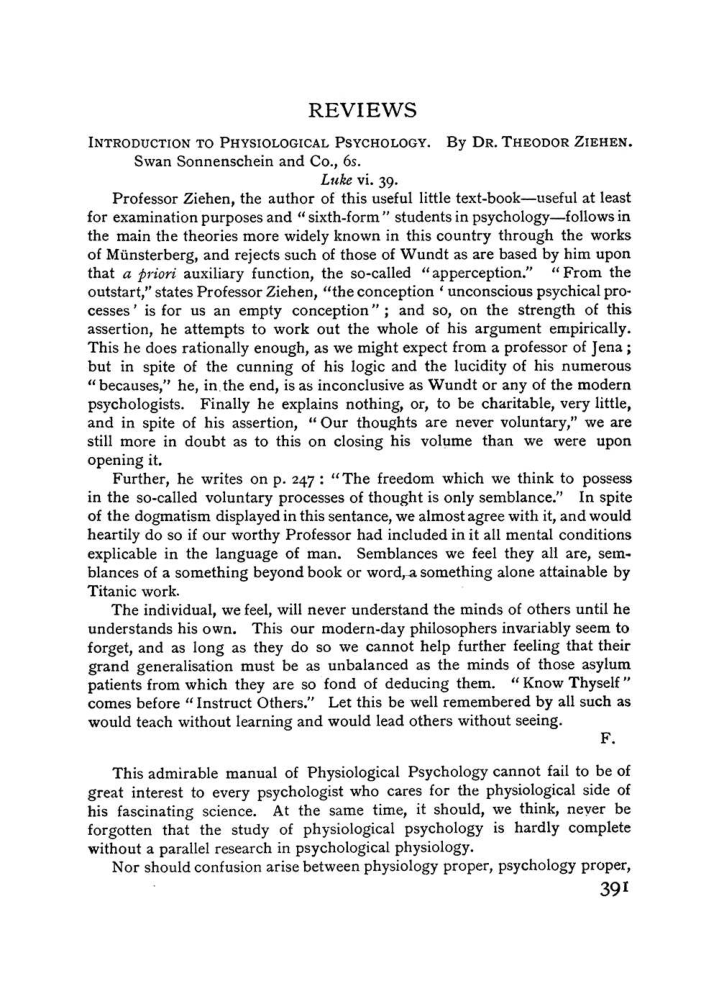
Highlights use the original PDF text layer. OCR-only matches may not be visible on the scan.
Transcription
Download text ↓raw extractionoriginal embedded textReview: unreviewed
REVIEWS
INTRODUCTION TO PHYSIOLOGICAL PSYCHOLOGY. By Dr. THEODOR ZIEHEN.
Swan Sonnenschein and Co., 6s.
Luke vi. 39.
Professor Ziehen, the author of this useful little text-book—useful at least
for examination purposes and “ sixth-form” students in psychology—follows in
the main the theories more widely known in this country through the works
of Minsterberg, and rejects such of those of Wundt as are based by him upon
that a priori auxiliary function, the so-called “apperception.” “From the
outstart,” states Professor Ziehen, “the conception ‘ unconscious psychical pro-
cesses’ is for us an empty conception”; and so, on the strength of this
assertion, he attempts to work out the whole of his argument empirically.
This he does rationally enough, as we might expect from a professor of Jena;
but in spite of the cunning of his logic and the lucidity of his numerous
“becauses,” he, in the end, is as inconclusive as Wundt or any of the modern
psychologists. Finally he explains nothing, or, to be charitable, very little,
and in spite of his assertion, ‘Our thoughts are never voluntary,” we are
still more in doubt as to this on closing his volume than we were upon
opening it.
Further, he writes on p. 247: “The freedom which we think to possess
in the so-called voluntary processes of thought is only semblance.” In spite
of the dogmatism displayed in this sentance, we almost agree with it, and would
heartily do so if our worthy Professor had included in it all mental conditions
explicable in the language of man. Semblances we feel they all are, sem-
blances of a something beyond book or word,a something alone attainable by
Titanic work.
The individual, we feel, will never understand the minds of others until he
understands his own. This our modern-day philosophers invariably seem to
forget, and as long as they do so we cannot help further feeling that their
grand generalisation must be as unbalanced as the minds of those asylum
patients from which they are so fond of deducing them. “Know Thyself”
comes before “Instruct Others.” Let this be well remembered by all such as
would teach without learning and would lead others without seeing.
F,
This admirable manual of Physiological Psychology cannot fail to be of
great interest to every psychologist who cares for the physiological side of
his fascinating science. At the same time, it should, we think, never be
forgotten that the study of physiological psychology is hardly complete
without a parallel research in psychological physiology.
Nor should confusion arise between physiology proper, psychology proper,
391
Page provenance & review flags
Stable page ID: bf2afab45b1dc0687d2d189d:p00399
Line breaks are preserved. Reading order and OCR accuracy may need review.
Printed page label has not been verified.
- No automated review flags. This does not establish transcription accuracy.