1909 · CLOSE READING
The Equinox (Volume I, Number II)
The Equinox (Volume I, Number II) (1909), PDF p. 304
Original page
Enlarge ↗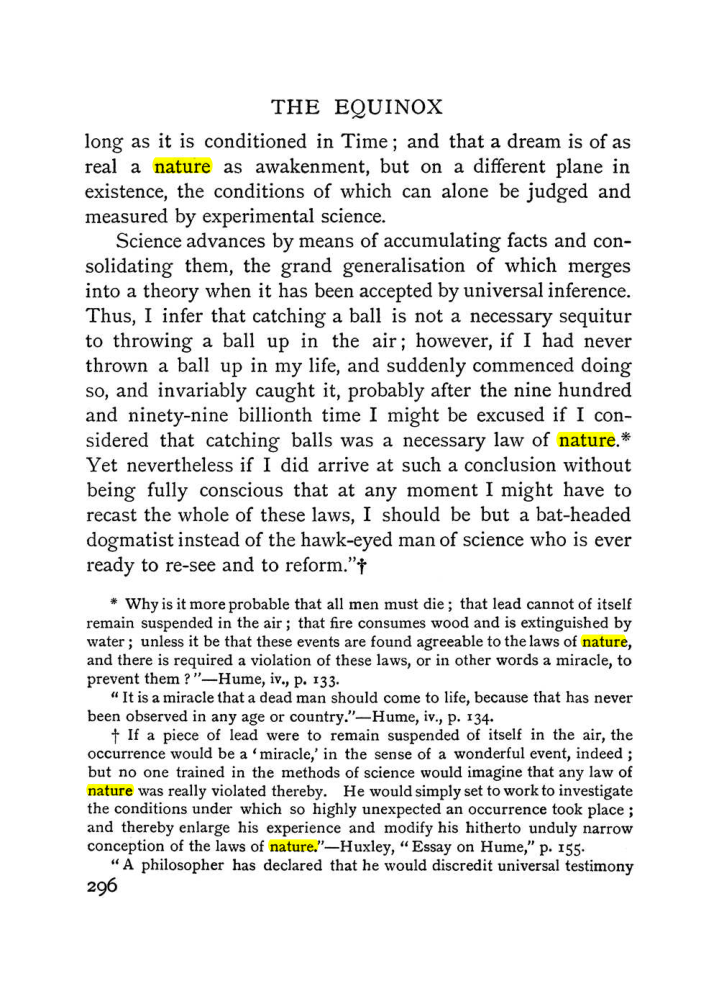
Highlights use the original PDF text layer. OCR-only matches may not be visible on the scan.
Transcription
Download text ↓raw extractionoriginal embedded textReview: unreviewed
THE EQUINOX
long as it is conditioned in Time; and that a dream is of as
real a nature as awakenment, but on a different plane in
existence, the conditions of which can alone be judged and
measured by experimental science.
Science advances by means of accumulating facts and con-
solidating them, the grand generalisation of which merges
into a theory when it has been accepted by universal inference.
Thus, I infer that catching a ball is not a necessary sequitur
to throwing a ball up in the air; however, if I had never
thrown a ball up in my life, and suddenly commenced doing
so, and invariably caught it, probably after the nine hundred
and ninety-nine billionth time I might be excused if I con-
sidered that catching balls was a necessary law of nature.*
Yet nevertheless if I did arrive at such a conclusion without
being fully conscious that at any moment I might have to
recast the whole of these laws, I should be but a bat-headed
dogmatist instead of the hawk-eyed man of science who is ever
ready to re-see and to reform.”
* Why is it more probable that all men must die; that lead cannot of itself
remain suspended in the air ; that fire consumes wood and is extinguished by
water; unless it be that these events are found agreeable to the laws of nature,
and there is required a violation of these laws, or in other words a miracle, to
prevent them ?”—Hume, iv., p. 133.
“It is a miracle that a dead man should come to life, because that has never
been observed in any age or country.”—Hume, iv., p. 134.
+ If a piece of lead were to remain suspended of itself in the air, the
occurrence would be a ‘miracle,’ in the sense of a wonderful event, indeed ;
but no one trained in the methods of science would imagine that any law of
nature was really violated thereby. He would simply set to work to investigate
the conditions under which so highly unexpected an occurrence took place ;
and thereby enlarge his experience and modify his hitherto unduly narrow
conception of the laws of nature.”—Huxley, “ Essay on Hume,” p. 155.
“A philosopher has declared that he would discredit universal testimony
296
Page provenance & review flags
Stable page ID: bf2afab45b1dc0687d2d189d:p00304
Line breaks are preserved. Reading order and OCR accuracy may need review.
Printed page label has not been verified.
- No automated review flags. This does not establish transcription accuracy.