1929 · CLOSE READING
Moonchild
Moonchild (1929), PDF p. 210
Original page
Enlarge ↗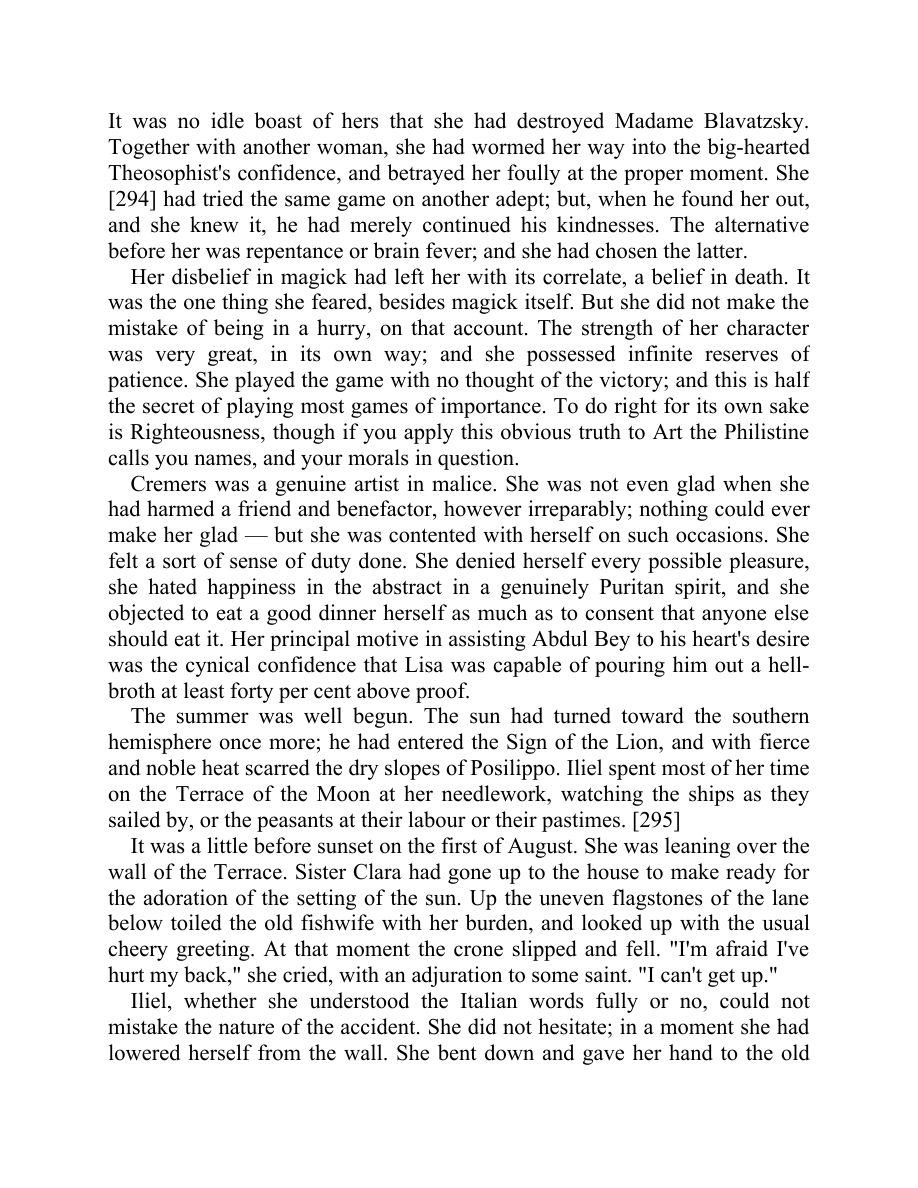
Highlights use the original PDF text layer. OCR-only matches may not be visible on the scan.
Transcription
Download text ↓raw extractionoriginal embedded textReview: unreviewed
It was no idle boast of hers that she had destroyed Madame Blavatzsky.
Together with another woman, she had wormed her way into the big-hearted
Theosophist's confidence, and betrayed her foully at the proper moment. She
[294] had tried the same game on another adept; but, when he found her out,
and she knew it, he had merely continued his kindnesses. The alternative
before her was repentance or brain fever; and she had chosen the latter.
Her disbelief in magick had left her with its correlate, a belief in death. It
was the one thing she feared, besides magick itself. But she did not make the
mistake of being in a hurry, on that account. The strength of her character
was very great, in its own way; and she possessed infinite reserves of
patience. She played the game with no thought of the victory; and this is half
the secret of playing most games of importance. To do right for its own sake
is Righteousness, though if you apply this obvious truth to Art the Philistine
calls you names, and your morals in question.
Cremers was a genuine artist in malice. She was not even glad when she
had harmed a friend and benefactor, however irreparably; nothing could ever
make her glad — but she was contented with herself on such occasions. She
felt a sort of sense of duty done. She denied herself every possible pleasure,
she hated happiness in the abstract in a genuinely Puritan spirit, and she
objected to eat a good dinner herself as much as to consent that anyone else
should eat it. Her principal motive in assisting Abdul Bey to his heart's desire
was the cynical confidence that Lisa was capable of pouring him out a hell-
broth at least forty per cent above proof.
The summer was well begun. The sun had turned toward the southern
hemisphere once more; he had entered the Sign of the Lion, and with fierce
and noble heat scarred the dry slopes of Posilippo. Iliel spent most of her time
on the Terrace of the Moon at her needlework, watching the ships as they
sailed by, or the peasants at their labour or their pastimes. [295]
It was a little before sunset on the first of August. She was leaning over the
wall of the Terrace. Sister Clara had gone up to the house to make ready for
the adoration of the setting of the sun. Up the uneven flagstones of the lane
below toiled the old fishwife with her burden, and looked up with the usual
cheery greeting. At that moment the crone slipped and fell. "I'm afraid I've
hurt my back," she cried, with an adjuration to some saint. "I can't get up."
Iliel, whether she understood the Italian words fully or no, could not
mistake the nature of the accident. She did not hesitate; in a moment she had
lowered herself from the wall. She bent down and gave her hand to the old
Page provenance & review flags
Stable page ID: ba1adb09e3af8d702fe24282:p00210
Line breaks are preserved. Reading order and OCR accuracy may need review.
Printed page label has not been verified.
- No automated review flags. This does not establish transcription accuracy.