1929 · CLOSE READING
Moonchild
Moonchild (1929), PDF p. 159
Original page
Enlarge ↗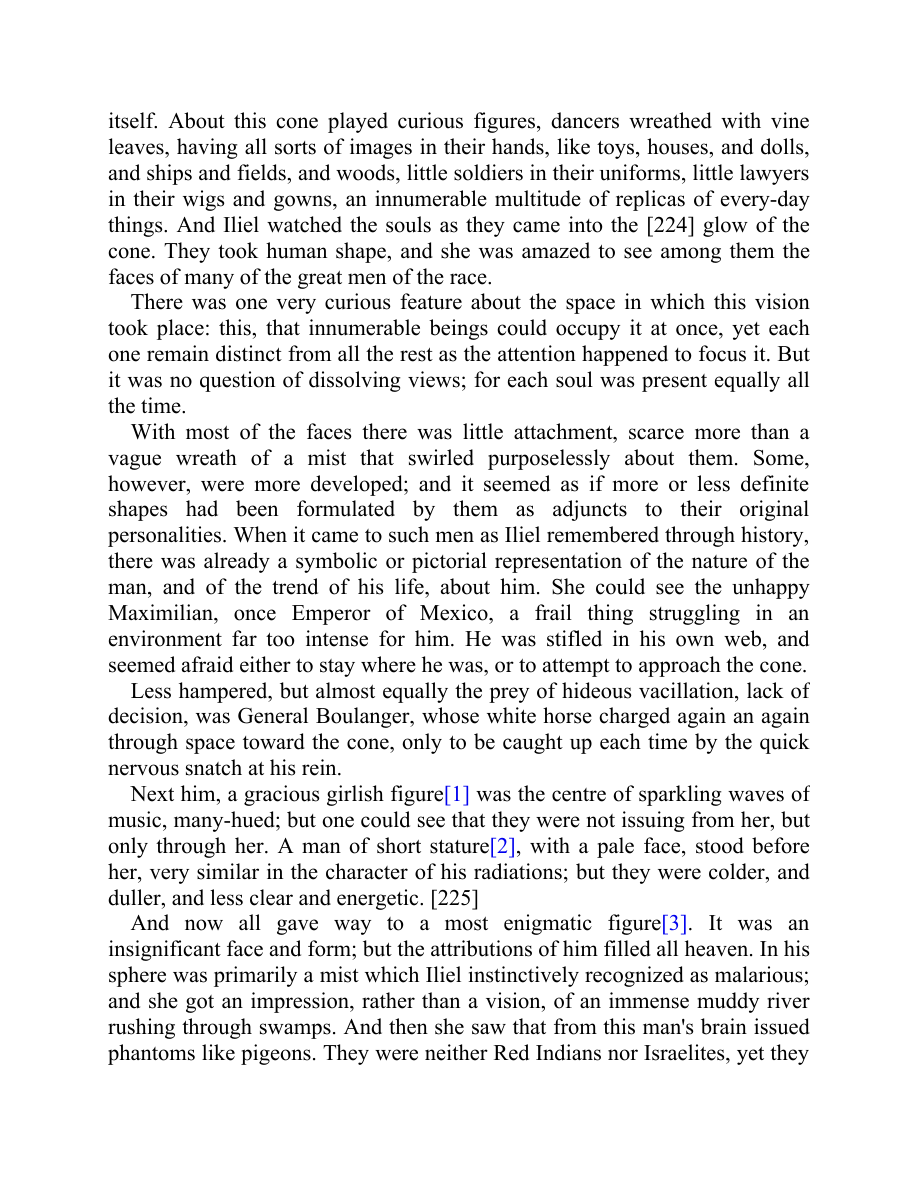
Highlights use the original PDF text layer. OCR-only matches may not be visible on the scan.
Transcription
Download text ↓raw extractionoriginal embedded textReview: unreviewed
itself. About this cone played curious figures, dancers wreathed with vine
leaves, having all sorts of images in their hands, like toys, houses, and dolls,
and ships and fields, and woods, little soldiers in their uniforms, little lawyers
in their wigs and gowns, an innumerable multitude of replicas of every-day
things. And Iliel watched the souls as they came into the [224] glow of the
cone. They took human shape, and she was amazed to see among them the
faces of many of the great men of the race.
There was one very curious feature about the space in which this vision
took place: this, that innumerable beings could occupy it at once, yet each
one remain distinct from all the rest as the attention happened to focus it. But
it was no question of dissolving views; for each soul was present equally all
the time.
With most of the faces there was little attachment, scarce more than a
vague wreath of a mist that swirled purposelessly about them. Some,
however, were more developed; and it seemed as if more or less definite
shapes had been formulated by them as adjuncts to their original
personalities. When it came to such men as Iliel remembered through history,
there was already a symbolic or pictorial representation of the nature of the
man, and of the trend of his life, about him. She could see the unhappy
Maximilian, once Emperor of Mexico, a frail thing struggling in an
environment far too intense for him. He was stifled in his own web, and
seemed afraid either to stay where he was, or to attempt to approach the cone.
Less hampered, but almost equally the prey of hideous vacillation, lack of
decision, was General Boulanger, whose white horse charged again an again
through space toward the cone, only to be caught up each time by the quick
nervous snatch at his rein.
Next him, a gracious girlish figure[1] was the centre of sparkling waves of
music, many-hued; but one could see that they were not issuing from her, but
only through her. A man of short stature[2], with a pale face, stood before
her, very similar in the character of his radiations; but they were colder, and
duller, and less clear and energetic. [225]
And now all gave way to a most enigmatic figure[3]. It was an
insignificant face and form; but the attributions of him filled all heaven. In his
sphere was primarily a mist which Iliel instinctively recognized as malarious;
and she got an impression, rather than a vision, of an immense muddy river
rushing through swamps. And then she saw that from this man's brain issued
phantoms like pigeons. They were neither Red Indians nor Israelites, yet they
Page provenance & review flags
Stable page ID: ba1adb09e3af8d702fe24282:p00159
Line breaks are preserved. Reading order and OCR accuracy may need review.
Printed page label has not been verified.
- No automated review flags. This does not establish transcription accuracy.