1929 · CLOSE READING
Moonchild
Moonchild (1929), PDF p. 140
Original page
Enlarge ↗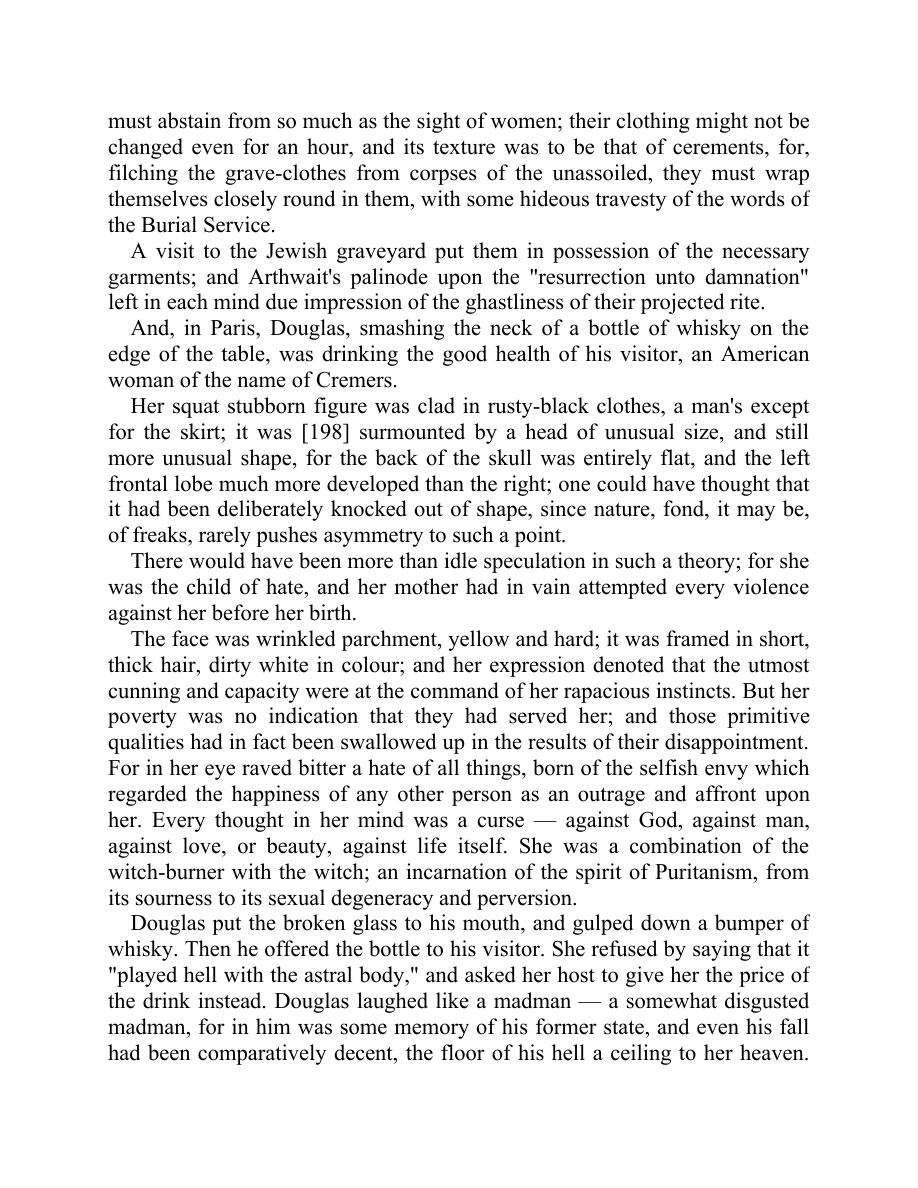
Highlights use the original PDF text layer. OCR-only matches may not be visible on the scan.
Transcription
Download text ↓raw extractionoriginal embedded textReview: unreviewed
must abstain from so much as the sight of women; their clothing might not be
changed even for an hour, and its texture was to be that of cerements, for,
filching the grave-clothes from corpses of the unassoiled, they must wrap
themselves closely round in them, with some hideous travesty of the words of
the Burial Service.
A visit to the Jewish graveyard put them in possession of the necessary
garments; and Arthwait's palinode upon the "resurrection unto damnation"
left in each mind due impression of the ghastliness of their projected rite.
And, in Paris, Douglas, smashing the neck of a bottle of whisky on the
edge of the table, was drinking the good health of his visitor, an American
woman of the name of Cremers.
Her squat stubborn figure was clad in rusty-black clothes, a man's except
for the skirt; it was [198] surmounted by a head of unusual size, and still
more unusual shape, for the back of the skull was entirely flat, and the left
frontal lobe much more developed than the right; one could have thought that
it had been deliberately knocked out of shape, since nature, fond, it may be,
of freaks, rarely pushes asymmetry to such a point.
There would have been more than idle speculation in such a theory; for she
was the child of hate, and her mother had in vain attempted every violence
against her before her birth.
The face was wrinkled parchment, yellow and hard; it was framed in short,
thick hair, dirty white in colour; and her expression denoted that the utmost
cunning and capacity were at the command of her rapacious instincts. But her
poverty was no indication that they had served her; and those primitive
qualities had in fact been swallowed up in the results of their disappointment.
For in her eye raved bitter a hate of all things, born of the selfish envy which
regarded the happiness of any other person as an outrage and affront upon
her. Every thought in her mind was a curse — against God, against man,
against love, or beauty, against life itself. She was a combination of the
witch-burner with the witch; an incarnation of the spirit of Puritanism, from
its sourness to its sexual degeneracy and perversion.
Douglas put the broken glass to his mouth, and gulped down a bumper of
whisky. Then he offered the bottle to his visitor. She refused by saying that it
"played hell with the astral body," and asked her host to give her the price of
the drink instead. Douglas laughed like a madman — a somewhat disgusted
madman, for in him was some memory of his former state, and even his fall
had been comparatively decent, the floor of his hell a ceiling to her heaven.
Page provenance & review flags
Stable page ID: ba1adb09e3af8d702fe24282:p00140
Line breaks are preserved. Reading order and OCR accuracy may need review.
Printed page label has not been verified.
- No automated review flags. This does not establish transcription accuracy.