1929 · CLOSE READING
Moonchild
Moonchild (1929), PDF p. 121
Original page
Enlarge ↗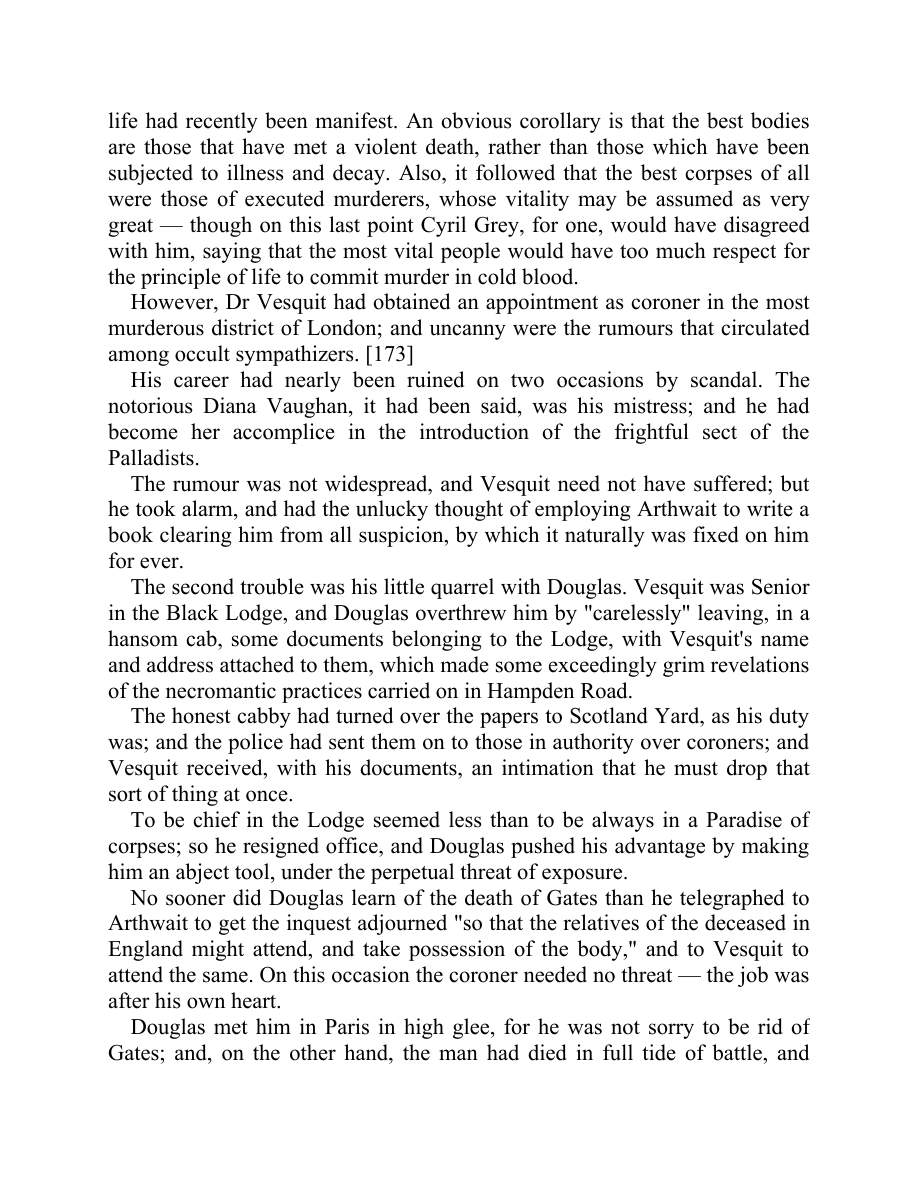
Highlights use the original PDF text layer. OCR-only matches may not be visible on the scan.
Transcription
Download text ↓raw extractionoriginal embedded textReview: unreviewed
life had recently been manifest. An obvious corollary is that the best bodies
are those that have met a violent death, rather than those which have been
subjected to illness and decay. Also, it followed that the best corpses of all
were those of executed murderers, whose vitality may be assumed as very
great — though on this last point Cyril Grey, for one, would have disagreed
with him, saying that the most vital people would have too much respect for
the principle of life to commit murder in cold blood.
However, Dr Vesquit had obtained an appointment as coroner in the most
murderous district of London; and uncanny were the rumours that circulated
among occult sympathizers. [173]
His career had nearly been ruined on two occasions by scandal. The
notorious Diana Vaughan, it had been said, was his mistress; and he had
become her accomplice in the introduction of the frightful sect of the
Palladists.
The rumour was not widespread, and Vesquit need not have suffered; but
he took alarm, and had the unlucky thought of employing Arthwait to write a
book clearing him from all suspicion, by which it naturally was fixed on him
for ever.
The second trouble was his little quarrel with Douglas. Vesquit was Senior
in the Black Lodge, and Douglas overthrew him by "carelessly" leaving, in a
hansom cab, some documents belonging to the Lodge, with Vesquit's name
and address attached to them, which made some exceedingly grim revelations
of the necromantic practices carried on in Hampden Road.
The honest cabby had turned over the papers to Scotland Yard, as his duty
was; and the police had sent them on to those in authority over coroners; and
Vesquit received, with his documents, an intimation that he must drop that
sort of thing at once.
To be chief in the Lodge seemed less than to be always in a Paradise of
corpses; so he resigned office, and Douglas pushed his advantage by making
him an abject tool, under the perpetual threat of exposure.
No sooner did Douglas learn of the death of Gates than he telegraphed to
Arthwait to get the inquest adjourned "so that the relatives of the deceased in
England might attend, and take possession of the body," and to Vesquit to
attend the same. On this occasion the coroner needed no threat — the job was
after his own heart.
Douglas met him in Paris in high glee, for he was not sorry to be rid of
Gates; and, on the other hand, the man had died in full tide of battle, and
Page provenance & review flags
Stable page ID: ba1adb09e3af8d702fe24282:p00121
Line breaks are preserved. Reading order and OCR accuracy may need review.
Printed page label has not been verified.
- No automated review flags. This does not establish transcription accuracy.