1929 · CLOSE READING
Moonchild
Moonchild (1929), PDF p. 106
Original page
Enlarge ↗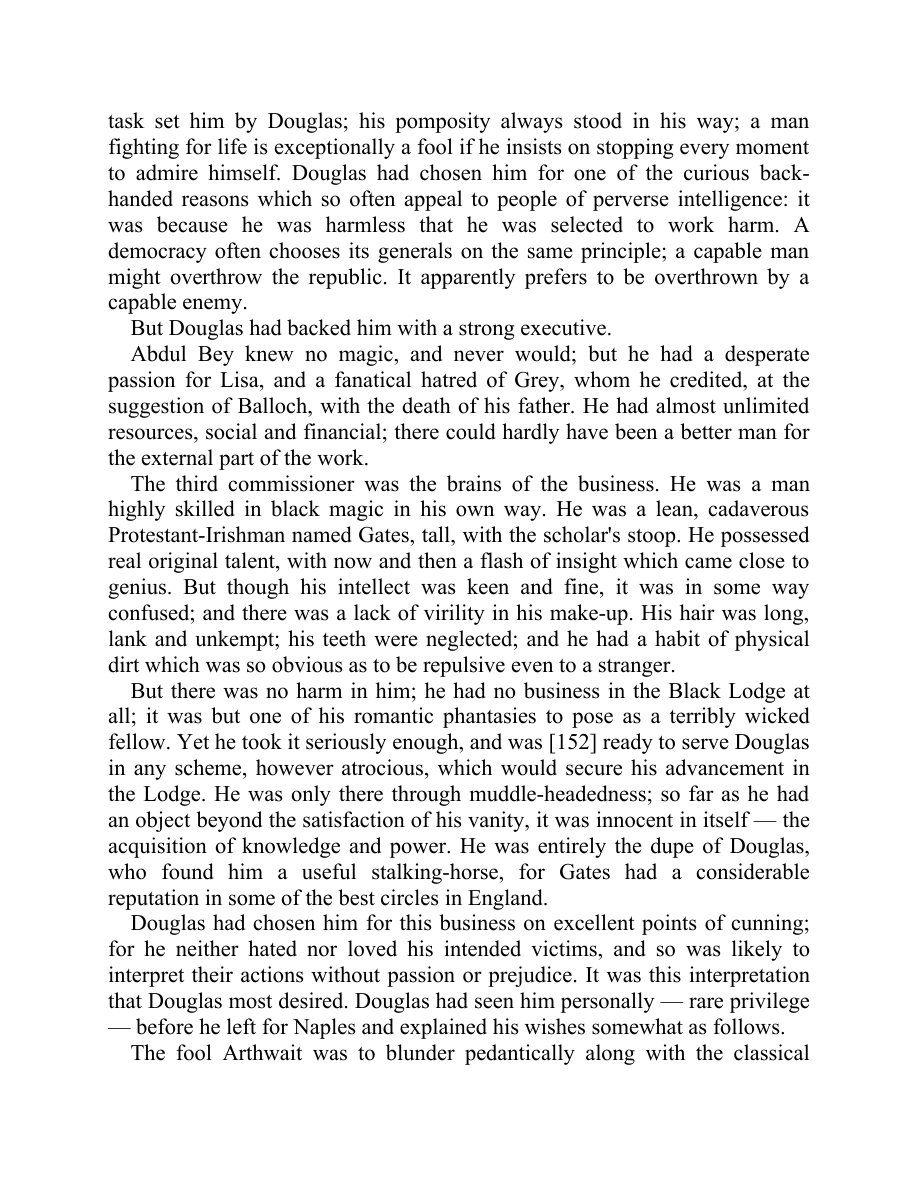
Highlights use the original PDF text layer. OCR-only matches may not be visible on the scan.
Transcription
Download text ↓raw extractionoriginal embedded textReview: unreviewed
task set him by Douglas; his pomposity always stood in his way; a man
fighting for life is exceptionally a fool if he insists on stopping every moment
to admire himself. Douglas had chosen him for one of the curious back-
handed reasons which so often appeal to people of perverse intelligence: it
was because he was harmless that he was selected to work harm. A
democracy often chooses its generals on the same principle; a capable man
might overthrow the republic. It apparently prefers to be overthrown by a
capable enemy.
But Douglas had backed him with a strong executive.
Abdul Bey knew no magic, and never would; but he had a desperate
passion for Lisa, and a fanatical hatred of Grey, whom he credited, at the
suggestion of Balloch, with the death of his father. He had almost unlimited
resources, social and financial; there could hardly have been a better man for
the external part of the work.
The third commissioner was the brains of the business. He was a man
highly skilled in black magic in his own way. He was a lean, cadaverous
Protestant-Irishman named Gates, tall, with the scholar's stoop. He possessed
real original talent, with now and then a flash of insight which came close to
genius. But though his intellect was keen and fine, it was in some way
confused; and there was a lack of virility in his make-up. His hair was long,
lank and unkempt; his teeth were neglected; and he had a habit of physical
dirt which was so obvious as to be repulsive even to a stranger.
But there was no harm in him; he had no business in the Black Lodge at
all; it was but one of his romantic phantasies to pose as a terribly wicked
fellow. Yet he took it seriously enough, and was [152] ready to serve Douglas
in any scheme, however atrocious, which would secure his advancement in
the Lodge. He was only there through muddle-headedness; so far as he had
an object beyond the satisfaction of his vanity, it was innocent in itself — the
acquisition of knowledge and power. He was entirely the dupe of Douglas,
who found him a useful stalking-horse, for Gates had a considerable
reputation in some of the best circles in England.
Douglas had chosen him for this business on excellent points of cunning;
for he neither hated nor loved his intended victims, and so was likely to
interpret their actions without passion or prejudice. It was this interpretation
that Douglas most desired. Douglas had seen him personally — rare privilege
— before he left for Naples and explained his wishes somewhat as follows.
The fool Arthwait was to blunder pedantically along with the classical
Page provenance & review flags
Stable page ID: ba1adb09e3af8d702fe24282:p00106
Line breaks are preserved. Reading order and OCR accuracy may need review.
Printed page label has not been verified.
- No automated review flags. This does not establish transcription accuracy.