1930 · CLOSE READING
The Banned Lecture
The Banned Lecture (1930), PDF p. 18
Original page
Enlarge ↗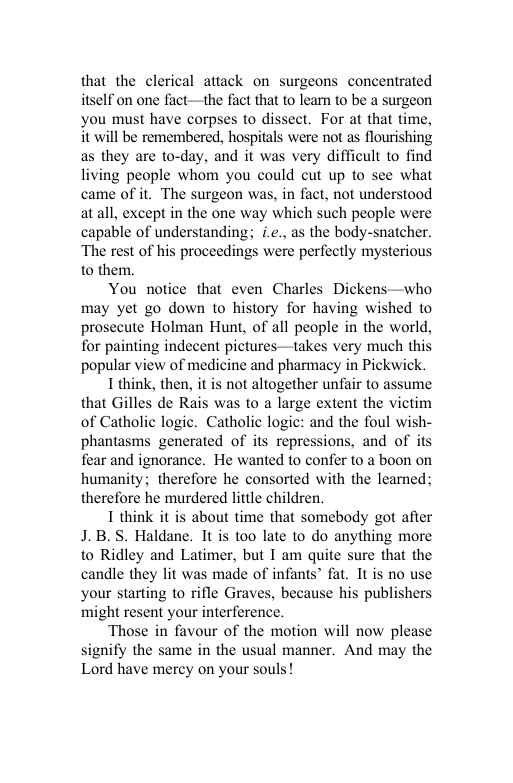
Highlights use the original PDF text layer. OCR-only matches may not be visible on the scan.
Transcription
Download text ↓raw extractionoriginal embedded textReview: unreviewed
that the clerical attack on surgeons concentrated
itself on one factthe fact that to learn to be a surgeon
you must have corpses to dissect. For at that time,
it will be remembered, hospitals were not as flourishing
as they are to-day, and it was very difficult to find
living people whom you could cut up to see what
came of it. The surgeon was, in fact, not understood
at all, except in the one way which such people were
capable of understanding ; i.e., as the body-snatcher.
The rest of his proceedings were perfectly mysterious
to them.
You notice that even Charles Dickenswho
may yet go down to history for having wished to
prosecute Holman Hunt, of all people in the world,
for painting indecent picturestakes very much this
popular view of medicine and pharmacy in Pickwick.
I think, then, it is not altogether unfair to assume
that Gilles de Rais was to a large extent the victim
of Catholic logic. Catholic logic: and the foul wish-
phantasms generated of its repressions, and of its
fear and ignorance. He wanted to confer to a boon on
humanity ; therefore he consorted with the learned ;
therefore he murdered little children.
I think it is about time that somebody got after
J. B. S. Haldane. It is too late to do anything more
to Ridley and Latimer, but I am quite sure that the
candle they lit was made of infants fat. It is no use
your starting to rifle Graves, because his publishers
might resent your interference.
Those in favour of the motion will now please
signify the same in the usual manner. And may the
Lord have mercy on your souls !
Page provenance & review flags
Stable page ID: b7c2702995695a9d8d9859ee:p00018
Line breaks are preserved. Reading order and OCR accuracy may need review.
Printed page label has not been verified.
- No automated review flags. This does not establish transcription accuracy.