1912 · CLOSE READING
Book 4 (Part I)
Book 4 (Part I) (1912), PDF p. 99
Original page
Enlarge ↗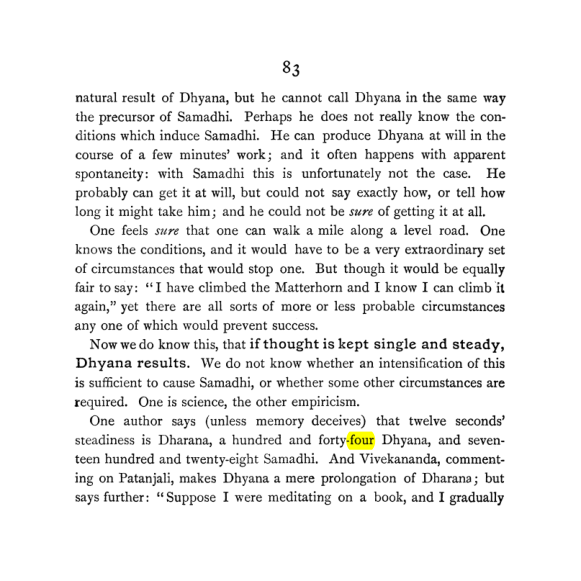
Highlights use the original PDF text layer. OCR-only matches may not be visible on the scan.
Transcription
Download text ↓raw extractionoriginal embedded textReview: unreviewed
83
natural result of Dhyana, but he cannot call Dhyana in the same way
the precursor of Samadhi. Perhaps he does not really know the con-
ditions which induce Samadhi. He can produce Dhyana at will in the
course of a few minutes’ work?,־and it often happens with apparent
spontaneity: with Samadhi this is unfortunately not the case.
He
probably can get it at will, but could not say exactly how, or tell how
long it might take him?,־and he could not be sure of getting it at all.
One feels sure that one can walk a mile along a level road.
One
knows the conditions, and it would have to be a very extraordinary set
of circumstances that would stop one.
But though it would be equally
fair to say: “I have climbed the Matterhorn and I know I can climb “it
again,” yet there are all sorts of more or less probable circumstances
any one of which would prevent success.
Now we do know this, that if thought is kept single and steady,
Dhyana results.
We do not know whether an intensification of this
is sufficient to cause Samadhi, or whether some other circumstances are
required. One is science, the other empiricism.
One author says (unless
memory deceives)
that twelve seconds’
steadiness is Dharana, a hundred and forty-four Dhyana, and seven-
teen hundred and twenty-eight Samadhi. And Vivekananda, comment-
ing on Patanjali, makes Dhyana a mere prolongation of Dharana?,־but
says further: “Suppose I were meditating on a book, and I gradually
Page provenance & review flags
Stable page ID: b57ece87819cbb5a1ea55583:p00099
Line breaks are preserved. Reading order and OCR accuracy may need review.
Printed page label has not been verified.
- No automated review flags. This does not establish transcription accuracy.