1912 · CLOSE READING
Book 4 (Part I)
Book 4 (Part I) (1912), PDF p. 98
Original page
Enlarge ↗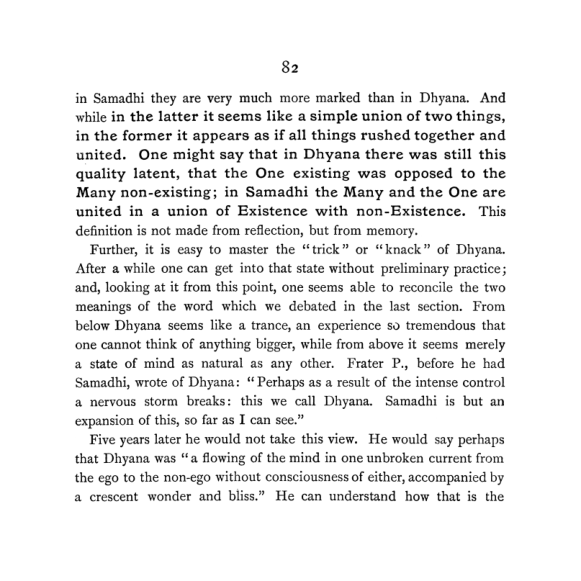
Highlights use the original PDF text layer. OCR-only matches may not be visible on the scan.
Transcription
Download text ↓raw extractionoriginal embedded textReview: unreviewed
82
in Samadhi they are very much more marked than in Dhyana. And
while in the latter it seems like a simple union of two things,
in the former it appears as if all things rushed together and
united.
One might say that in Dhyana there was still this
quality latent, that the One existing was opposed to the
Many non-existing; in Samadhi the Many and the One are
united in a union of Existence with non-Existence.
This
definition is not made from reflection, but from memory.
Further, it is easy to master the “trick ” or “knack” of Dhyana.
After a while one can get into that state without preliminary practice;
and, looking at it from this point, one seems able to reconcile the two
meanings of the word which we debated in the last section.
From
below Dhyana seems like a trance, an experience so tremendous that
one cannot think of anything bigger, while from above it seems merely
a state of mind as natural as any other.
Frater P., before he had
Samadhi, wrote of Dhyana: “ Perhaps as a result of the intense control
a nervous storm breaks: this we call Dhyana. Samadhi is but an
expansion of this, so far as I can see.”
Five years later he would not take this view. He would say perhaps
that Dhyana was “ a flowing of the mind in one unbroken current from
the ego to the non-ego without consciousnessof either, accompanied by
a crescent wonder and bliss.”
He can understand how that is the
Page provenance & review flags
Stable page ID: b57ece87819cbb5a1ea55583:p00098
Line breaks are preserved. Reading order and OCR accuracy may need review.
Printed page label has not been verified.
- No automated review flags. This does not establish transcription accuracy.