1912 · CLOSE READING
Book 4 (Part I)
Book 4 (Part I) (1912), PDF p. 89
Original page
Enlarge ↗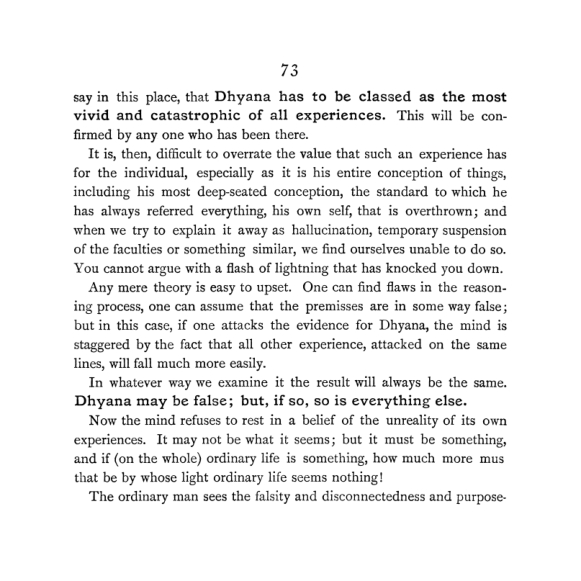
Highlights use the original PDF text layer. OCR-only matches may not be visible on the scan.
Transcription
Download text ↓raw extractionoriginal embedded textReview: unreviewed
73
say in this place, that Dhyana has to be classed as the most
vivid and catastrophic of all experiences. This will be con-
firmed by any one who has been there.
It is, then, difficult to overrate the value that such an experience has
for the individual, especially
as it is his entire conception of things,
including his most deep—seated conception, the standard to which he
has always referred everything, his own self, that is overthrown; and
when we try to explain it away as hallucination, temporary suspension
of the faculties or something similar, we find ourselves unable to do so.
You cannot argue with a flash of lightning that has knocked you down.
Any mere theory is easy to upset. One can find flaws in the reason-
ing process, one can assume that the premisses are in some way false;
but in this case, if one attacks the evidence for Dhyana, the mind is
staggered by the fact that all other experience, attacked on the same
lines, will fall much more easily.
In whatever way we examine it the result Will always be the same.
Dhyana may be false; but, if so, so is everything else.
Now the mind refuses to rest in a belief of the unreality of its own
experiences. It may not be what it seems; but it must be something,
and if (on the whole) ordinary life is something, how much more mus
that be by whose light ordinary life seems nothing!
The ordinary man sees the falsity and disconnectedness and purpose-
Page provenance & review flags
Stable page ID: b57ece87819cbb5a1ea55583:p00089
Line breaks are preserved. Reading order and OCR accuracy may need review.
Printed page label has not been verified.
- No automated review flags. This does not establish transcription accuracy.