1912 · CLOSE READING
Book 4 (Part I)
Book 4 (Part I) (1912), PDF p. 88
Original page
Enlarge ↗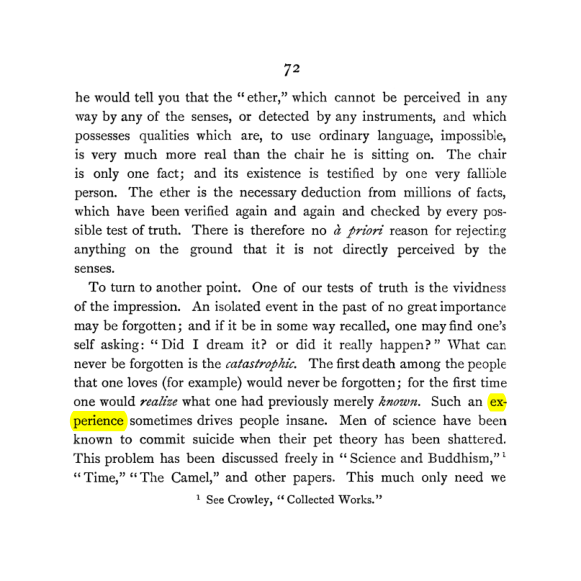
Highlights use the original PDF text layer. OCR-only matches may not be visible on the scan.
Transcription
Download text ↓raw extractionoriginal embedded textReview: unreviewed
72
he would tell you that the “ether,” which cannot be perceived in any
way by any of the senses, or detected by any instruments, and which
possesses
qualities which are, to use ordinary language,
impossible,
is very much more real than the chair he is sitting on.
The chair
is only one fact; and its existence is testified by one very falliole
person. The ether is the necessary deduction from millions of facts,
which have been verified again and again and checked by every pos-
sible test of truth. There is therefore no ὰpriori reason for rejecting
anything on the
ground that it is not directly perceived by the
senses.
To turn to another point. One of our tests of truth is the vividness
of the impression. An isolated event in the past of no great importance
may be forgotten; and if it be in some way recalled, one may find one’s
self asking: “Did I dream it? or did it really happen?” What can
never be forgotten is the 22%/?»!?ש”מקThe first death among the people
that one loves (for example) would neverbe forgotten; for the first time
one would realize what one had previously merely known.
Such an ex-
perience sometimes drives people insane. Men of science have been
known to commit suicide when their pet theory has been shattered.
This problem has been discussed freely in “ Science and Buddhism,”
1
“Time,” “
he Camel,” and other papers. This much only need we
1 See Crowley, “ Collected Works.”
Page provenance & review flags
Stable page ID: b57ece87819cbb5a1ea55583:p00088
Line breaks are preserved. Reading order and OCR accuracy may need review.
Printed page label has not been verified.
- No automated review flags. This does not establish transcription accuracy.