1912 · CLOSE READING
Book 4 (Part I)
Book 4 (Part I) (1912), PDF p. 87
Original page
Enlarge ↗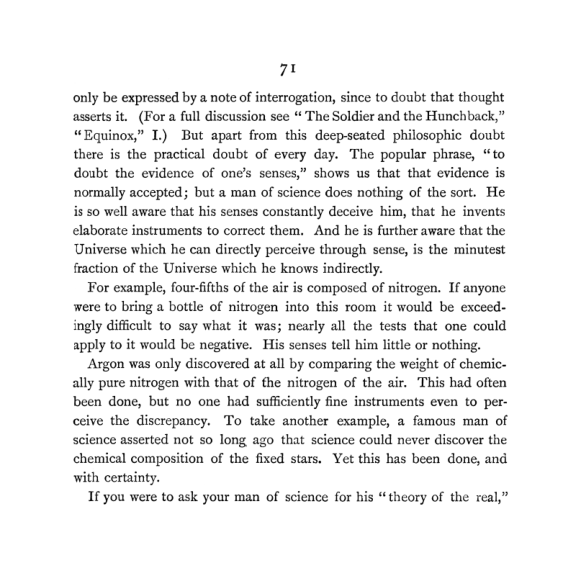
Highlights use the original PDF text layer. OCR-only matches may not be visible on the scan.
Transcription
Download text ↓raw extractionoriginal embedded textReview: unreviewed
71
only be expressedby a note of interrogation, since to doubt that thought
asserts it.
(For a full discussion see “ The Soldierand the Hunchback,”
“ Equinox,” Ι.)
But apart from this deep-seated philosophic doubt
there is the practical doubt of every day.
The popular phrase, “to
doubt the evidence of one’s senses,”
shows us that that evidence is
normally accepted; but a man of science does nothing of the sort. He
is so well aware that his senses constantly deceive him, that he invents
elaborate instruments to correct them. And he is further aware that the
Universe which he can directly perceive through sense, is the minutest
fraction of the Universe which he knows indirectly.
For example, four-fifths of the air is composed of nitrogen. If anyone
were to bring a bottle of nitrogen into this room it would be exceed-
ingly difficult to say what it was; nearly all the tests that one could
apply to it would be negative.
His senses tell him little or nothing.
Argon was only discovered at all by comparing the weight of chemic-
ally pure nitrogen with that of the nitrogen of the air. This had often
been done, but no one had sufficiently fine instruments even to per-
ceive the discrepancy. To take another example, a famous man of
science asserted not so long, ago that science could never discover the
chemical composition of the fixed stars. Yet this has been done, and
with certainty.
If you were to ask your man of science for his “theory of the real,”
Page provenance & review flags
Stable page ID: b57ece87819cbb5a1ea55583:p00087
Line breaks are preserved. Reading order and OCR accuracy may need review.
Printed page label has not been verified.
- No automated review flags. This does not establish transcription accuracy.