1912 · CLOSE READING
Book 4 (Part I)
Book 4 (Part I) (1912), PDF p. 82
Original page
Enlarge ↗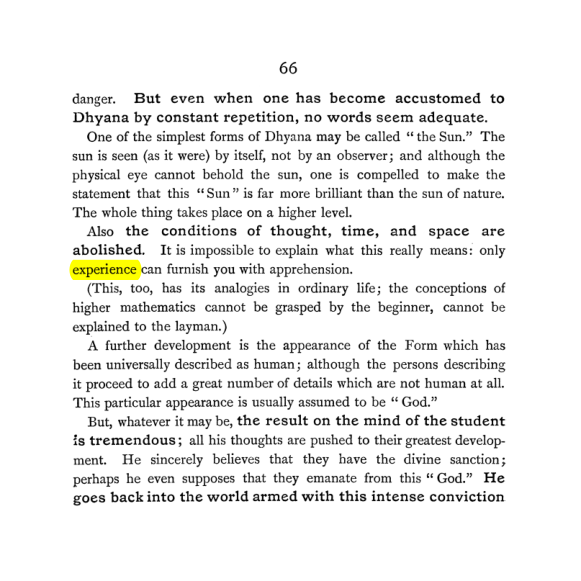
Highlights use the original PDF text layer. OCR-only matches may not be visible on the scan.
Transcription
Download text ↓raw extractionoriginal embedded textReview: unreviewed
66
danger.
But even when one has become accustomed to
Dhyana by constant repetition, no words seem adequate.
One of the simplest forms of Dhyana may be called “the Sun.” The
sun is seen (as it were) by itself, not by an observer; and although the
physical eye cannot behold the sun, one is compelled to make the
statement that this “ Sun” is far more brilliant than the sun of nature.
The whole thing takes place on a higher level.
Also the conditions of thought, time, and space are
abolished.
It is impossible to explain what this really means
:i only
experience can furnish you with apprehension.
(This, too, has its analogies in ordinary life; the conceptions of
higher mathematics cannot be grasped by the beginner, cannot be
explained to the layman.)
Α further development is the appearance of the Form which has
been universallydescribed as human; although the persons describing
it proceed to add a great number of details which are not human at all.
This particular appearance is usually assumed to be “ God.”
But, whatever it may be, the result on the mind of the student:
is tremendous;
all his thoughts are pushed to their greatest develop-
ment.
He sincerely believes
that they have the divine sanction;
perhaps he even supposes that they emanate from this “God.” He
goes back into the world armed with this intense conviction.
Page provenance & review flags
Stable page ID: b57ece87819cbb5a1ea55583:p00082
Line breaks are preserved. Reading order and OCR accuracy may need review.
Printed page label has not been verified.
- No automated review flags. This does not establish transcription accuracy.