1912 · CLOSE READING
Book 4 (Part I)
Book 4 (Part I) (1912), PDF p. 74
Original page
Enlarge ↗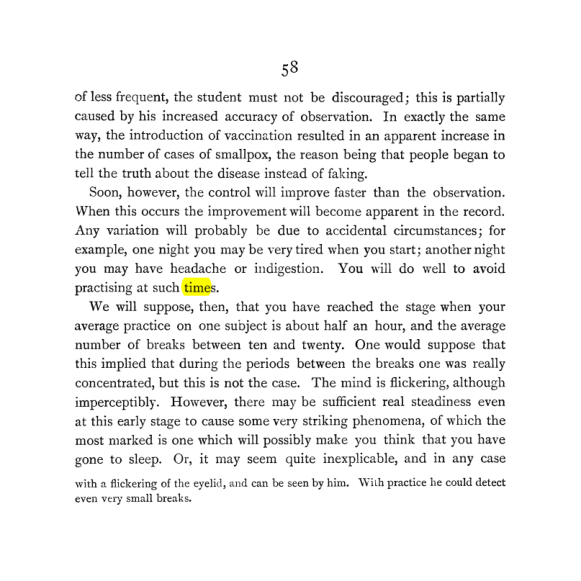
Highlights use the original PDF text layer. OCR-only matches may not be visible on the scan.
Transcription
Download text ↓raw extractionoriginal embedded textReview: unreviewed
58
of less frequent, the student must not be discouraged; this is partially
caused by his increased accuracy of observation. In exactly the same
way, the introduction of vaccination resulted in an apparent increase in
the number of cases of smallpox, the reason being that people began to
tell the truth about the disease instead of faking.
Soon, however, the control will improve faster than the observation.
When this occurs the improvementwill become apparent in the record.
Any variation will probably be due to accidental circumstances; for
example, one night you may be very tired when you start; another night
you may have headache or indigestion.
You will do well to avoid
practising at such times.
We will suppose, then, that you have reached the stage when your
average practice on one subject is about half an hour, and the average
number of breaks between ten and twenty.
One would suppose that
this implied that during the periods between the breaks one was really
concentrated, but this is not the case.
The mind is flickering, although
imperceptibly. However, there may be sufficient real steadiness even
at this early stage to cause some very striking phenomena, of which the
most marked is one which will possibly make you think that you have
gone to sleep.
Or, it may seem quite inexplicable, and in any case
with a flickering of the eyelid, and can be seen by him. With practice he could detect
even very small breaks.
Page provenance & review flags
Stable page ID: b57ece87819cbb5a1ea55583:p00074
Line breaks are preserved. Reading order and OCR accuracy may need review.
Printed page label has not been verified.
- No automated review flags. This does not establish transcription accuracy.