1912 · CLOSE READING
Book 4 (Part I)
Book 4 (Part I) (1912), PDF p. 57
Original page
Enlarge ↗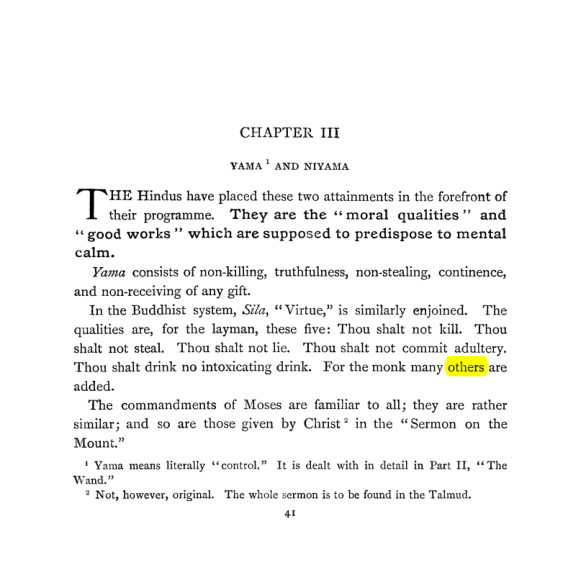
Highlights use the original PDF text layer. OCR-only matches may not be visible on the scan.
Transcription
Download text ↓raw extractionoriginal embedded textReview: unreviewed
CHAPTER III
YAMA
1 AND NIYAMA
HE Hindus have placed these two attainments in the forefront of
their programme. They are the “moral qualities” and
“ good works ” which are supposed to predispose to mental
calm.
Fama consists of non-killing, truthfulness, non-stealing,
continence,
and non-receivingof any gift.
In the Buddhist system, Sz'la, “Virtue,” is similarly enjoined.
The
qualities are, for the layman, these five: Thou shalt not kill.
Thou
shalt not steal.
Thou shalt not lie.
Thou shalt not commit adultery.
Thou shalt drink no intoxicating drink. For the monk many others are
added.
The commandments of Moses are familiar to all?,־they are rather
similar; and so are those given by Christ2 in the “Sermon on the
Mount.”
' Yama means literally “control.” It is dealt With in detail in Part II, “The
Wand.”
2 Not, however, original.
The whole sermon is to be found in the Talmud.
4.1
Page provenance & review flags
Stable page ID: b57ece87819cbb5a1ea55583:p00057
Line breaks are preserved. Reading order and OCR accuracy may need review.
Printed page label has not been verified.
- No automated review flags. This does not establish transcription accuracy.