1912 · CLOSE READING
Book 4 (Part I)
Book 4 (Part I) (1912), PDF p. 38
Original page
Enlarge ↗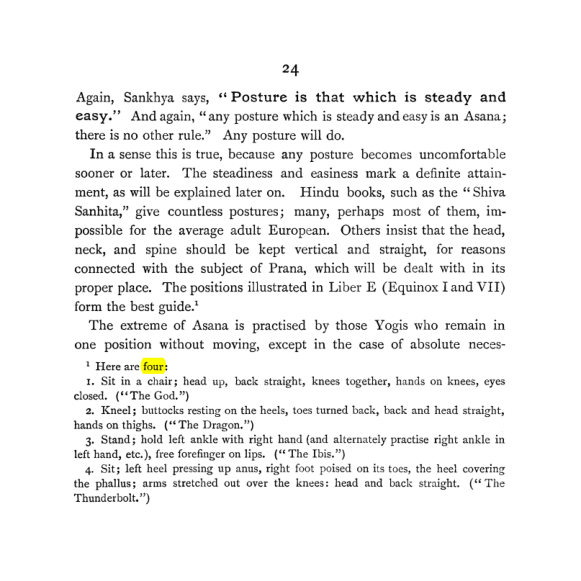
Highlights use the original PDF text layer. OCR-only matches may not be visible on the scan.
Transcription
Download text ↓raw extractionoriginal embedded textReview: unreviewed
24
Again, Sankhya says, “Posture is that which is steady and
easy.” And again, “any posture which is steady and easy is an Asana;
there is no other rule.”
Any posture will do.
In a sense this is true, because any posture becomes uncomfortable
sooner or later.
The steadiness and easiness mark a definite attain-
ment, as will be explained later on.
Hindu books, such as the “Shiva
Sanhita,” give countless postures; many, perhaps most of them, im-
possible for the average adult European. Others insist that the head,
neck, and spine should be kept vertical and straight,
for reasons
connected with the subject of Prana, which will be dealt with in its
proper place.
The positions illustrated in Liber E (Equinox I and VII)
form the best guide.1
The extreme of Asana is practised by those Yogis who remain in
one position without moving, except in the case of absolute neces—
1 Here are four:
1. Sit in a chair; head up, back straight, knees together, hands on knees, eyes
closed. (“The God.”)
2. Kneel; buttocks resting on the heels, toes turned back, back and head straight,
hands on thighs. (“ The Dragon.’ ’)
_
3. Stand; hold left ankle with right hand (and alternately practise right ankle in
left hand, etc.), free forefinger on lips. (“ The Ibis”)
4. Sit; left heel pressing up anus, right foot poised on its toes, the heel covering
the phallus; arms stretched out over the knees: head and back straight. (“The
Thunderbolt.”)
Page provenance & review flags
Stable page ID: b57ece87819cbb5a1ea55583:p00038
Line breaks are preserved. Reading order and OCR accuracy may need review.
Printed page label has not been verified.
- No automated review flags. This does not establish transcription accuracy.