1912 · CLOSE READING
Book 4 (Part I)
Book 4 (Part I) (1912), PDF p. 32
Original page
Enlarge ↗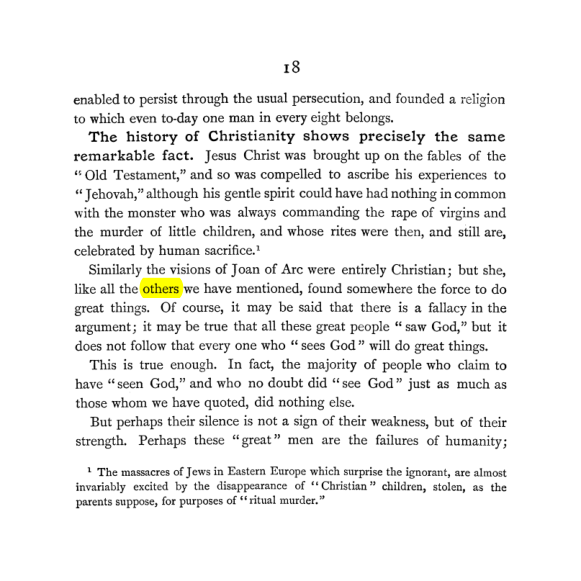
Highlights use the original PDF text layer. OCR-only matches may not be visible on the scan.
Transcription
Download text ↓raw extractionoriginal embedded textReview: unreviewed
18
enabled to persist through the usual persecution, and founded a religion
to which even to—day one man in every eight belongs.
The history of Christianity shows precisely the same
remarkable fact. Jesus Christ was brought up on the fables of the
“ Old Testament,” and so was compelled to ascribe his experiences to
“Jehovah,” although his gentle spirit could have had nothing in common
with the monster who was always commanding the rape of virgins and
the murder of little children, and whose rites were then, and still are,
celebrated by human sacrifice.1
Similarly the visions of Joan of Arc were entirely Christian; but she,
like all the others we have mentioned, found somewherethe force to do
great things.
Of course, it may be said that there is a fallacy in the
argument; it may be true that all these great people “ saw God,” but it
does not follow that every one who “ sees God ” will do great things.
This is true enough. In fact, the majority of people who claim to
have “seen God,” and who no doubt did “see God” just as much as
those whom we have quoted, did nothing else.
But perhaps their silence is not a Sign of their weakness, but of their
strength. Perhaps these “great ” men are the failures of humanity;
1 The massacres of Jews in Eastern Europe which surprise the ignorant, are almost
invariably excited by the disappearance
of “ Christian ” children, stolen, as the
parents suppose, for purposes of “ ritual murder.”
Page provenance & review flags
Stable page ID: b57ece87819cbb5a1ea55583:p00032
Line breaks are preserved. Reading order and OCR accuracy may need review.
Printed page label has not been verified.
- No automated review flags. This does not establish transcription accuracy.