1912 · CLOSE READING
Book 4 (Part I)
Book 4 (Part I) (1912), PDF p. 28
Original page
Enlarge ↗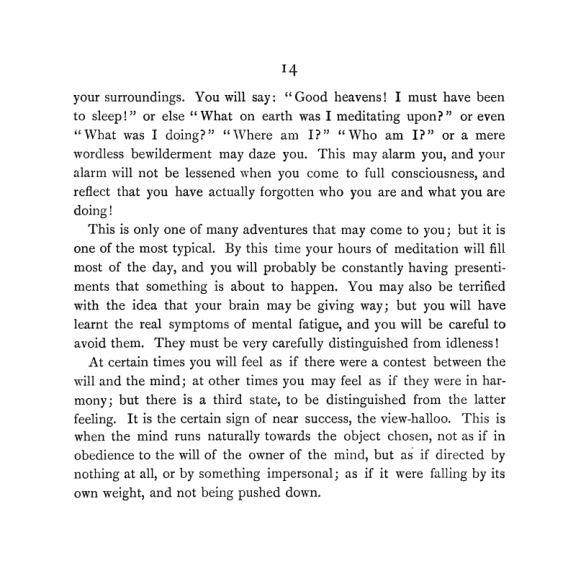
Highlights use the original PDF text layer. OCR-only matches may not be visible on the scan.
Transcription
Download text ↓raw extractionoriginal embedded textReview: unreviewed
I4
your surroundings. You will say: “Good heavens! I must have been
to sleep!” or else “What on earth was I meditating upon?” or even
“What was I doing?” “Where am I?” “Who am I?” or a mere
wordless bewilderment may daze you. This may alarm you, and your
alarm will not be lessened when you come to full consciousness, and
reflect that you have actually forgotten who you are and what you are
doing!
This is only one of many adventures that may come to you ; but it is
one of the most typical.
By this time your hours of meditation will fill
most of the day, and you will probably be constantly having presenti-
ments that something is about to happen. You may also be terrified
with the idea that your brain may be giving way ; but you will have
learnt the real symptoms of mental fatigue, and you will be careful to
avoid them. They must be very carefully distinguished from idleness!
At certain times you will feel as if there were a contest between the
will and the mind; at other times you may feel as if they were in har-
mony; but there is a third state, to be distinguished from the latter
feeling. It is the certain sign of near success, the view-halloo.
This is
when the mind runs naturally towards the object chosen, not as if in
obedience to the will of the owner of the mind, but as if directed by
nothing at all, or by something impersonal,' as if it were falling by its
own weight, and not being pushed down.
Page provenance & review flags
Stable page ID: b57ece87819cbb5a1ea55583:p00028
Line breaks are preserved. Reading order and OCR accuracy may need review.
Printed page label has not been verified.
- No automated review flags. This does not establish transcription accuracy.