1912 · CLOSE READING
Book 4 (Part I)
Book 4 (Part I) (1912), PDF p. 25
Original page
Enlarge ↗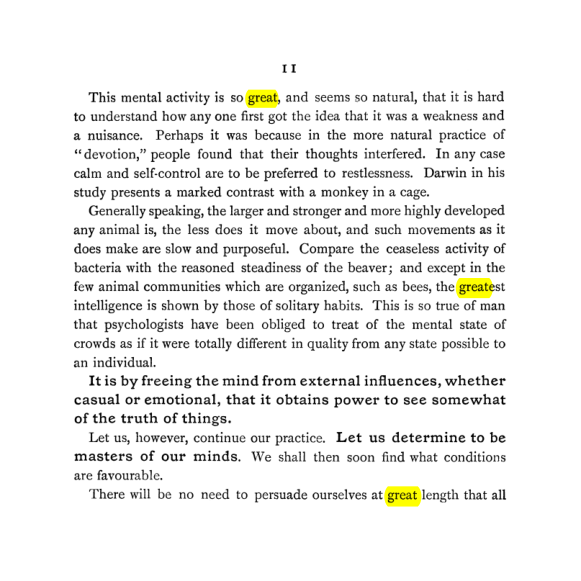
Highlights use the original PDF text layer. OCR-only matches may not be visible on the scan.
Transcription
Download text ↓raw extractionoriginal embedded textReview: unreviewed
II
This mental activity is so great, and seems so natural, that it is hard
to understand how any one first got the idea that it was a weakness and
a nuisance. Perhaps it was because in the more natural practice of
“devotion,” people found that their thoughts interfered. In any case
calm and self-controlare to be preferred to restlessness. Darwin in his
study presents a marked contrast with a monkey in a cage.
Generallyspeaking, the larger and stronger and more highly developed
any animal is, the less does it move about, and such movements as it
does make are slow and purposeful. Compare the ceaseless activity of
bacteria with the reasoned steadiness of the beaver; and except in the
few animal communities which are organized, such as bees, the greatest
intelligence is shown by those of solitary habits. This is so true of man
that psychologists have been obliged to treat of the mental state of
crowds as if it were totally different in quality from any state possible to
an individual.
It is by freeing the mind from external influences,whether
casual or emotional, that it obtains power to see somewhat
of the truth of things.
Let us, however, continue our practice. Let us determine to be
masters of our minds. We shall then soon find what conditions
are favourable.
There will be no need to persuade ourselves at great length that all
Page provenance & review flags
Stable page ID: b57ece87819cbb5a1ea55583:p00025
Line breaks are preserved. Reading order and OCR accuracy may need review.
Printed page label has not been verified.
- No automated review flags. This does not establish transcription accuracy.