1912 · CLOSE READING
Book 4 (Part I)
Book 4 (Part I) (1912), PDF p. 20
Original page
Enlarge ↗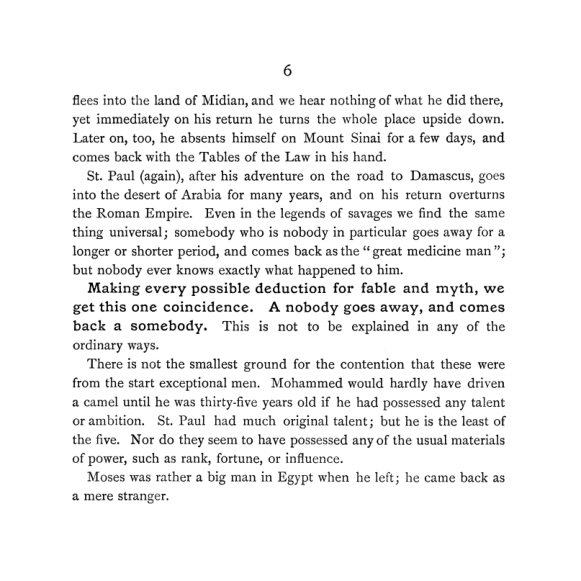
Highlights use the original PDF text layer. OCR-only matches may not be visible on the scan.
Transcription
Download text ↓raw extractionoriginal embedded textReview: unreviewed
6
flees into the land of Midian, and we hear nothing of what he did there,
yet immediately on his return he turns the whole place upside down.
Later on, too, he absents himself on Mount Sinai for a few days, and
comes back with the Tables of the Law in his hand.
St. Paul (again), after his adventure on the road to Damascus, goes
into the desert of Arabia for many years, and on his return overturns
the Roman Empire. Even in the legends of savages we find the same
thing universal; somebody who is nobody in particular goes away for a
longer or shorter period, and comes back as the “ great medicine man”;
but nobody ever knows exactly what happened to him.
Making every possible deduction for fable and myth, we
get this one coincidence.
A nobody goes away, and comes
back a somebody.
This is not to be explained in any of the
ordinary ways.
There is not the smallest ground for the contention that these were
from the start exceptional men.
Mohammed would hardly have driven
a camel until he was thirty-five years old if he had possessed any talent
or ambition.
St. Paul had much original talent; but he is the least of
the five. Nor do they seem to have possessed any of the usual materials
of power, such as rank, fortune, or influence.
Moses was rather a big man in Egypt when he left; he came back as
a mere stranger.
Page provenance & review flags
Stable page ID: b57ece87819cbb5a1ea55583:p00020
Line breaks are preserved. Reading order and OCR accuracy may need review.
Printed page label has not been verified.
- No automated review flags. This does not establish transcription accuracy.