1912 · CLOSE READING
Book 4 (Part I)
Book 4 (Part I) (1912), PDF p. 101
Original page
Enlarge ↗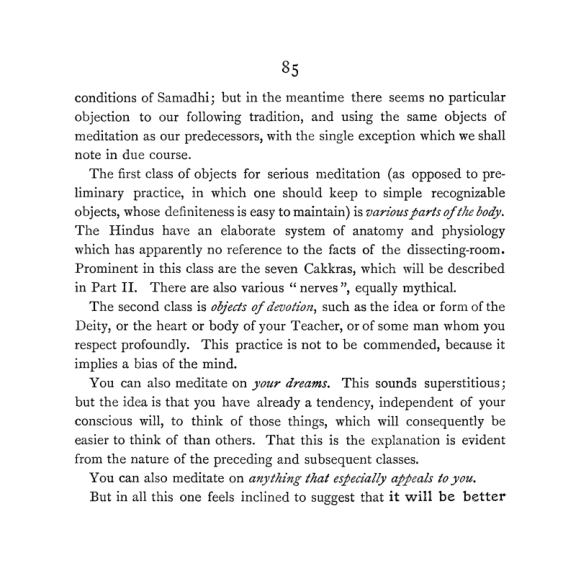
Highlights use the original PDF text layer. OCR-only matches may not be visible on the scan.
Transcription
Download text ↓raw extractionoriginal embedded textReview: unreviewed
85
conditions of Samadhi; but in the meantime there seems no particular
objection to our following tradition, and using the same objects of
meditation as our predecessors,with the single exception which we shall
note in due course.
The first class of objects for serious meditation (as opposed to pre-
liminary practice, in which one should keep to simple recognizable
objects, whose definitenessis easy to maintain) is varz'ousparz'sofz‘lzelady.
The Hindus have an elaborate system of anatomy and physiology
which has apparently no reference to the facts of the dissecting-room.
Prominent in this class are the seven Cakkras, which will be described
in Part II.
There are also various “ nerves”, equally mythical.
The second class is ob./eois ofdooofz'ofz, such as the idea or form of the
Deity, or the heart or body of your Teacher, or of some man whom you
respect profoundly. This practice is not to be commended, because it
implies a bias of the mind.
You can also meditate on your dreams.
This sounds superstitious;
but the idea is that you have already a tendency, independent of your
conscious will, to think of those things, which will consequently be
easier to think of than others. That this is the explanation is evident
from the nature of the preceding and subsequent classes.
You can also meditate on elm/Ming illa! especially appeals loyou.
But in all this one feels inclined to suggest that it will be better
Page provenance & review flags
Stable page ID: b57ece87819cbb5a1ea55583:p00101
Line breaks are preserved. Reading order and OCR accuracy may need review.
Printed page label has not been verified.
- No automated review flags. This does not establish transcription accuracy.