1913 · CLOSE READING
The Equinox (Volume I, Number IX)
The Equinox (Volume I, Number IX) (1913), PDF p. 610
Original page
Enlarge ↗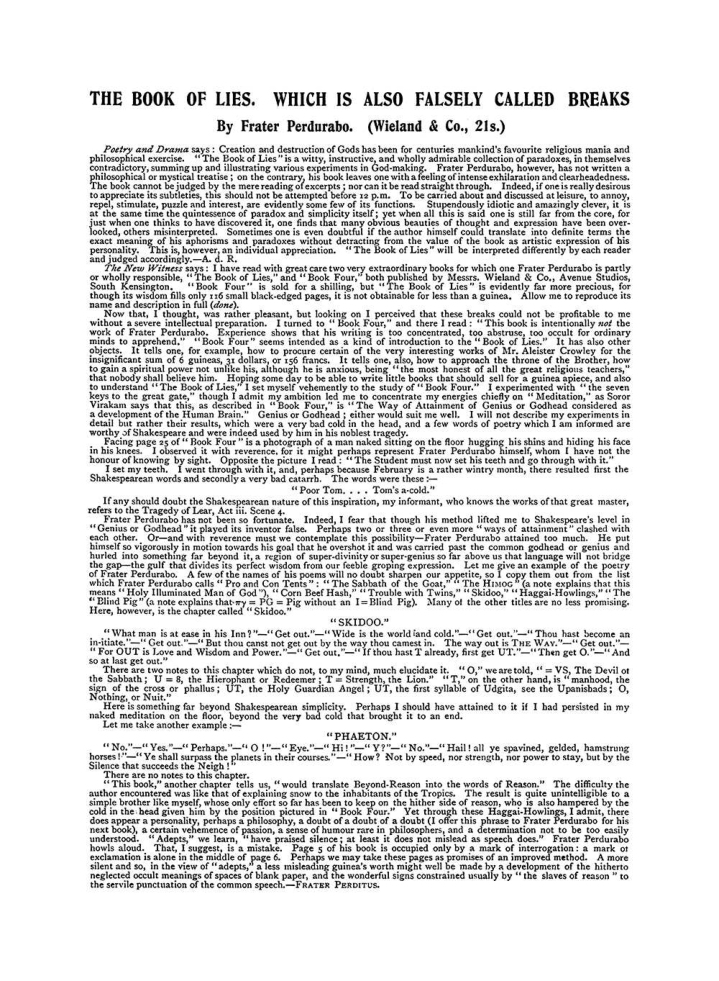
Highlights use the original PDF text layer. OCR-only matches may not be visible on the scan.
Transcription
Download text ↓raw extractionoriginal embedded textReview: unreviewed
THE BOOK OF LIES. WHICH IS ALSO FALSELY CALLED BREAKS
By Frater Perdurabo. (Wieland & Co., 21s.)
Poetry and Drama says: Creation and destruction of Gods has been for centuries mankind’s favourite religious mania and
philosophical exercise. ‘The Book of Lies’ is a witty, instructive, and wholly admirable collection of paradoxes, in themselves.
Contradictory, summing up and illustrating various experiments in God-making. Frater Perdurabo, however, has not written a
Philosophical or mystical treatise; on the contrary, his book leaves one witha feeling of intense exhilaration and clearheadedness.
"he book cannot be judged by the mere reading of excerpts; nor can it be read straight through. Indeed, if oneis really desirous
to appreciate its subileties, this should not be attempted before 12 p.m. ‘To be carried about and discussed at leisure, to annoy,
repel, stimulate, puzzle and interest, are evidently some few of its functions. Stupendously idiotic and amazingly clever, it is
at the same time the quintessence of paradox and simplicity itself; yet when all this is said one is still far from the core, for
just when one thinks fo have discovered it, one finds that many obvious beauties of thought and expression have been over-
looked, others misinterpreted. Sometimes one is even doubtful if the author himself could translate into definite terms the
exact meaning of his aphorisms and paradoxes without detracting from the value of the book as artistic expression of is
personality. This is, however, an individual appreciation. * jook of Lies” will be interpreted differently by each reader
andjudged accordingly.—A. d. R. . . .
"he New Witness says: I have read with great care two very extraordinary books for which one Frater Perdurabo is partly
or wholly responsible, “The Book of Lies,” and Book Four,” both published by Messrs, Wieland & Co,, Avenue Studios,
South Kensington. ’ “Book Four” ‘is ‘sold for a shilling,’ but ‘The Book of Lies” is evidently far more precious, for
though its wisdom fills only 136 small black-edged pages, it is not obtainable for less than a guinea, Allow me to reproduce its
name and description in full (done). "
_ Now that, I thought, was rather pleasant, but looking on I perceived that these breaks could not be profitable to me
without a severe intellectual preparation. I timed to Book Four,” and there I read: "This book fs intentionally not the
work of Frater Perdurabo. Experience shows that his writing is’ too concentrated, too abstruse, too occult for ordinary
minds to apprehend.” ‘Book Four” seems intended as a kind of introduction to the “Book of Lies.” It has also other
objects, It tells one, for example, how to procure certain of the very interesting works of Mr, Aleister Crowley for the
insignificant sum of6 guineas, 31 dollars, or 156 francs. It tells one, also, how to approach the throne of the Brother, how
to gaina spiritual power not unlike his, although he is anxious, being “the most honest of all the great religious teacher,”
that nobody shall believe him. Hoping some day to be able to write litle books that should ‘sell fora guinea apiece, and also
to understand ‘ The Book of Lies,” I set myself vehemently to the study of “Book Four.” 1 experimented with “the seven
Keys to the great gate,” thoughI admit my ambition led me, to concentrate my energies chiefly on ‘ Meditation,” as Soror
Virakam says that this, as described in “Book Four,” is “The Way of Attainment of Genius or Godhead considered as
development of the Human Brain.” Genius or Godhead; either would suit me well. I will not describe my experiments in
detail but rather their results, which were a very bad cold in the head, and a few words of poetry which I am informed are
‘worthy of Shakespeare and were indeed used by him in his noblest tragedy. oe ae
in Hssing page 25 of Book Four” is a photograph of a man naked sitting onthe floor hugging.
his shing and hiding his face
in his knees. "I observed it with reverence, for it might perhaps represent Frater Perdurabo himself, whom I have not, the
honour of knowing by sight. Opposite the picture I read : “The Student must now set his teeth and go through with it.”
Tset my teeth. I went through with it, and, perhaps because February is a rather wintry month, there resulted first the
Shakespearean words and secondlya very bad catarrh. The words were these -—
“Poor Tom. . . Tom's a-cold.”
Ifany should doubt the Shakespearean nature of this inspiration, my informant, who knows the works of that great master,
refers to the Tragedy of Lear, Act li. Scene 4. ‘
Frater Perdurabo has not’ been so fortunate. Indeed, I fear that though his method lifted me to Shakespeare's level
in
“Genius or Godhead "it played its inventor false." Perhaps two or three or even more ‘ways of attainment” clashed with
each other. Or—and with reverence must we contemplate this possibility—Frater Perdurabo attained too much. He put
bimsef
so vigorously in motion towards his goal that he overshot it and was carried past the common, godhead of genius and
hurled into something far keyond it,a region of super-divinity
or super-genius so far above us that language will not bridge
the gap—the gulf that divides is perfect wisdom from our feble groping expression. Let me give an example of the poetry
of Frater Perdurabo, A few of the names of his poems will no doubt sharpen our appetite, so I copy them out from the list
which Frater Perdurabo calls “ Pro and Con Tents”: ‘The Sabbath of the Goat, e Hintoc,” (a note explains that this
means
‘ Holy Illuminated Man of God”), “ Corn Beef Hash,” Trouble with Twins,” Skidoo,” Haggai-H. ‘
«Blind Pig” (a note explains thay = PG = Pig without an nd Pig). Many’of the other titles are no less prom
Here, however, is the chapter called “Skidoo.”
ing.
“SKIDOO.”
“Wide is the world fand cold.’
“What man is at ease in his Ton?”—“
Get out’ n
tiate.""—"' Get out.” —" But thou canst not get out by the way thou camest in. The way
"For OUT is Love and Wisdom and Power."=-" Get out,”—"
If thou hastT already, frst get UT-
so at last get out.”
‘There are two notes to this chapter which do not, to,my
the Sabbath; U = 8 the Hicrophant or, Redeemer:
"—* Thou hast become, an
Tue, Way.”—" Get out.”—
"Then get 0."—""And
1d, much elucidate it,“ 0,” wearetold, '§, The Devil ot
Strength, the Lion.” ‘'T,” on the other hand, is “manhood, the
gn, of the Cross or ‘phallus; UT, the Holy Guardian Angel; UT, the first syllable of Udgita, see the Upanishads; O,
fothing,
or Nuit.”
Here is something far beyond Shakespearean simplicity. Perhaps I should have attained to it if I bad persisted in my
naked meditation on the floor, beyond the very bad cold that brought it to an end.
Let me take another example -—
“PHAETON.”
4 No," Yes,"—« Pethaps."—"0 1" Eye.""—" Hi!" ¥2"—" No,”—"
Hail ! all ye spavined, gelded, hamstrung
horses !""—Ye shall surpassthe planets in their courses.”
—“ How? Not by speed, nor strength, nor power to stay, but by the
Silence that succeeds the Neigh |?
here are no notes to this chapter. it
“This book,” another chapter tells us, “would translate Beyond-Reason into the words of Reason.” The difficulty the
author encountered was like that of explaining snow to the inhabitants of the Tropics. The result is quite unintelligible to a
simple brother like myself, whose only effort so far has been to keep on the hither side of reason, who is also hampered by the
cold in the head given him by the position pictured in ‘Book Four.” Vet through these Haggai-Howlings, I admit, there
does appear a personality, perhaps a philosophy, a doubt ofa doubt
of a doubt (I offer this phrase to Frater Perdurabo for his
next book), a certain vehemence of passion, a sense of humour rare in philosophers, and a determination not to be too easily
understood. “Adepts,” we learn, “have praised silence; at least it does not mislead as speech does.” Frater Perdurabo
howls aloud. That, suggest is'a mistake, “Page s of his book is occupied only by a mark of interrogation: a mark ot
exclamation is alone inthe middle of page 6. Perhaps we may take these pages as promises of an improved method. A more
silent
and so, in the view of “adeptsj’ a less misleading guinea’s worth might well Be made by a development of the hitherto
neglected occult meanings of spaces of blank paper, and the wonderful signs constrained usuall
the servile punctuation of the common speech. —FRaTER PERDITUS.
ly by ‘the slaves of reason” to
Page provenance & review flags
Stable page ID: b19b302fada611776d16b5bf:p00610
Line breaks are preserved. Reading order and OCR accuracy may need review.
Printed page label has not been verified.
- No automated review flags. This does not establish transcription accuracy.