1913 · CLOSE READING
The Equinox (Volume I, Number IX)
The Equinox (Volume I, Number IX) (1913), PDF p. 602
Original page
Enlarge ↗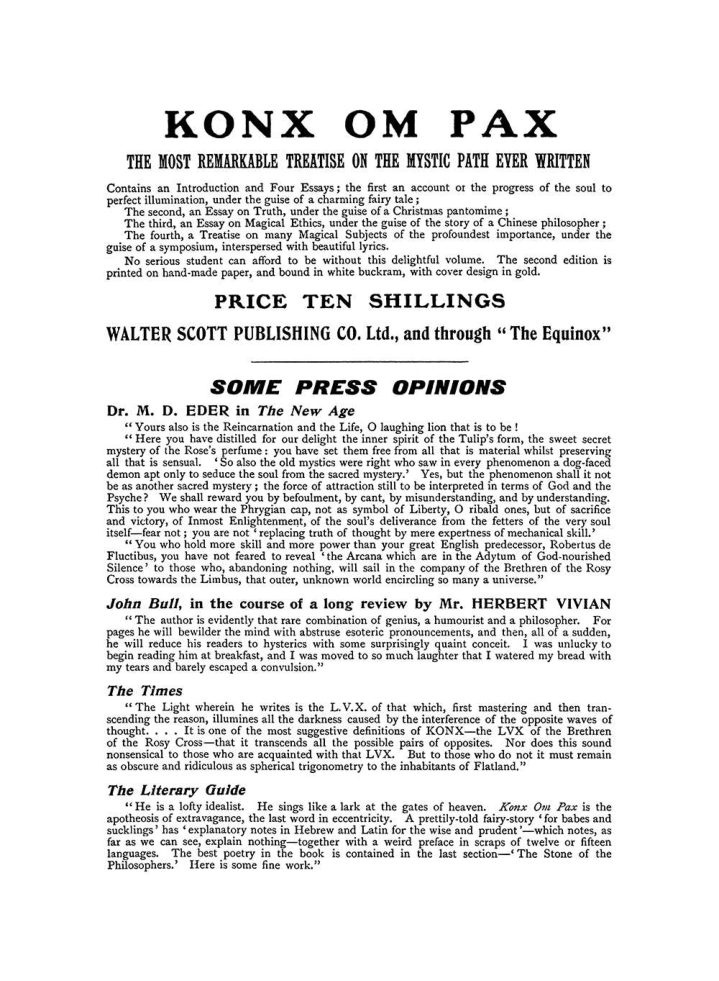
Highlights use the original PDF text layer. OCR-only matches may not be visible on the scan.
Transcription
Download text ↓raw extractionoriginal embedded textReview: unreviewed
KONX OM PAX
THE MOST REMARKABLE TREATISE ON THE MYSTIC PATH EYER WRITTEN
Contains an Introduction and Four Essays; the first an account or the progress of the soul to
perfect illumination, under the guise of a charming fairy tale 5
‘The second, an Essay on Truth, under the guise ofa Christmas pantomime;
The third, an Essay on Magical Ethics, tinder the guise of the story of a Chinese philosopher ;
‘The fourth, a Treatise on many Magical Subjects of the profoundest importance, under the
guise of a symposium, interspersed with beautiful lyrics.
No serious student can afford to be without this delightful volume. The second edition is
printed on hand-made paper, and bound in white buckram, with cover design in gold.
PRICE TEN SHILLINGS
WALTER SCOTT PUBLISHING CO. Ltd., and through “ The Equinox”
SOME PRESS OPINIONS
Dr. M. D. EDER in The New Age
“ Yours also is the Reincarnation and the Life, O laughing lion that is to be !
“Here you have distilled for our delight the inner spirit of the Tulip’s form, the sweet secret
mystery of the Rose’s perfume: you have set them free from all that is material whilst. preservin,
ail that is sensual, ‘So also the old mysties were right who saw in every phenomenon a dog-faced
demon apt only to seduce the soul from the sacred mystery.’ Yes, but the phenomenon shall it not
be as another sacred mystery5 the force of attraction still to be interpreted in terms of God and the
Psyche? We shall reward you by befoulment, by cant, by misunderstanding, and by understanding.
This to you who wear the Phrygian cap, not as symbol of Liberty, O ribald ones, but of sacrifice
and victory, of Inmost Enlightenment, of the soul’s deliverance from the fetters of the very soul
itself—fear not; you are not ‘replacing truth of thought by mere expertness of mechanical skill.’
“You who hold more skill and more power than your great English predecessor, Robertus de
Fluctibus, you have not feared to reveal “the Arcana which are in the Adytum of God-nourished
Silence’ to those who, abandoning nothing, will sail in the company of the Brethren of the Rosy
Cross towards the Limbus, that outer, unknown world encircling so many a universe.”
John Bull, in the course of a long review by Mr. HERBERT VIVIAN
“The author is evidently that rare combination of genius, a humourist and a philosopher. For
pages he will bewilder the mind with abstruse esoteric pronouncements, and then, all of a sudden,
he will reduce his readers to hysterics with some surprisingly quaint conceit. 1 was unlucky to
begin reading him at breakfast, and I was moved to so much laughter that I watered my bread with
my tears and barely escaped a convulsion.”
The Times
“The Light wherein he writes is the L.V.X. of that which, first mastering and then tran-
scending the reason, illumines all the darkness caused by the interference of the opposite waves of
thought. . . . It is’one of the most suggestive definitions of KONX—the LVX of the Brethren
of the Rosy Cross—that it transcends ‘all the possible pairs of opposites. Nor does this sound
nonsensical to those who are acquainted with that LVX. | But to those who do not it must remain
as obscure and ridiculous as spherical trigonometry to the inhabitants of Flatland.”
The Literary Guide
“He is a lofty idealist. He sings like a lark at the gates of heaven. Konx Om Pax is the
apotheosis of extravagance, the last word in eccentricity, “A. prettily-told fairy-story ‘for babes and
sucklings’ has ‘explanatory notes in Hebrew and Latin for the wise and prudent’—which notes, as
far as we can see explain nothing —together with a weird preface in scraps of twelve or fifteen
languages. The best poetry in the book is contained in the last section—‘The Stone of the
Philosophers.’ Here is some fine work.”
Page provenance & review flags
Stable page ID: b19b302fada611776d16b5bf:p00602
Line breaks are preserved. Reading order and OCR accuracy may need review.
Printed page label has not been verified.
- No automated review flags. This does not establish transcription accuracy.