1913 · CLOSE READING
The Equinox (Volume I, Number IX)
The Equinox (Volume I, Number IX) (1913), PDF p. 498
Original page
Enlarge ↗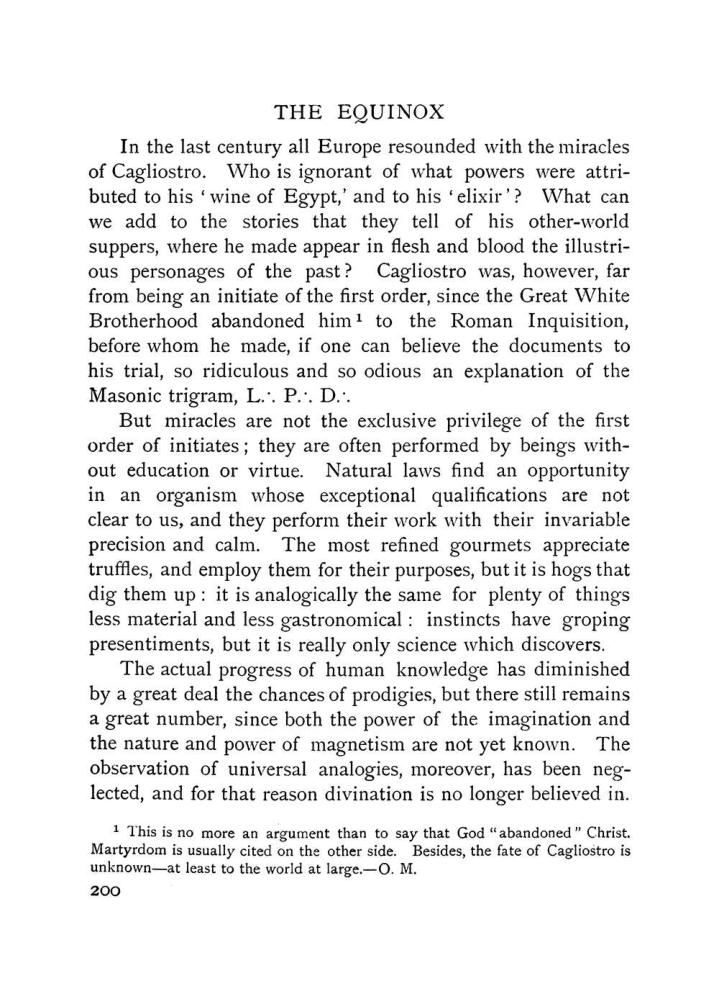
Highlights use the original PDF text layer. OCR-only matches may not be visible on the scan.
Transcription
Download text ↓raw extractionoriginal embedded textReview: unreviewed
THE EQUINOX
In the last century all Europe resounded with the miracles
of Cagliostro. Who is ignorant of what powers were attri-
buted to his ‘wine of Egypt,’ and to his ‘elixir’? What can
we add to the stories that they tell of his other-world
suppers, where he made appear in flesh and blood the illustri-
ous personages of the past? Cagliostro was, however, far
from being an initiate of the first order, since the Great White
Brotherhood abandoned him! to the Roman Inquisition,
before whom he made, if one can believe the documents to
his trial, so ridiculous and so odious an explanation of the
Masonic trigram, L.°. P.*. D..
But miracles are not the exclusive privilege of the first
order of initiates; they are often performed by beings with-
out education or virtue. Natural laws find an opportunity
in an organism whose exceptional qualifications are not
clear to us, and they perform their work with their invariable
precision and calm. The most refined gourmets appreciate
truffles, and employ them for their purposes, but it is hogs that
dig them up: it is analogically the same for plenty of things
less material and less gastronomical : instincts have groping
presentiments, but it is really only science which discovers.
The actual progress of human knowledge has diminished
by a great deal the chances of prodigies, but there still remains
a great number, since both the power of the imagination and
the nature and power of magnetism are not yet known. The
observation of universal analogies, moreover, has been neg-
lected, and for that reason divination is no longer believed in.
1 This isno more an argument than to say that God “abandoned” Christ.
Martyrdom is usually cited on the other side. Besides, the fate of Cagliostro is
unknown—at least to the world at large—O. M.
200
Page provenance & review flags
Stable page ID: b19b302fada611776d16b5bf:p00498
Line breaks are preserved. Reading order and OCR accuracy may need review.
Printed page label has not been verified.
- No automated review flags. This does not establish transcription accuracy.