1913 · CLOSE READING
The Equinox (Volume I, Number IX)
The Equinox (Volume I, Number IX) (1913), PDF p. 487
Original page
Enlarge ↗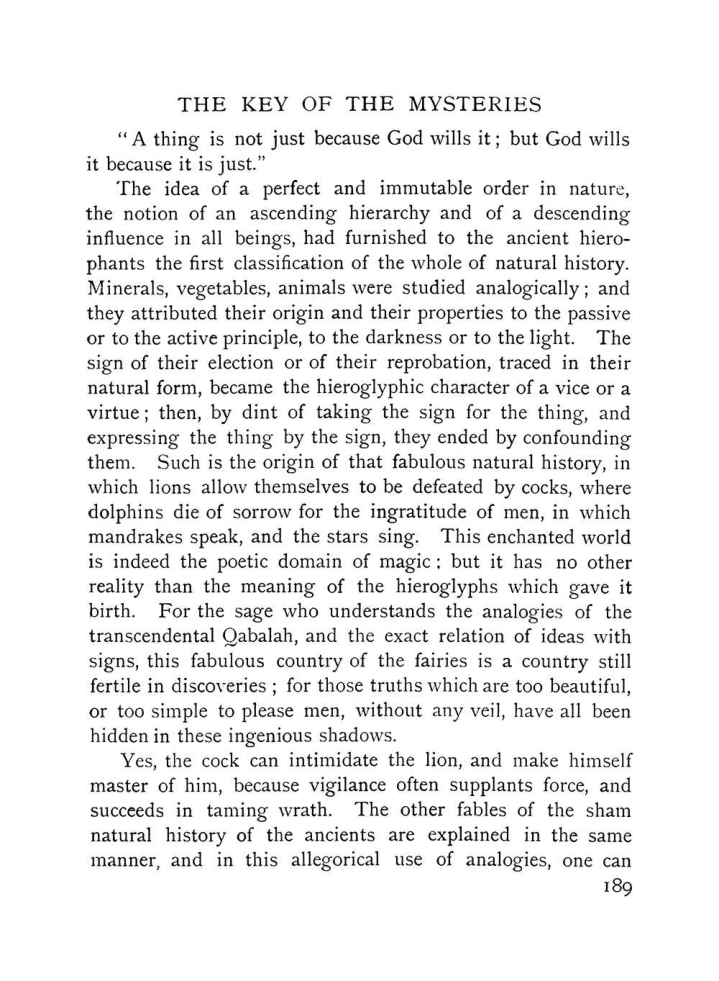
Highlights use the original PDF text layer. OCR-only matches may not be visible on the scan.
Transcription
Download text ↓raw extractionoriginal embedded textReview: unreviewed
THE KEY OF THE MYSTERIES
“A thing is not just because God wills it; but God wills
it because it is just.”
The idea of a perfect and immutable order in nature,
the notion of an ascending hierarchy and of a descending
influence in all beings, had furnished to the ancient hiero-
phants the first classification of the whole of natural history.
Minerals, vegetables, animals were studied analogically; and
they attributed their origin and their properties to the passive
or to the active principle, to the darkness or to the light. The
sign of their election or of their reprobation, traced in their
natural form, became the hieroglyphic character of a vice or a
virtue; then, by dint of taking the sign for the thing, and
expressing the thing by the sign, they ended by confounding
them. Such is the origin of that fabulous natural history, in
which lions allow themselves to be defeated by cocks, where
dolphins die of sorrow for the ingratitude of men, in which
mandrakes speak, and the stars sing. This enchanted world
is indeed the poetic domain of magic; but it has no other
reality than the meaning of the hieroglyphs which gave it
birth. For the sage who understands the analogies of the
transcendental Qabalah, and the exact relation of ideas with
signs, this fabulous country of the fairies is a country still
fertile in discoveries ; for those truths which are too beautiful,
or too simple to please men, without any veil, have all been
hidden in these ingenious shadows.
Yes, the cock can intimidate the lion, and make himself
master of him, because vigilance often supplants force, and
succeeds in taming wrath. The other fables of the sham
natural history of the ancients are explained in the same
manner, and in this allegorical use of analogies, one can
189
Page provenance & review flags
Stable page ID: b19b302fada611776d16b5bf:p00487
Line breaks are preserved. Reading order and OCR accuracy may need review.
Printed page label has not been verified.
- No automated review flags. This does not establish transcription accuracy.