1913 · CLOSE READING
The Equinox (Volume I, Number IX)
The Equinox (Volume I, Number IX) (1913), PDF p. 450
Original page
Enlarge ↗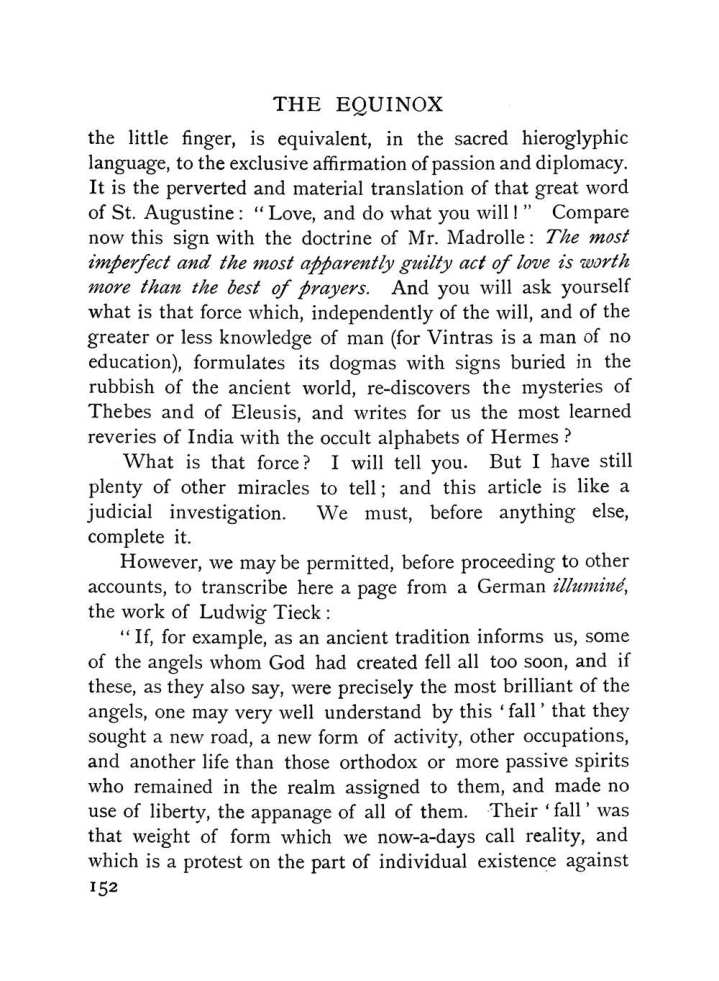
Highlights use the original PDF text layer. OCR-only matches may not be visible on the scan.
Transcription
Download text ↓raw extractionoriginal embedded textReview: unreviewed
THE EQUINOX
the little finger, is equivalent, in the sacred hieroglyphic
language, to the exclusive affirmation of passion and diplomacy.
It is the perverted and material translation of that great word
of St. Augustine: ‘Love, and do what you will!” Compare
now this sign with the doctrine of Mr. Madrolle: Ze most
imperfect and the most apparently guilty act of love is worth
more than the best of prayers. And you will ask yourself
what is that force which, independently of the will, and of the
greater or less knowledge of man (for Vintras is a man of no
education), formulates its dogmas with signs buried in the
rubbish of the ancient world, re-discovers the mysteries of
Thebes and of Eleusis, and writes for us the most learned
reveries of India with the occult alphabets of Hermes ?
What is that force? I will tell you. But I have still
plenty of other miracles to tell; and this article is like a
judicial investigation. We must, before anything else,
complete it.
However, we may be permitted, before proceeding to other
accounts, to transcribe here a page from a German dluminé,
the work of Ludwig Tieck :
“Tf, for example, as an ancient tradition informs us, some
of the angels whom God had created fell all too soon, and if
these, as they also say, were precisely the most brilliant of the
angels, one may very well understand by this ‘fall’ that they
sought a new road, a new form of activity, other occupations,
and another life than those orthodox or more passive spirits
who remained in the realm assigned to them, and made no
use of liberty, the appanage of all of them. ‘Their ‘fall’ was
that weight of form which we now-a-days call reality, and
which is a protest on the part of individual existence against
152
Page provenance & review flags
Stable page ID: b19b302fada611776d16b5bf:p00450
Line breaks are preserved. Reading order and OCR accuracy may need review.
Printed page label has not been verified.
- No automated review flags. This does not establish transcription accuracy.