1913 · CLOSE READING
The Equinox (Volume I, Number IX)
The Equinox (Volume I, Number IX) (1913), PDF p. 420
Original page
Enlarge ↗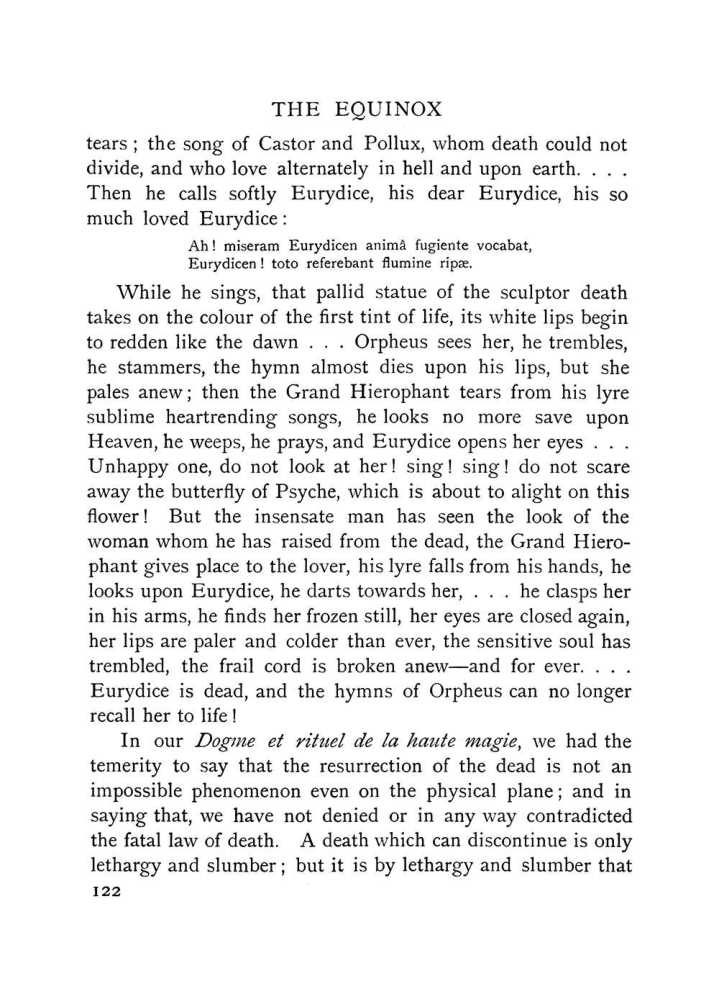
Highlights use the original PDF text layer. OCR-only matches may not be visible on the scan.
Transcription
Download text ↓raw extractionoriginal embedded textReview: unreviewed
THE EQUINOX
tears ; the song of Castor and Pollux, whom death could not
divide, and who love alternately in hell and upon earth. . . .
Then he calls softly Eurydice, his dear Eurydice, his so
much loved Eurydice:
Ah! miseram Eurydicen anima fugiente vocabat,
Eurydicen! toto referebant flumine rip.
While he sings, that pallid statue of the sculptor death
takes on the colour of the first tint of life, its white lips begin
to redden like the dawn . . . Orpheus sees her, he trembles,
he stammers, the hymn almost dies upon his lips, but she
pales anew; then the Grand Hierophant tears from his lyre
sublime heartrending songs, he looks no more save upon
Heaven, he weeps, he prays, and Eurydice opens her eyes . . .
Unhappy one, do not look at her! sing! sing! do not scare
away the butterfly of Psyche, which is about to alight on this
flower! But the insensate man has seen the look of the
woman whom he has raised from the dead, the Grand Hiero-
phant gives place to the lover, his lyre falls from his hands, he
looks upon Eurydice, he darts towards her, . . . he clasps her
in his arms, he finds her frozen still, her eyes are closed again,
her lips are paler and colder than ever, the sensitive soul has
trembled, the frail cord is broken anew—and for ever. . . .
Eurydice is dead, and the hymns of Orpheus can no longer
recall her to life!
In our Dogme et rituel de la haute magie, we had the
temerity to say that the resurrection of the dead is not an
impossible phenomenon even on the physical plane; and in
saying that, we have not denied or in any way contradicted
the fatal law of death. A death which can discontinue is only
lethargy and slumber; but it is by lethargy and slumber that
122
Page provenance & review flags
Stable page ID: b19b302fada611776d16b5bf:p00420
Line breaks are preserved. Reading order and OCR accuracy may need review.
Printed page label has not been verified.
- No automated review flags. This does not establish transcription accuracy.