1913 · CLOSE READING
The Equinox (Volume I, Number IX)
The Equinox (Volume I, Number IX) (1913), PDF p. 402
Original page
Enlarge ↗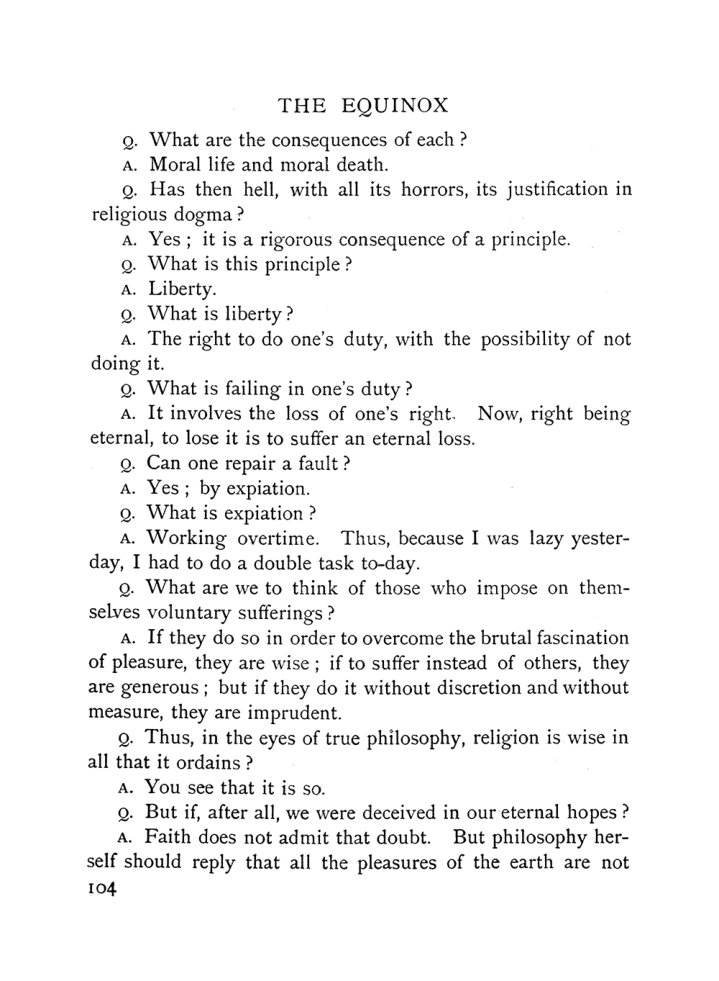
Highlights use the original PDF text layer. OCR-only matches may not be visible on the scan.
Transcription
Download text ↓raw extractionoriginal embedded textReview: unreviewed
THE EQUINOX
Q. What are the consequences of each ?
A. Moral life and moral death.
Q. Has then hell, with all its horrors, its justification in
religious dogma?
A. Yes; it is a rigorous consequence of a principle.
Q. What is this principle?
A. Liberty.
Q. What is liberty?
A. The right to do one’s duty, with the possibility of not
doing it.
Q. What is failing in one’s duty?
A. It involves the loss of one’s right. Now, right being
eternal, to lose it is to suffer an eternal loss.
Q. Can one repair a fault?
a. Yes; by expiation.
Q. What is expiation ?
A. Working overtime. Thus, because I was lazy yester-
day, I had to do a double task to-day.
Q. What are we to think of those who impose on them-
selves voluntary sufferings?
A. If they do so in order to overcome the brutal fascination
of pleasure, they are wise; if to suffer instead of others, they
are generous; but if they do it without discretion and without
measure, they are imprudent.
Q. Thus, in the eyes of true philosophy, religion is wise in
all that it ordains?
A. You see that it is so.
Q. But if, after all, we were deceived in our eternal hopes?
A. Faith does not admit that doubt. But philosophy her-
self should reply that all the pleasures of the earth are not
104
Page provenance & review flags
Stable page ID: b19b302fada611776d16b5bf:p00402
Line breaks are preserved. Reading order and OCR accuracy may need review.
Printed page label has not been verified.
- No automated review flags. This does not establish transcription accuracy.