1913 · CLOSE READING
The Equinox (Volume I, Number IX)
The Equinox (Volume I, Number IX) (1913), PDF p. 331
Original page
Enlarge ↗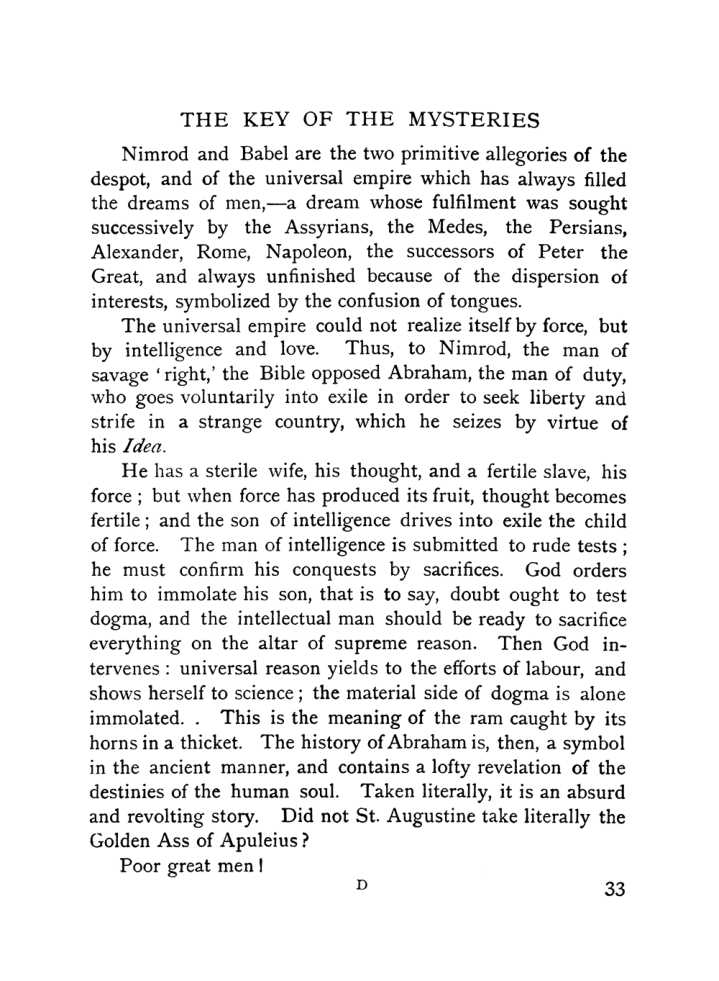
Highlights use the original PDF text layer. OCR-only matches may not be visible on the scan.
Transcription
Download text ↓raw extractionoriginal embedded textReview: unreviewed
THE KEY OF THE MYSTERIES
Nimrod and Babel are the two primitive allegories of the
despot, and of the universal empire which has always filled
the dreams of men,—a dream whose fulfilment was sought
successively by the Assyrians, the Medes, the Persians,
Alexander, Rome, Napoleon, the successors of Peter the
Great, and always unfinished because of the dispersion of
interests, symbolized by the confusion of tongues.
The universal empire could not realize itself by force, but
by intelligence and love. Thus, to Nimrod, the man of
savage ‘right,’ the Bible opposed Abraham, the man of duty,
who goes voluntarily into exile in order to seek liberty and
strife in a strange country, which he seizes by virtue of
his Zdea.
He has a sterile wife, his thought, and a fertile slave, his
force ; but when force has produced its fruit, thought becomes
fertile; and the son of intelligence drives into exile the child
of force. The man of intelligence is submitted to rude tests;
he must confirm his conquests by sacrifices. God orders
him to immolate his son, that is to say, doubt ought to test
dogma, and the intellectual man should be ready to sacrifice
everything on the altar of supreme reason. Then God in-
tervenes : universal reason yields to the efforts of labour, and
shows herself to science; the material side of dogma is alone
immolated. . This is the meaning of the ram caught by its
horns in a thicket. The history of Abraham is, then, a symbol
in the ancient manner, and contains a lofty revelation of the
destinies of the human soul. Taken literally, it is an absurd
and revolting story. Did not St. Augustine take literally the
Golden Ass of Apuleius?
Poor great men!
D 33
Page provenance & review flags
Stable page ID: b19b302fada611776d16b5bf:p00331
Line breaks are preserved. Reading order and OCR accuracy may need review.
Printed page label has not been verified.
- No automated review flags. This does not establish transcription accuracy.