1905 · CLOSE READING
Collected Works (Vol. I)
Collected Works (Vol. I) (1905), PDF p. 46
Original page
Enlarge ↗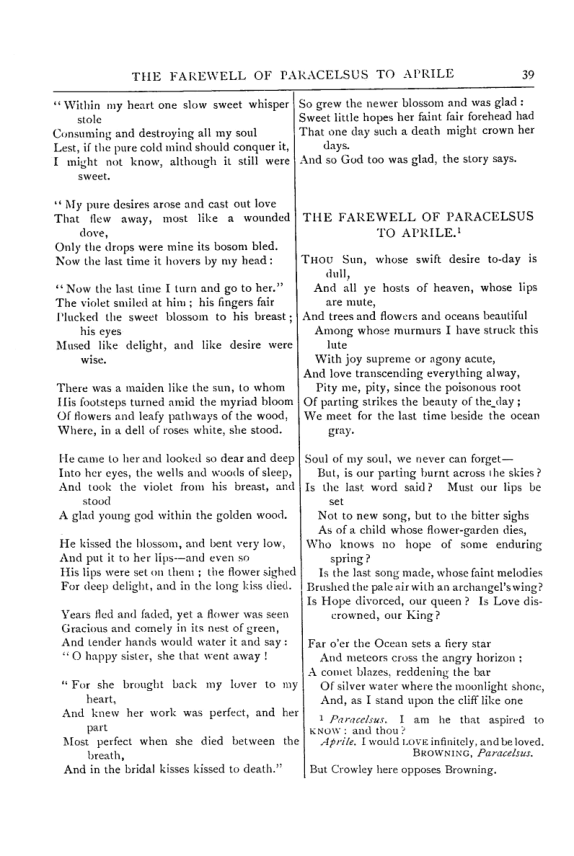
Highlights use the original PDF text layer. OCR-only matches may not be visible on the scan.
Transcription
Download text ↓raw extractionoriginal embedded textReview: unreviewed
THE FAREWELL OF PARACELSUS TO APRILE
39
‘©Within my heart one slow sweet whisper
stole
Consuming and destroying all my soul
Lest, if the pure cold mind should conquer it,
TI might not know, although it still were
sweet.
‘‘My pure desires arose and cast out love
That flew away, most like a wounded
dove,
Only the drops were mine its bosom bled.
Now the last time it hovers by my head:
‘* Now the last time I turn and go to her.”’
The violet smiled at him; his fingers fair
Plucked the sweet blossom to his breast;
his eyes.
Mused like delight, and like desire were
wise.
There was a maiden like the sun, to whom
[lis footsteps turned amid the myriad bloom
Of flowers and leafy pathways of the wood,
Where, in a dell of roses white, she stood.
He came to her and looked so dear and deep
Into her eyes, the wells and woods of sleep,
And took the violet from his breast, and
stood
A glad young god within the golden wood.
He kissed the blossom, and bent very low,
And put it to her lips-—and even so
His lips were set on them ; the flower sighed |
For deep delight, and in the long kiss died.
Years fled and faded, yet a flower was seen
Gracious and comely in its nest of green,
And tender hands would water it and say:
‘*( happy sister, she that went away !
“For she brought back my lover to my
heart,
And knew her work was perfect, and her
part
Most perfect when she died between the
breath,
And in the bridal kisses kissed to death.”
So grew the newer blossom and was glad:
Sweet little hopes her faint fair forehead had
That one day such a death might crown her
days.
And so God too was glad, the story says.
THE FAREWELL OF PARACELSUS
TO APRILE.!
THou Sun, whose swift desire to-day is
dull,
And all ye hosts of heaven, whose lips
are mute,
And trees and flowers and oceans beautiful
Among whose murmurs I have struck this
lute
With joy supreme or agony acute,
And love transcending everything alway,
Pity me, pity, since the poisonous root
Of parting strikes the beauty of the_day ;
We meet for the last time beside the ocean
gray.
Soul of my soul, we never can forget—
But, is our parting burnt across the skies ?
Is the last word said? Must our lips be
set
Not to new song, but to the bitter sighs
As of a child whose flower-garden dies,
Who knows no hope of some enduring
spring P
Is the last song made, whose faint melodies
Brushed the pale air with an archangel’s wing?
Is Hope divorced, our queen? Is Love dis-
crowned, our King?
Far o’er the Ocean sets a flery star
And meteors cross the angry horizon ;
A comet blazes, reddening the bar
Of silver water where the moonlight shone,
And, as I stand upon the cliff like one
1 Paracelsus. I am he that aspired to
KNOW: and thou ?
Aprile, [would LOVE infinitely, and be loved.
BROWNING, Paracelsus.
But Crowley here opposes Browning.
Page provenance & review flags
Stable page ID: b03aa009a08a365c27b62469:p00046
Line breaks are preserved. Reading order and OCR accuracy may need review.
Printed page label has not been verified.
- No automated review flags. This does not establish transcription accuracy.