1905 · CLOSE READING
Collected Works (Vol. I)
Collected Works (Vol. I) (1905), PDF p. 232
Original page
Enlarge ↗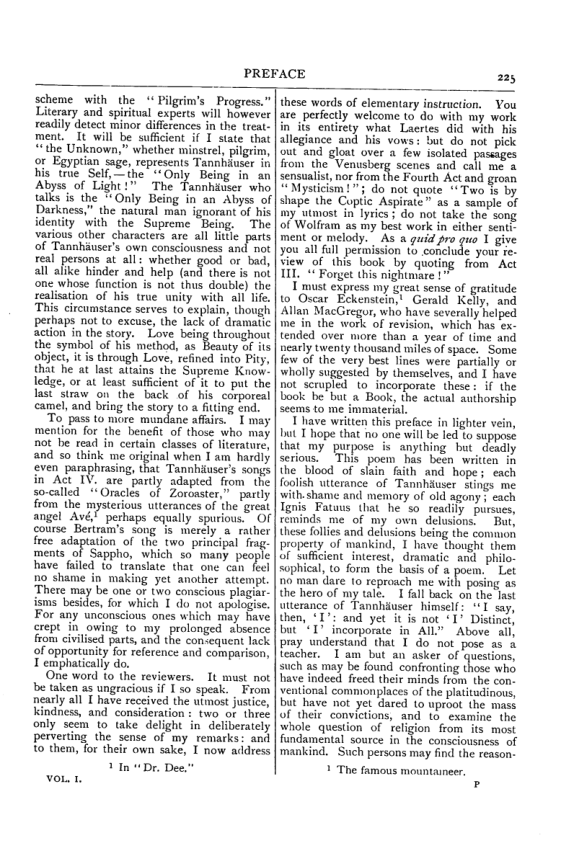
Highlights use the original PDF text layer. OCR-only matches may not be visible on the scan.
Transcription
Download text ↓raw extractionoriginal embedded textReview: unreviewed
PREFACE
225
scheme with the ‘‘Pilgrim’s Progress.”
Literary and spiritual experts will however
readily detect minor differences in the treat-
ment. It will be sufficient if I state that
“the Unknown,” whether minstrel, pilgrim,
or Egyptian sage, represents Tannhduser in
his true Self,—the ‘‘Only Being in an
Abyss of Light!” The Tannhduser who
talks is the ‘‘Only Being in an Abyss of
Darkness,” the natural man ignorant of his
identity with the Supreme Being. The
various other characters are all little parts
of Tannhiauser’s own consciousness and not
real persons at all: whether good or bad,
all alike hinder and help (and there is not
one whose function is not thus double) the
realisation of his true unity with all life,
This circumstance serves to explain, though
perhaps not to excuse, the lack of dramatic
action in the story. Love being throughout
the symbol of his method, as Beauty of its
object, it is through Love, refined into Pity,
that he at last attains the Supreme Know-
ledge, or at least sufficient of it to put the
last straw on the back of his corporeal
camel, and bring the story to a fitting end.
To pass to more mundane affairs. I may
mention for the benefit of those who may
not be read in certain classes of literature,
and so think me original when I am hardly
even paraphrasing, that Tannhduser’s songs
in Act IV. are partly adapted from the
so-called ‘‘Oracles of Zoroaster,” partly
from the mysterious utterances of the great
angel Avé,’ perhaps equally spurious. Of
course Bertram’s song is merely a rather
free adaptation of the two principal frag-
ments of Sappho, which so many people
have failed to translate that one can feel
no shame in making yet another attempt.
There may be one or two conscious plagiar-
isms besides, for which I do not apologise.
For any unconscious ones which may have
crept in owing to my prolonged absence
from civilised parts, and the consequent lack
of opportunity for reference and comparison,
I emphatically do.
One word to the reviewers. It must not
be taken as ungracious if I so speak. From
nearly all I have received the utmost justice,
kindness, and consideration: two or three
only seem to take delight in deliberately
perverting the sense of my remarks: and
to them, for their own sake, I now address
1 In '‘Dr. Dee,”
VOL, I.
these words of elementary instruction. You
are perfectly welcome to do with my work
in its entirety what Laertes did with his
allegiance and his vows: but do not pick
out and gloat over a few isolated passages
from the Venusberg scenes and call me a
sensualist, nor from the Fourth Act and groan
“Mysticism!”; do not quote ‘‘Two is by
shape the Coptic Aspirate” as a sample of
my utmost in lyrics; do not take the song
of Wolfram as my best work in either senti-
ment or melody. As a gudd pro quo I give
you all full permission to conclude your re-
view of this book by quoting from Act
III. ‘‘ Forget this nightmare !”
I must express my great sense of gratitude
to Oscar Eckenstein,! Gerald Kelly, and
Allan MacGregor, who have severally helped
me in the work of revision, which has ex-
tended over more than a year of time and
nearly twenty thousand miles of space. Some
few of the very best lines were partially or
wholly suggested by themselves, and I have
not scrupled to incorporate these: if the
book be but a Book, the actual authorship
seems to me immaterial.
I have written this preface in lighter vein,
but I hope that no one will be led to suppose
that my purpose is anything but deadly
serious. This poem has been written in
the blood of slain faith and hope; each
foolish utterance of Tannhauser stings me
with.shame and memory of old agony; each
Ignis Fatuus that he so readily pursues,
reminds me of my own delusions. But,
these follies and delusions being the common
property of mankind, I have thought them
of sufficient interest, dramatic and_philo-
sophical, to form the basis of a poem. Let
no man dare to reproach me with posing as
the hero of my tale. I fall back on the last
utterance of Tannhduser himself: ‘‘I say,
then, ‘I’: and yet it is not ‘I’ Distinct,
but ‘I’ incorporate in All.” Above all,
pray understand that I do not pose as a
teacher. I am but an asker of questions,
such as may be found confronting those who
have indeed freed their minds from the con-
ventional commonplaces of the platitudinous,
but have not yet dared to uproot the mass
of their convictions, and to examine the
whole question of religion from its most
fundamental source in the consciousness of
mankind. Such persons may find the reason-
1 The famous mountaineer.
P
Page provenance & review flags
Stable page ID: b03aa009a08a365c27b62469:p00232
Line breaks are preserved. Reading order and OCR accuracy may need review.
Printed page label has not been verified.
- No automated review flags. This does not establish transcription accuracy.