1905 · CLOSE READING
Collected Works (Vol. I)
Collected Works (Vol. I) (1905), PDF p. 231
Original page
Enlarge ↗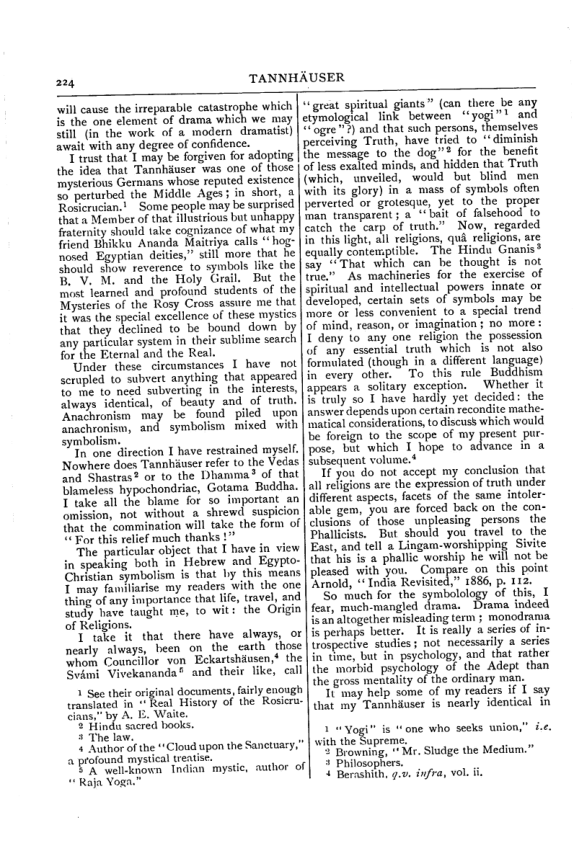
Highlights use the original PDF text layer. OCR-only matches may not be visible on the scan.
Transcription
Download text ↓raw extractionoriginal embedded textReview: unreviewed
224
TANNHAUSER
will cause the irreparable catastrophe which
is the one element of drama which we may
still (in the work of a modern dramatist)
await with any degree of confidence.
I trust that I may be forgiven for adopting
the idea that Tannhiduser was one of those
mysterious Germans whose reputed existence
so perturbed the Middle Ages; in short, a
Rosicrucian.! Some people may be surprised
that a Member of that illustrious but unhappy
fraternity should take cognizance of what my
friend Bhikku Ananda Maitriya calls ‘‘ hog-
nosed Egyptian deities,”’ still more that he
should show reverence to symbols like the
B. V. M. and the Holy Grail. But_ the
most learned and profound students of the
Mysteries of the Rosy Cross assure me that
it was the special excellence of these mystics
that they declined to be bound down by
any particular system in their sublime search
for the Eternal and the Real.
Under these circumstances I have not
scrupled to subvert anything that appeared
to me to need subverting in the interests,
always identical, of beauty and of truth.
Anachronism may be found piled upon
anachronism, and symbolism mixed with
symbolism.
In one direction I have restrained myself.
Nowhere does Tannhiuser refer to the Vedas
and Shastras? or to the Dhamma® of that
blameless hypochondriac, Gotama Buddha.
I take all the blame for so important an
omission, not without a shrewd suspicion
that the commination will take the form of
‘For this relief much thanks !”
The particular object that I have in view
in speaking both in Hebrew and Egypto-
Christian symbolism is that by this means
I may familiarise my readers with the one
thing of any importance that life, travel, and
study have taught me, to wit: the Origin
of Religions.
I take it that there have always, or
nearly always, been on the earth those
whom Councillor von Eckartshdusen,* the
SvAmi Vivekananda® and their like, call
1 See their original documents, fairly enough
translated in ‘‘ Real History of the Rosicru-
cians,” by A. If. Waite.
2 Hindu sacred books.
3 The law.
4 Author of the ‘‘Cloud upon the Sanctuary,”
a profound mystical treatise.
5 A well-known Indian mystic,
‘ Raja Yoga.”
author of
‘Coreat spiritual giants” (can there be any
etymological link between ‘‘yogi 71 and
‘“opre”?) and that such persons, themselves
perceiving Truth, have tried to ‘¢ diminish
the message to the dog”? for the benefit
of less exalted minds, and hidden that Truth
(which, unveiled, would but blind men
with its glory) in a mass of symbols often
perverted or grotesque, yet to the proper
man transparent; a ‘‘bait of falsehood to
catch the carp of truth.” Now, regarded
in this light, all religions, qua religions, are
equally contemptible. The Hindu Gnanis ®
say ‘That which can be thought is not
true.’ As machineries for the exercise of
spiritual and intellectual powers innate or
developed, certain sets of symbols may be
more or less convenient to a special trend
of mind, reason, or imagination; no more:
I deny to any one religion the possession
of any essential truth which is not also
formulated (though in a different language)
in every other. To this rule Buddhism
appears a solitary exception. Whether it
is truly so I have hardly yet decided: the
answer depends upon certain recondite mathe-
matical considerations, to discuss which would
be foreign to the scope of my present pur-
pose, but which I hope to advance in a
subsequent volume.‘
If you do not accept my conclusion that
all religions are the expression of truth under
different aspects, facets of the same intoler-
able gem, you are forced back on the con-
clusions of those unpleasing persons the
Phallicists. But should you travel to the
East, and tell a Lingam-worshipping Sivite
that his is a phallic worship he will not be
pleased with you. Compare on this point
Arnold, ‘‘ India Revisited,” 1886, p. 112.
So much for the symbolology of this, I
fear, much-mangled drama. Drama indeed
is an altogether misleading term 5 monodrama
is perhaps better. It is really a series of in-
trospective studies; not necessarily a series
in time, but in psychology, and that rather
the morbid psychology of the Adept than
the gross mentality of the ordinary man.
It may help some of my readers if I say
that my Tannhiuser is nearly identical in
1 * Yogi” is ‘‘one who seeks union,’ 2.é.
with the Supreme,
2 Browning, ‘Mr. Sludge the Medium.”
3 Philosophers.
4 Berashith, g.v. iufra, vol. il.
Page provenance & review flags
Stable page ID: b03aa009a08a365c27b62469:p00231
Line breaks are preserved. Reading order and OCR accuracy may need review.
Printed page label has not been verified.
- No automated review flags. This does not establish transcription accuracy.