1929 · CLOSE READING
Magick in Theory and Practice (Section 1)
Magick in Theory and Practice (Section 1) (1929), PDF p. 55
Original page
Enlarge ↗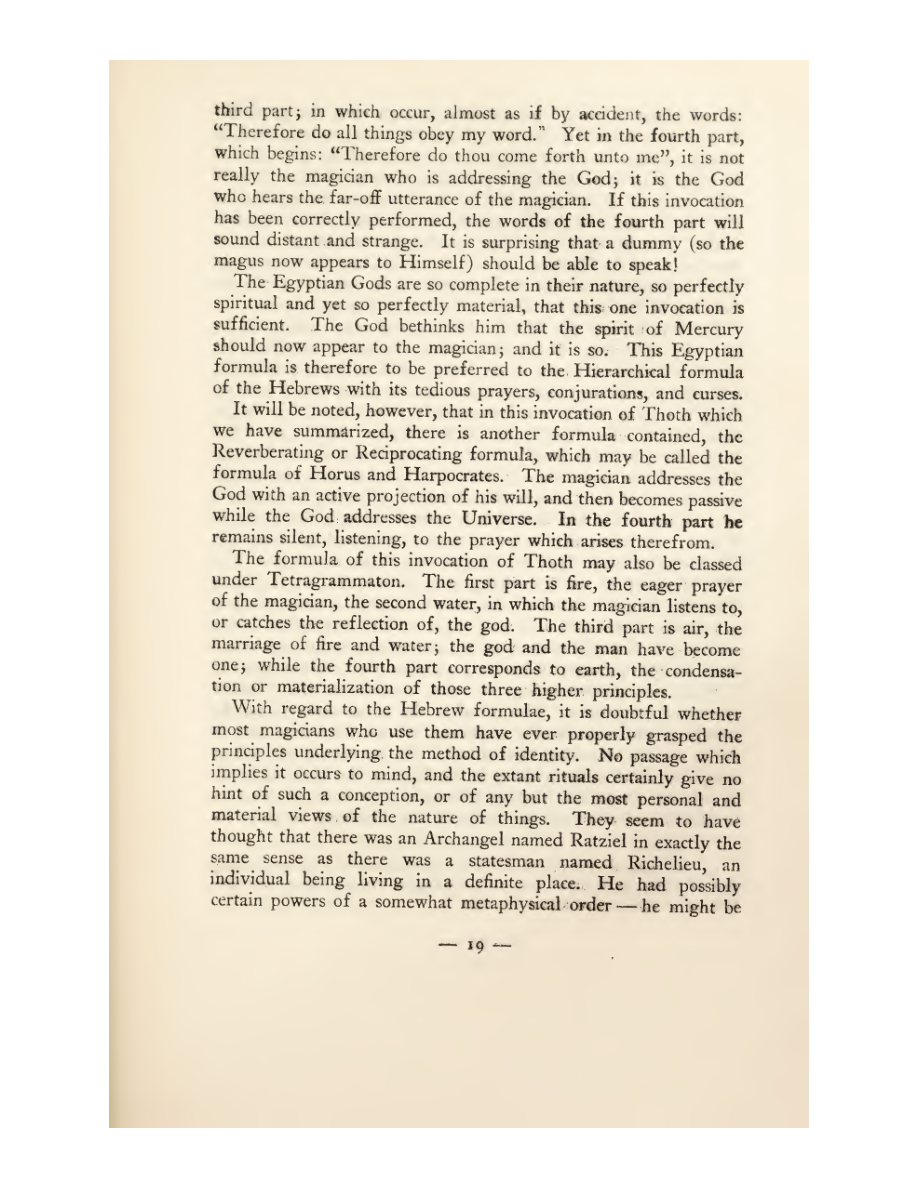
Highlights use the original PDF text layer. OCR-only matches may not be visible on the scan.
Transcription
Download text ↓raw extractionoriginal embedded textReview: unreviewed
third part; in which occur, almost as if by accident, the words:
‘‘Therefore do ail things obey my word.” Yet in the fourth part,
which begins: “Therefore do thou corne forth unto me”, it is not
really the magician who is addressing the God; it is the God
who hears the far-off utterance of the magician. If this invocation
has been correctly performed, the words of the fourth part will
Sound distant and strange. It is surprising that a dummy (so the
magus now appears to Himself) should be able to speak!
The Egyptian Gods are so complété in their nature, so perfectly
spiritual and yet so perfectly material, that this one invocation is
sufficient. The God bethinks him that the spirit of Mercury
should now appear to the magician; and it is so. This Egyptian
formula is therefore to be preferred to the Hierarchical formula
of the Hebrews with its tedious prayers, conjurations, and curses.
It will be noted, however, that in this invocation of Thoth which
we hâve summârized, there is another formula contained, the
Reverberating or Reciprocating formula, which may be called the
formula of Horus and Harpocrates. The magician addresses the
God with an active projection of nis will, and then becomes passive
while the God addresses the Universe. In the fourth part he
remains silent, listening, to the prayer which arises therefrom.
The formula of this invocation of Thoth may also be classed
under Tetragrammaton. The first part is fire, the eager prayer
of the magician, the second water, in which the magician°listens to,
or catches the reflection of, the god. The third part is air, the
marriage of fire and water; the god and the man hâve become
one; while the fourth part corresponds to earth, the condensa¬
tion 01 matenalization of those three highcr principles.
With regard to the Hebrew formulae, it is doubtful whether
inost magicians who use them hâve ever properly grasped the
principles underlying the method of identity. No passage which
împlies it occurs to mind, and the extant ntuais certainly give no
hmt of such a conception, or of any but the most personal and
material views of the nature of things. They seem to hâve
thought that there was an Archangel named Ratziel in exactly the
same sense as there was a statesman named Richelieu, an
individual being living in a definite place. Eté had possibly
certain powers of a somewhat metaphysical order—he might be
— 19 —
Page provenance & review flags
Stable page ID: ada196c290adc6561dda8e9d:p00055
Line breaks are preserved. Reading order and OCR accuracy may need review.
Printed page label has not been verified.
- No automated review flags. This does not establish transcription accuracy.