1929 · CLOSE READING
Magick in Theory and Practice (Section 1)
Magick in Theory and Practice (Section 1) (1929), PDF p. 50
Original page
Enlarge ↗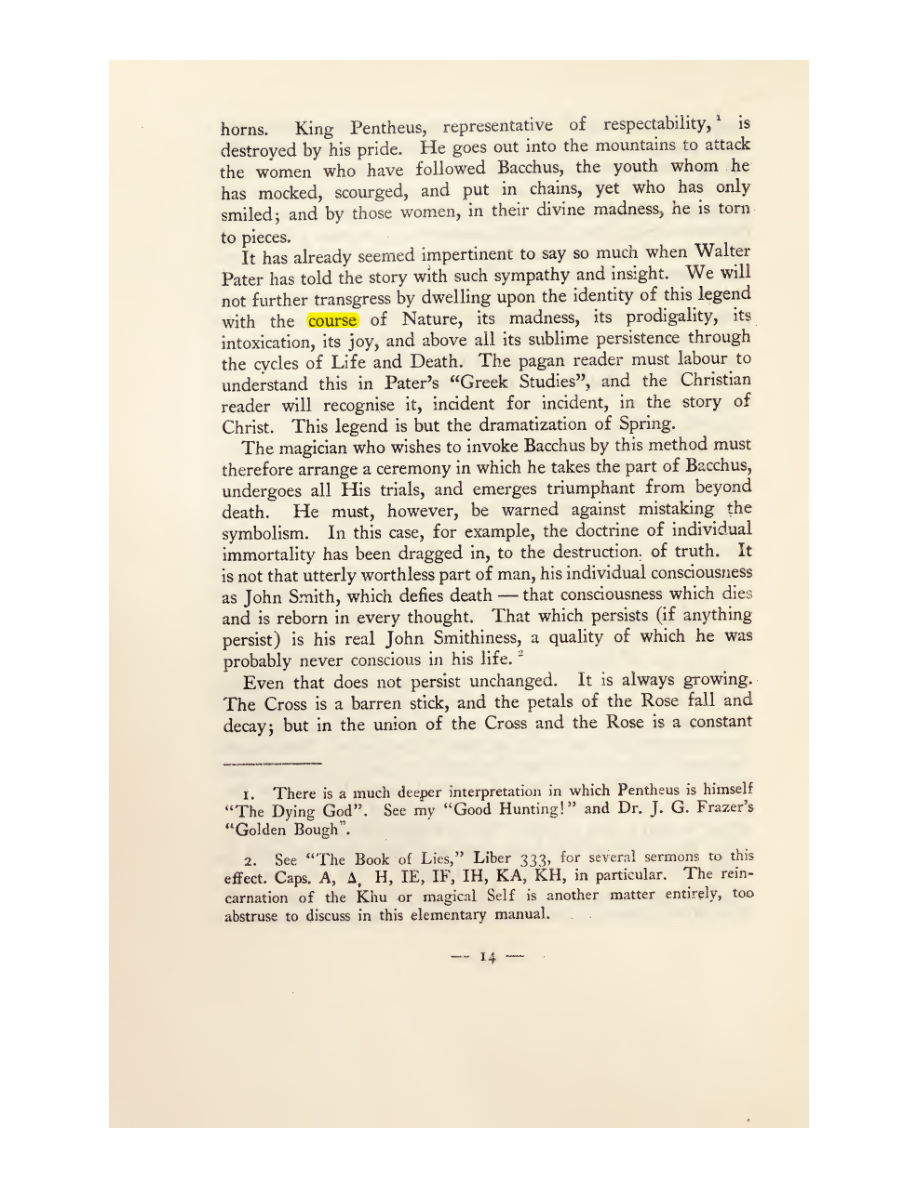
Highlights use the original PDF text layer. OCR-only matches may not be visible on the scan.
Transcription
Download text ↓raw extractionoriginal embedded textReview: unreviewed
horns. King Pentheus, représentative of respectabilité1 2 is
destroved by his pnde. He goes ont into the monntams to actack
the wornen who bave followed Bacchus, the youth whom Aie
has mocked, scourged, and put in chains, yet who h as only
smiled; and by those women, in their divine madness* he is torn
to pièces.
It has already seemed impertinent to say so mueh when Walter
Pater has told the story with such sympathy and insight. We will
not further transgress by dwelling upon the identity of this legend
with the course of Nature, its madness, its prodigality, its
intoxication, its joy, and above ali its sublime persistence through
the cycles of Life and Death. The pagan reader must labour to
understand this in Pater’s “Greek Studies”, and the Christian
reader will recognise it, incident for incident, in the story of
Christ. This legend is but the dramatization of Spring.
The magician who wishes to invoke Bacchus by this method must
therefore arrange a ceremony in which he takes the part of Bacchus,
undergoes ail His trials, and emerges triumphant from beyond
death. He must, however, be warned against mistaking the
symbolism. In this case, for example, the doctrine of individual
immortality has been dragged in, to the destruction, of truth. It
is not that utterly worthless part of man, his individual consciousness
as John Smith, which défiés death — that consciousness which dies
and is reborn in every thought. That which persists (if anything
persist) is his real John Smithiness, a quality of which he was
probably never conscious in his life. "
Even that does not persist unchanged. It is always growing.
The Cross is a barren stick, and the petals of the Rose fall and
decayj but in the union of the Cross and the Rose is a constant
1. There is a much deeper interprétation in which Pentheus is himself
“The Dying God”. See my “Good Hunting!” and Dr. J. G. Frazer’s
“Golden Bough
2. See “The Book of Lies,” Liber 333, for se vend sermons to this
effect. Caps. A, Af H, LE, II, IH, KA, KH, in particular. The réin¬
carnation of the Khu or magical Self is another matter entirely, too
abstruse to discuss in this elementary manual.
14
Page provenance & review flags
Stable page ID: ada196c290adc6561dda8e9d:p00050
Line breaks are preserved. Reading order and OCR accuracy may need review.
Printed page label has not been verified.
- No automated review flags. This does not establish transcription accuracy.