1929 · CLOSE READING
Magick in Theory and Practice (Section 1)
Magick in Theory and Practice (Section 1) (1929), PDF p. 49
Original page
Enlarge ↗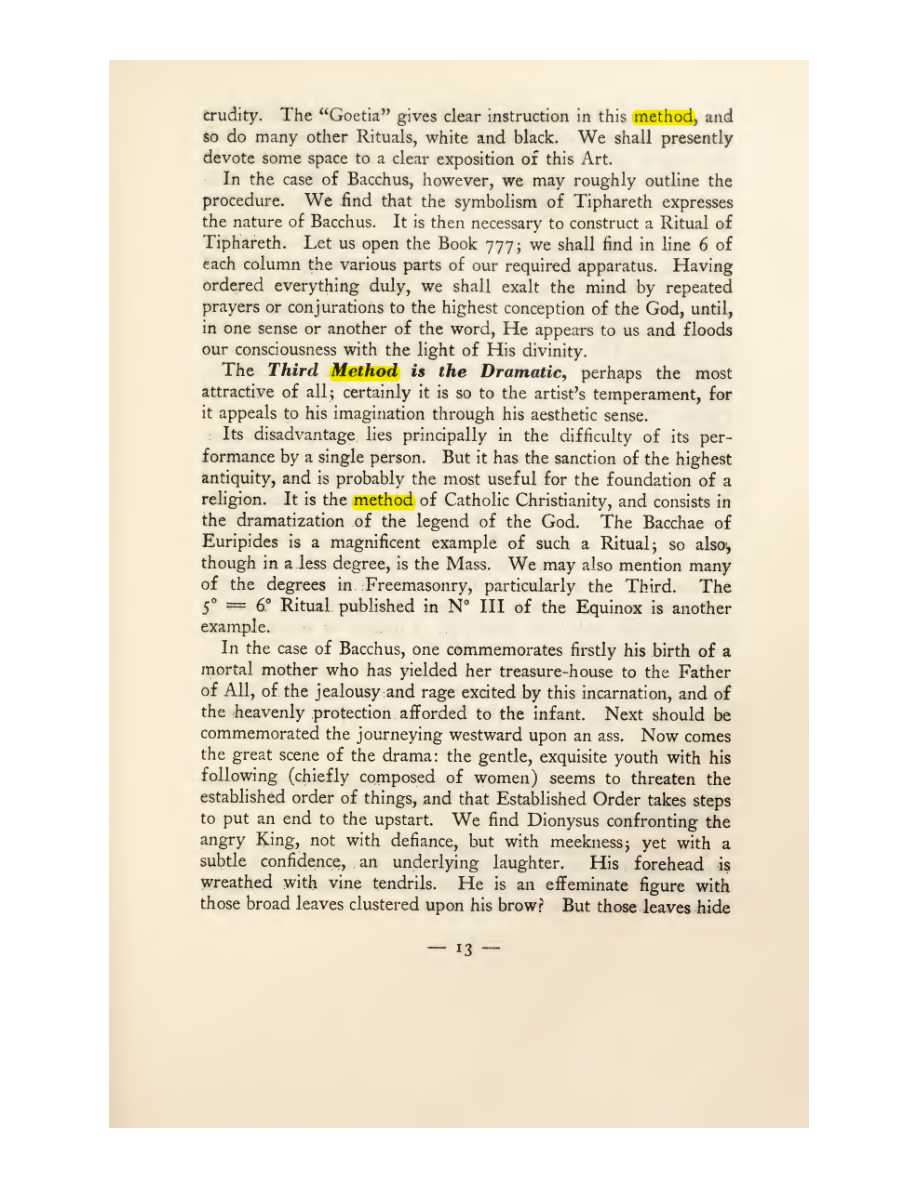
Highlights use the original PDF text layer. OCR-only matches may not be visible on the scan.
Transcription
Download text ↓raw extractionoriginal embedded textReview: unreviewed
crudity. The “Goetia” gives clear instruction in this method, and
$o do many other Rituals, white and black. We shall presently
devote some space to a clear exposition of this Art.
In the case of Bacchus, however, we may roughly outline the
procedure. We find that the symbolism of Tiphareth expresses
the nature of Bacchus. It is then necessary to construct a Ritual of
Tiphareth. Let us open the Book 777 ; we shall find in line 6 of
each column the various parts of our required apparatus. Having
ordered everything duly, we shall exalt the mind by repeated
prayers or conjurations to the highest conception of the God, until,
in one sense or another of the Word, He appears to us and floods
our consciousness with the light of His divinity.
The Third Method is the Dramatic, perhaps the most
attractive of ail; certainly it is so to the artist’s tempérament, for
it appeals to his imagination through his aesthetic sense.
Its disadvantage lies principally in the difficulty of its per¬
formance by a single person. But it has the sanction of the highest
antiquity, and is probably the most useful for the foundation of a
religion. It is the method of Catholic Christianity, and consists in
the dramatization of the legend of the God. The Bacchae of
Euripides is a magnificent example of such a Ritual; so also^
though in a less degree, is the Mass. We may also mention many
of the degrees in Freemasonry, particularly the Third. The
5° — 6° Ritual published in N° III of the Equinox is another
example.
In the case of Bacchus, one commémorâtes firstly his birth of a
mortal mother who has yielded her treasure-house to the Father
of AU, of the jealousy and rage excited by this incarnation, and of
the heavenly protection afforded to the infant. Next should be
commemorated the journeying westward upon an ass. Now cornes
the great scene of the drama: the gentle, exquisite youth with his
foliowing (chiefly composed of women) seems to threaten the
established order of things, and that Established Order takes steps
to put an end to the upstart. We find Dionysus confronting the
angry King, not with défiance, but with meekness; yet with a
subtle confidence, an underlying laughter. His forehead is
wreathed with vine tendrils. He is an effeminate figure with
those broad leaves clustered upon his brow? But those leaves hide
H
Page provenance & review flags
Stable page ID: ada196c290adc6561dda8e9d:p00049
Line breaks are preserved. Reading order and OCR accuracy may need review.
Printed page label has not been verified.
- No automated review flags. This does not establish transcription accuracy.