1929 · CLOSE READING
Magick in Theory and Practice (Section 1)
Magick in Theory and Practice (Section 1) (1929), PDF p. 48
Original page
Enlarge ↗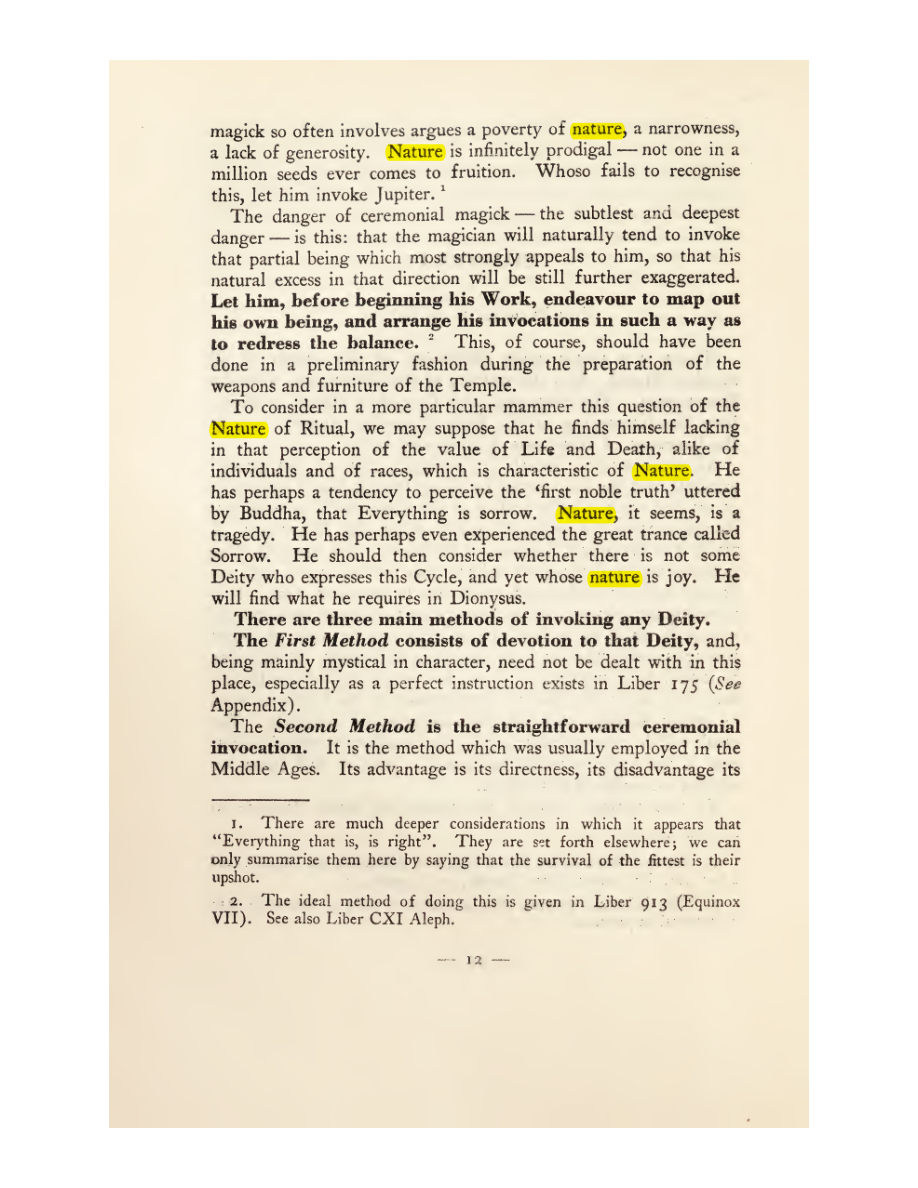
Highlights use the original PDF text layer. OCR-only matches may not be visible on the scan.
Transcription
Download text ↓raw extractionoriginal embedded textReview: unreviewed
magick so often involves argues a poverty o£ nature, a narrowness,
a lack of generosity. Nature is infinitely prodigal — not one in a
million seeds ever cornes to fruition. Whoso fails to recognise
this, let him invoke Jupiter.1 2
The danger o£ cérémonial magick — the subtlest and deepest
danger —is this: that the magician will naturally tend to invoke
that partial being which most strongly appeals to him, so that his
natural excess in that direction will be still further exaggerated.
Let him, before beginning his Work, endeavour to map out
his own being, and arrange his invocations in such a way as
to redress the balance. 2 This, of course, should hâve been
done in a preliminary fashion during the préparation of the
weapons and furniture of the Temple.
To consider in a more particular mammer this question of the
Nature of Ritual, we may suppose that he finds himself lacking
in that perception of the value of Life and Death, alike of
individuals and of races, which is characteristic of Nature. He
has perhaps a tendency to perceive the ‘first noble truth’ uttered
by Buddha, that Everything is sorrow. Nature, it seems, is a
tragedy. He has perhaps even experienced the great trance called
Sorrow. He should then consider whether there is not some
Deity who expresses this Cycle, and yet whose nature is joy. He
will find what he requires in Dionysus.
There are three main methods of invoking any Deity.
The First Method consists of dévotion to that Deity, and,
being mainly mystical in character, need not be dealt with in this
place, especially as a perfect instruction exists in Liber 175 (See
Âppendix).
The Second Method is the straightforward cérémonial
invocation. It is the method which was usually employed in the
Middle Ages. Its advantage is its directness, its disadvantage its
1. There are much deeper considérations in which it appears that
“Everything that is, is right”. They are set forth elsewhere; we can
only summarise them here by saying that the survîval of the frttest is their
upshot.
2. The ideaî method of doing this is given in Liber 913 (Equinox
VII). See also Liber CXI Aleph.
12
Page provenance & review flags
Stable page ID: ada196c290adc6561dda8e9d:p00048
Line breaks are preserved. Reading order and OCR accuracy may need review.
Printed page label has not been verified.
- No automated review flags. This does not establish transcription accuracy.