1929 · CLOSE READING
Magick in Theory and Practice (Section 1)
Magick in Theory and Practice (Section 1) (1929), PDF p. 20
Original page
Enlarge ↗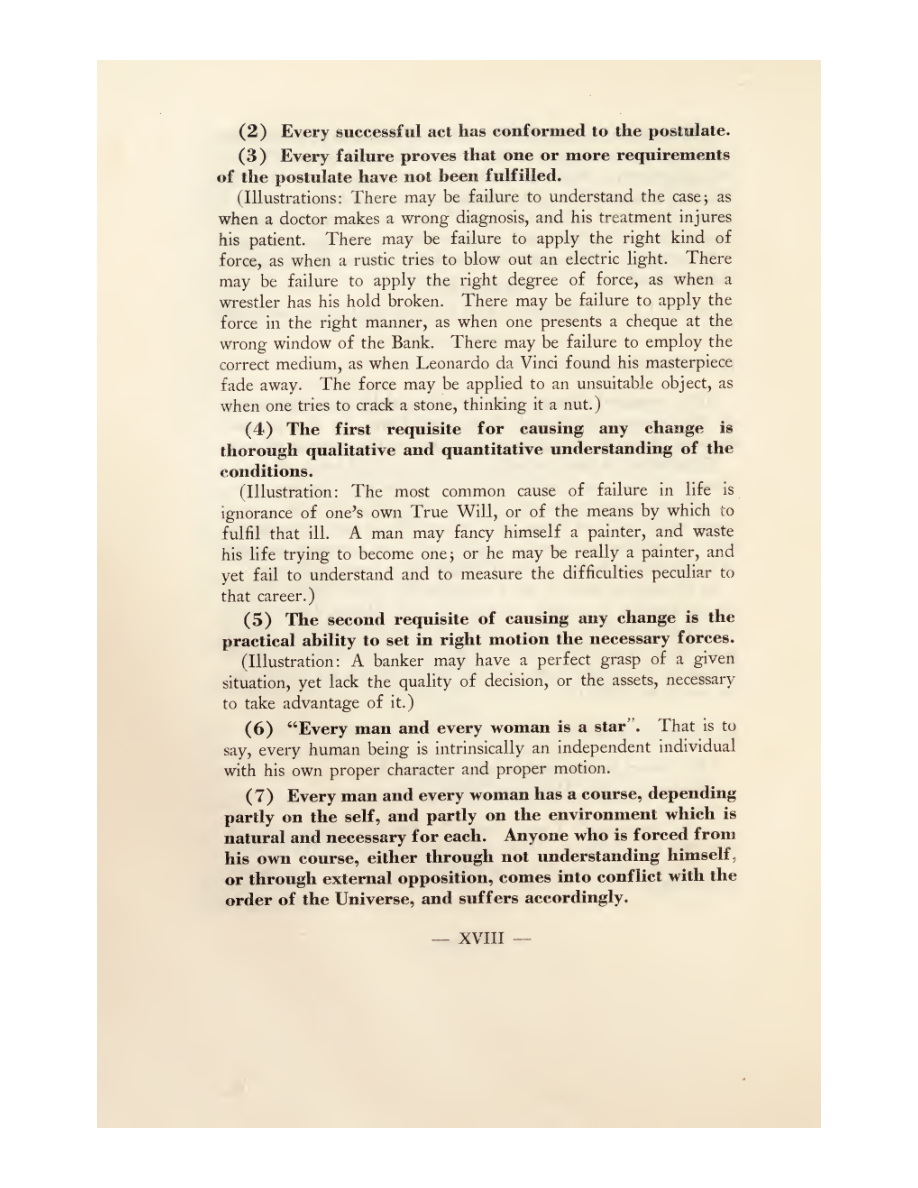
Highlights use the original PDF text layer. OCR-only matches may not be visible on the scan.
Transcription
Download text ↓raw extractionoriginal embedded textReview: unreviewed
(2) Every successful act has conformed to the postulate.
(3) Every failure proves that one or more requirements
of the postuîate hâve not been fulfilled.
(Illustrations: There may be failure to understand the case; as
when a doctor makes a wrong diagnosis, and his treatment injures
his patient. There may be failure to apply the right kind of
force, as when a rustic tries to blow out an electric light. There
may be failure to apply the right degree of force, as when a
wrestler has his hold broken. There may be failure to apply the
force in the right manner, as when one présents a chèque at the
wrong window of the Bank. There may be failure to employ the
correct medium, as when Leonardo da Vinci found his masterpiece
fade away. The force may be applied to an unsuitable object, as
when one tries to crack a stone, thinking it a nut.)
(4) The first requisite for causing any change is
ihorough qualitative and quantitative understanding of the
conditions.
(Illustration: The most common cause of failure in life is
ignorance of one’s own True Will, or of the means by which to
fulfil that ill. A man may fancy himself a painter, and waste
his life trying to become one; or he may be really a painter, and
yet fail to understand and to measure the difficulties peculiar to
that career.)
(5) The second requisite of causing any change is the
practical ability to set in right motion the necessary forces.
(Illustration: A banker may hâve a perfect grasp of a given
situation, yet lack the quality of decision, or the assets, necessary
to take advantage of it.)
(6) “Every man and every woman is a star’. That is to
say, every human being is intrinsically an independent individual
with his own proper character and proper motion.
( 7 ) Every man and every woman has a course, depending
partly on the self, and partly on the environment which is
natural and necessary for each. Anyone who is forced from
his own course, either through not understanding himself,
or through external opposition, cornes into conflict with the
order of the Universe, and suffers accordingly.
XVIII
Page provenance & review flags
Stable page ID: ada196c290adc6561dda8e9d:p00020
Line breaks are preserved. Reading order and OCR accuracy may need review.
Printed page label has not been verified.
- No automated review flags. This does not establish transcription accuracy.